Cartalax Peptide: The Ultimate Guide to this Bioregulator
Research‑Use‑Only Notice: All content on this website and all product information are for educational and informational purposes only. All products referenced are for laboratory research, analytical, and in‑vitro or preclinical in‑vivo use only. They are not medicines or drugs, have not been evaluated or approved by the FDA, and are not intended to diagnose, treat, cure, or prevent any disease. Any bodily introduction into humans or animals is strictly prohibited.
Cartalax Peptide: The Ultimate Guide to This Bioregulator
Peptide bioregulators—tiny sequences just 2–7 amino acids long—are being explored for their potential to nudge cells toward balanced function. Among them, cartalax peptide (sequence AED: alanine–glutamate–aspartate) is frequently discussed in relation to connective-tissue biology, extracellular-matrix (ECM) balance, and cell-stress responses. Below you’ll find a comprehensive, research-forward explainer: what cartalax peptide is, how it’s hypothesized to work, concentration and exposure planning in research models, safety considerations, and cartalax peptide study leads—with primary-source references at the end.
Disclaimer: This guide is for educational and research purposes only. Cartalax peptide is discussed in the context of scientific investigation. Nothing here is medical advice.
What is Cartalax Peptide? (Bioregulator)
Cartalax peptide is described in the bioregulator literature as a tissue-oriented ultrashort peptide (tripeptide AED). In open literature on short peptides, these molecules are investigated for their ability to modulate gene expression and protein synthesis—sometimes via direct interactions with chromatin components or DNA—resulting in systems-level effects rather than single-target pharmacology [1–4]. (MDPI)
Researchers often situate cartalax peptide within the broader bioregulator model: cell-permeant, ultrashort peptides that can reach intracellular compartments and, in some cases, nuclei, influencing gene programs tied to maintenance and repair [1–3]. (MDPI)

How Does Cartalax Work?
Two mechanistic pillars are commonly referenced for cartalax peptide (and related ultrashort peptides):
- Feasible cellular transport of ultrashort peptides. Multiple modeling and review papers indicate that PEPT (POT) and LAT transporter families can accommodate di- and tri-peptides, supporting a plausible route into cells for regulatory ultrashort peptides [2,5]. (MDPI)
- Transcriptional/epigenetic modulation. Reviews and experimental papers on short peptides report interactions with nucleosomes, histones, and specific DNA sites; these interactions are proposed to shift gene expression programs associated with homeostasis and stress resilience [1,3,4]. A fibroblast study comparing the dipeptide KE and the tripeptide AED (same sequence as cartalax peptide) explored effects on sirtuins, collagen I, cytokines, and NF-κB signaling during replicative aging, consistent with a bioregulation mechanism hypothesis [3,6]. (MDPI)
For an approachable, lay summary of ultrashort-peptide transport and why USPs are studied, see the open-access review on POT/LAT carriers and a plain-English explainer on aging-tissue context [5,7]. (MDPI)
Where to Buy Cartalax?
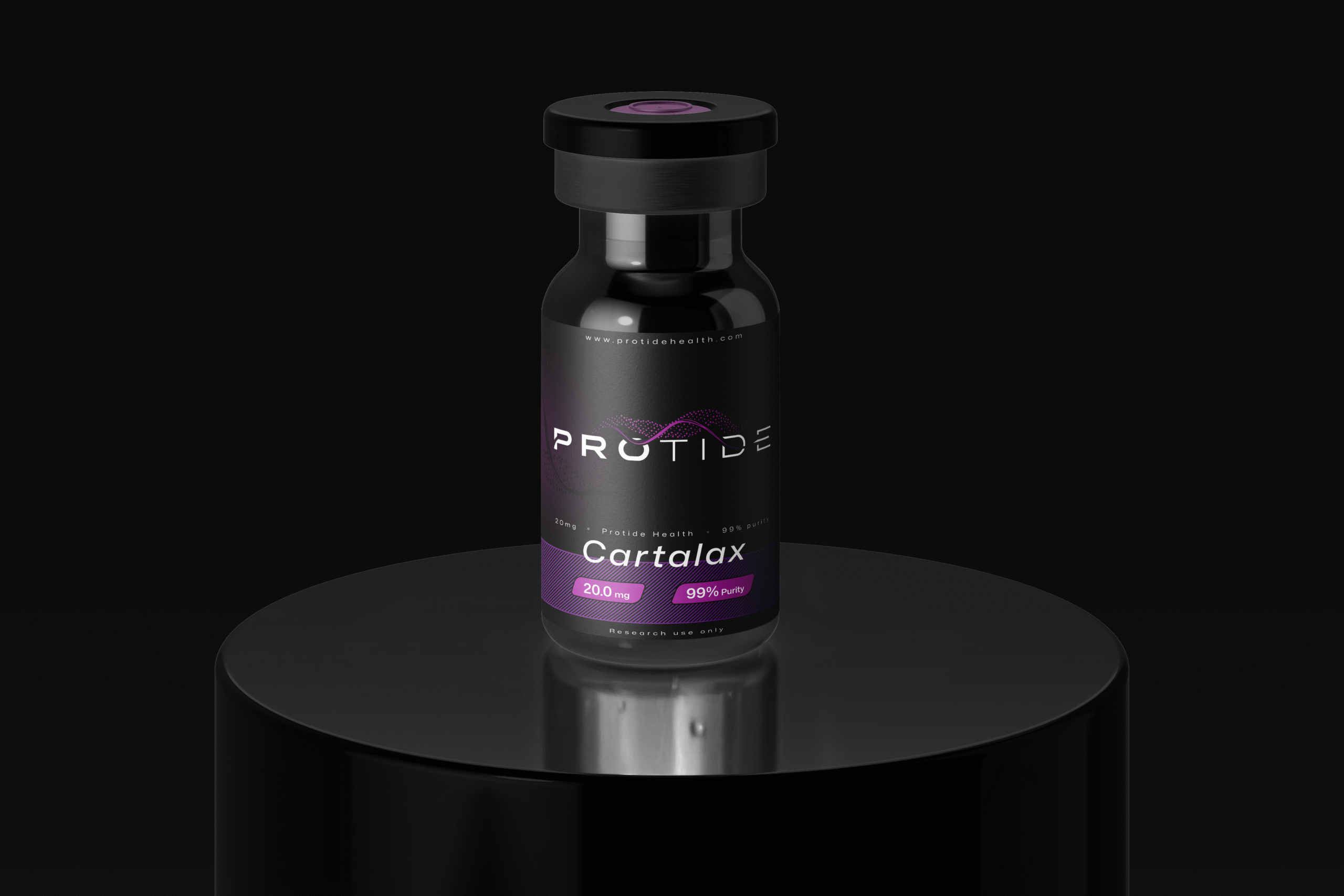
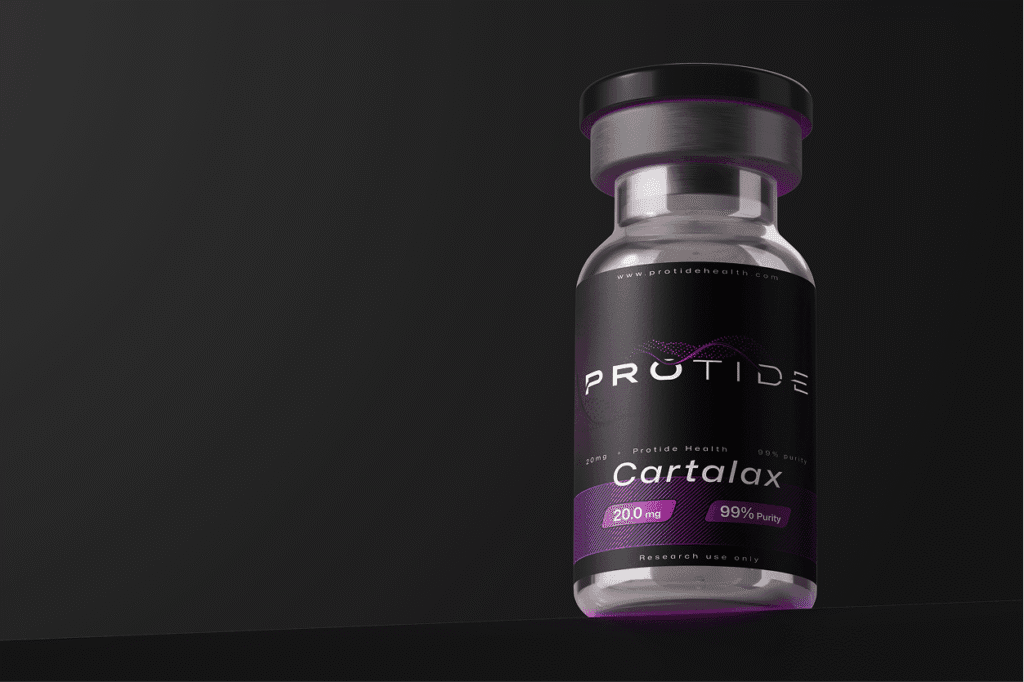
If you’re looking for a trusted source for lab-tested, high-purity research peptides, you can purchase cartalax at Protide Health.
We are rooted in scientific integrity, transparency, rigorous quality standards, and we are committed to providing the highest grade peptides on the market.
- Cartalax 20 mg (research use) — product page: Cartalax 20 mg
- Browse current inventory — shop: research peptide shop
What Are the Research Focuses of Cartalax Peptide?
(Research Themes & Outcomes Scientists Track)
In research settings, investigations of cartalax peptide typically monitor:
- ECM homeostasis markers (collagen I and related readouts, proteoglycans, matrix metalloproteinases). ECM balance is central to tissue integrity and is well-reviewed in cartilage aging literature [8–10]. (ScienceDirect)
- Cell-stress signaling (oxidative stress indices, mitochondrial markers, heat-shock pathways, NF-κB activity). Short peptide papers—AED included—have examined cytokines, NF-κB, and sirtuins in aging fibroblasts [6]. (SpringerLink)
- Transcriptional programs consistent with maintenance/repair (supported by mechanistic reviews on short peptides) [1,4]. (MDPI)
These signals are hypothesis-generating; definitive clinical outcomes for cartalax peptide remain to be firmly established in large, controlled human trials. That is why cartalax peptide study remains an active area of exploratory work.
Cartalax peptide concentrations in research models
There is no universally accepted clinical or standardized research dosing regimen for cartalax peptide. In laboratory contexts, teams typically:
- Back-calculate target concentrations from desired in‑vitro or in‑vivo exposure levels using a calculator to convert mass ↔ volume ↔ molarity; a neutral, stepwise peptide reconstitution tool helps reduce arithmetic errors.
- Follow sterile reconstitution practices, often using bacteriostatic water where appropriate to the protocol and sequence solubility characteristics, as outlined in peptide‑handling guides. (MilliporeSigma)
- Run range-finding pilots before scaling and document batch IDs, solvent, pH, storage temperature, and time in solution.
For reconstitution and handling, technical bulletins from major suppliers describe lyophilized storage (typically ≤ −20 °C), allowing vials to equilibrate to room temperature before opening to reduce moisture uptake, and selecting solvents based on peptide chemistry. (MilliporeSigma)
Cartalax peptide safety and research considerations
Human safety datasets specific to cartalax peptide are limited in the open literature. General considerations for peptide research include:
- Immunogenicity risk: Risk can vary with sequence, impurities, formulation, and route. FDA‑authored reviews summarize risk factors and assessment frameworks for therapeutic peptide products; although cartalax peptide is a research compound, principles such as minimizing impurities and monitoring anti‑drug antibodies are instructive (U.S. Food and Drug Administration).
- Purity and identity: Sequence errors or impurities above low thresholds (for example, >0.5%) can elevate risk, so verifying COAs and analytical data where possible is recommended (U.S. Food and Drug Administration).
- Conservative exposure planning: Without standardized clinical regimens, researchers typically use conservative exposure ranges in pilot studies and adjust methodically within approved research protocols, recognizing this does not constitute dosing guidance for humans.
- Storage stability: Improper storage can create degradation products (for example, deamidation or oxidation) that confound results, so labs should consult established peptide‑handling SOPs and technical bulletins for lyophilized storage (often ≤ −20 °C), equilibration before opening, and solvent selection (MilliporeSigma peptide handling guide).
Practical Lab Notes: Reconstitution, Storage, and Handling
- Use a reconstitution checklist: sterile diluent (commonly bacteriostatic water where suitable), clean workspace, appropriate needles/syringes, and aliquoting to minimize freeze–thaw cycles, following peptide‑handling guidance.
- Label and log the date, concentration, solvent, batch/lot, and storage temperature for each preparation.
- Store lyophilized material at low temperatures (often ≤ −20 °C) and allow vials to equilibrate before opening to reduce condensation, as recommended in peptide handling guides (MilliporeSigma peptide handling guide).
Cartalax Peptide Study: What Does the Evidence Show?
- Transport feasibility: Modeling and review data support ultrashort‑peptide uptake through PEPT1/2 and LAT1/2 carriers, consistent with cellular entry of sequences like AED (MDPI POT/LAT review).
- In vitro, AED has been studied in aging human fibroblasts for effects on sirtuins, collagen I, NF‑κB, and cytokines such as IL‑1 and TGF‑β (SpringerLink aging fibroblast study).
- Independent reviews of cartilage ECM aging highlight how changes in collagen turnover and matrix metalloproteinases shape tissue integrity, offering useful endpoints for future cartalax peptide experiments (ScienceDirect ECM aging review).
For a broader mechanistic overview of USP transport and gene‑regulation hypotheses, see the open‑access POT/LAT review and comprehensive short‑peptide gene‑expression reviews available via MDPI.
Cartalax Peptide FAQs
Is cartalax a peptide bioregulator?
Yes—cartalax peptide is categorized in the literature as an ultrashort peptide bioregulator, a class explored for gene-expression modulation and tissue-specific support [1,4]. (MDPI)
How does cartalax work?
Working models emphasize cellular uptake via PEPT/LAT transporters and epigenetic/transcriptional influences on maintenance pathways in relevant cells (e.g., fibroblasts) [2,4–6]. (MDPI)
What endpoints do cartalax peptide studies typically track?
Cartalax‑related studies commonly monitor endpoints such as extracellular‑matrix balance, collagen dynamics, and cell‑stress or inflammatory signaling markers in preclinical models, with outcomes remaining investigational and not established as clinical effects.
How do researchers derive cartalax peptide concentrations for experiments?
There is no universal standard concentration. Researchers typically use lab calculators to derive target concentrations from desired exposure levels, apply sterile reconstitution and storage SOPs, and pilot conservative ranges within approved protocols, without creating human dosing guidance.
Where can you buy cartalax peptide in the USA?
If you’re looking for a trusted source for lab-tested, high-purity research peptides, you can purchase cartalax at Protide Health.

Helpful Tools & How-To Resources
- Peptide reconstitution tool — convert mg ↔ mL ↔ molarity for lab solutions with fewer errors: peptide reconstitution tool.
- Step‑by‑step reconstitution — sterile technique and solvent choice: peptide reconstitution guide.
- 2025 overview of concentration and exposure frameworks — lab‑planning reference: peptide research planning guide 2025.
- If you’re new to peptides — research foundations and common terms: starter guide to peptides (2025).
References (Selected, Peer-Reviewed Where Possible)
- Molecules (MDPI) — Peptide Regulation of Gene Expression: A Systematic Review (2021). Summarizes nuclear entry and nucleosome/histone interactions by short peptides. (MDPI)
- Biomolecules (MDPI) — Feasibility of Transport of 26 Biologically Active Ultrashort Peptides via LAT/PEPT (2023). Molecular docking showing tri-peptides fit PEPT1/LAT1 binding sites. (MDPI)
- Review PDF — Peptide Regulation of Gene Expression (Khavinson/Popovich). Mechanistic background on DNA–peptide interactions and epigenetic modulation. (khavinson.info)
- AED/Histone Modeling PDF — AEDG peptide & histone interactions (mechanistic analog within the bioregulator family). (khavinson.info)
- POT/LAT Review (open access) — Transport of Biologically Active Ultrashort Peptides Using POT and LAT Carriers (review). (MDPI)
- Springer (Bull Exp Biol Med) — Comparison of effects of KE and AED peptides in aging human fibroblasts (collagen I, cytokines, NF-κB, sirtuins). (SpringerLink)
- LTC News — Cartalax peptide & aging/tissue health (plain-English overview; not peer-reviewed). (Muscle and Brawn)
- J. Controlled Release / Biomaterials reviews — Cartilage ECM homeostasis & biomarkers; regenerative strategies (cartilage ECM in OA/aging). (ScienceDirect)
- Nature Reviews Bioengineering (Perspective PDF) — Reconstructing the ageing extracellular matrix (2023). ECM aging context across tissues. (Nature)
- PLOS ONE — Age-related collagen turnover of the interstitial matrix and basement membranes (2018). Biomarker context for matrix remodeling. (PLOS)
- MilliporeSigma Technical Bulletin (PDF) — Peptide Handling & Storage Guide (lyophilized storage ≤ −20 °C, equilibrate before opening). (MilliporeSigma)
- FDA Guidance (PDF) — Assessing Immunogenicity Risk of Peptides: Synthetic Peptide Impurities (quality attributes; impurity thresholds). (U.S. Food and Drug Administration)
- Bachem Knowledge Center — Handling and Storage Guidelines for Peptides (solubility and storage SOPs). (Bachem)
- Edge Peptides (how-to) — Peptide Reconstitution Guide (practical steps; solvent considerations). (Edge Peptides)
- Sigma Protocol Page — Synthetic Peptide Handling & Solubility Protocol (solvent selection guidance). (MilliporeSigma)
- Frontiers in Immunology (2020; 2025 FDA authors) — T-cell dependent immunogenicity of biotherapeutics; Immunogenicity of therapeutic peptide products (risk frameworks). (Europe PMC)
Bottom Line: Cartalax peptide is an ultrashort bioregulator under active preclinical study with plausible cellular transport and gene-program modulation mechanisms. Research teams typically focus on ECM homeostasis, collagen dynamics, and cell-stress signaling, using careful reconstitution, storage, and conservative exposure‑range pilots in preclinical models. When you’re ready to source cartalax peptide for laboratory research, see Cartalax 20 mg or browse the research shop.