
Klow Peptide: Scientific Research Guide to the Klow Blend
Research‑Use‑Only Notice: All content on this website and all product information are for educational and informational purposes only. All products referenced are for laboratory research, analytical, and in‑vitro or preclinical in‑vivo use only. They are not medicines or drugs, have not been evaluated or approved by the FDA, and are not intended to diagnose, treat, cure, or prevent any disease. Any bodily introduction into humans or animals is strictly prohibited.
Curious about the Klow peptide blend and why it is used in research models? You’re in the right place. Below, this scientific research guide explains what the Klow blend is, which peptides it contains, how each component works in plain language, and how to think about experimental design in in‑vitro studies.
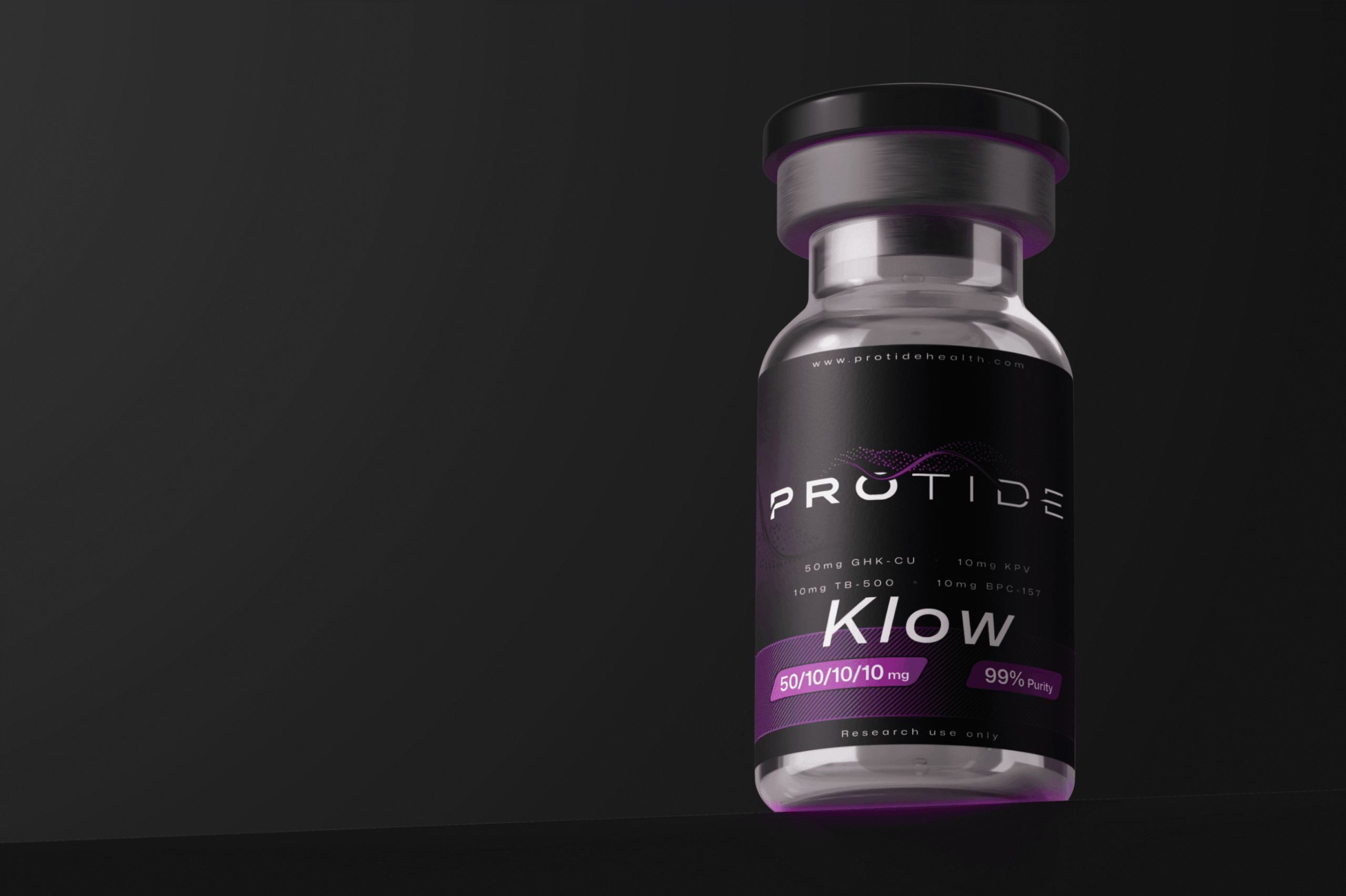
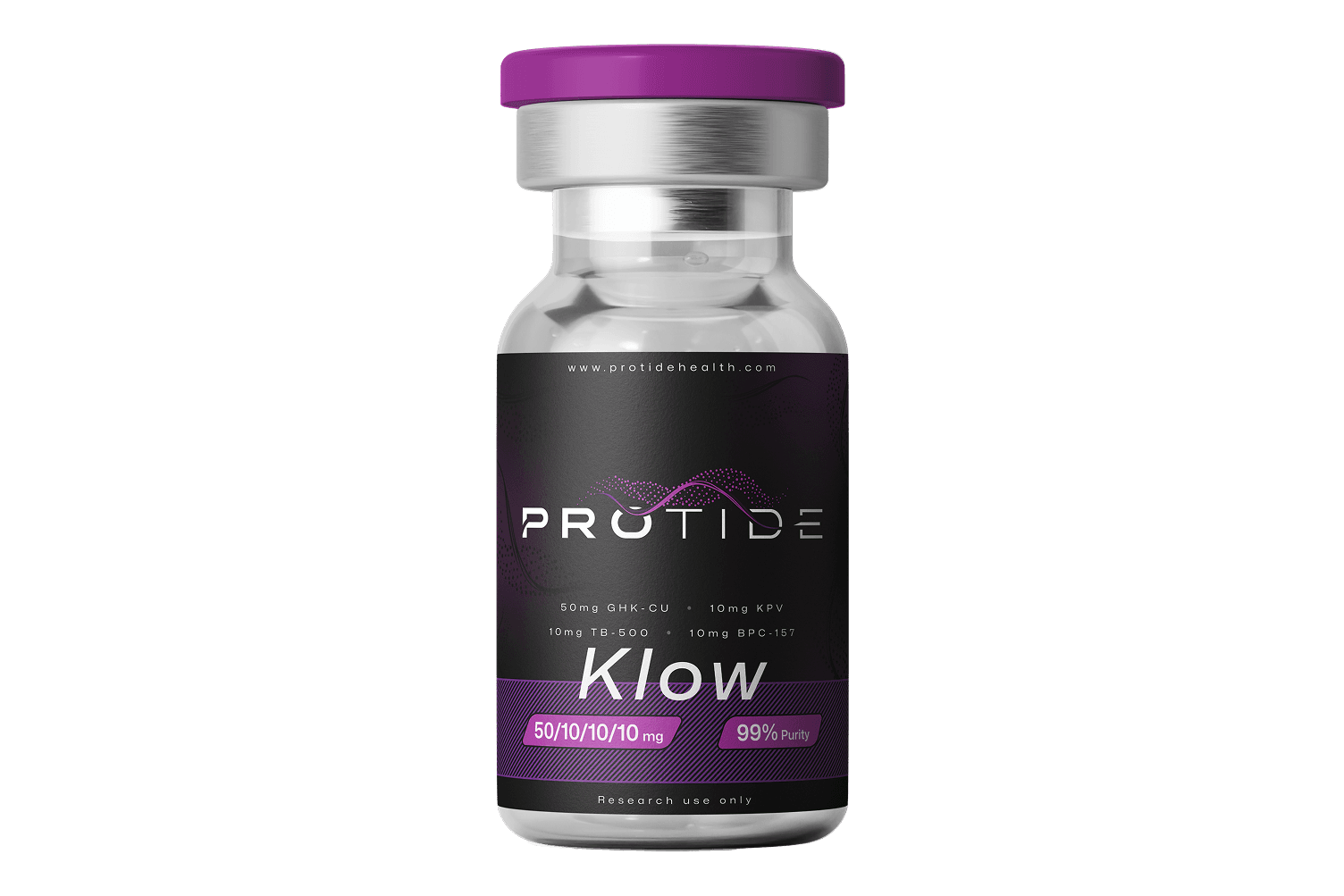
Summary: The Klow blend combines GHK‑Cu 50 mg, KPV 10 mg, BPC‑157 10 mg, and TB‑500 10 mg in one vial for research use only.
What is the Klow peptide?
The Klow peptide is a four-peptide research blend. It includes:
This format lets research labs evaluate each component under matched preparation conditions across independent mechanistic assays. See the product page for specifications: Klow Blend: 50mg/10/10/10 (GHK-Cu, KPV, BPC-157, TB-500).
Key takeaways
- Built for bench research, not for human or veterinary use.
- Each component peptide has been studied independently in different mechanistic contexts. This article does not assert that combining them produces additive or synergistic effects in any model system.
How the Klow peptide blend is studied (simple science)
- GHK-Cu: A natural copper-binding tripeptide studied for ECM remodeling pathways in in-vitro fibroblast cultures and animal skin biology models. It is associated in published preclinical literature with collagen and decorin regulation and broad gene-expression shifts in ECM-related markers. Laboratory studies investigate effects on fibroblast cultures and extracellular matrix synthesis pathways. (Wiley Online Library)
- KPV: A tripeptide fragment of α-MSH that can be transported by PepT1 and has been shown in murine intestinal inflammation models to downshift NF-κB/MAPK signaling and related cytokine markers. Studies examine inflammatory pathway modulation in intestinal in-vivo and barrier-integrity in-vitro models. (Europe PMC)
- BPC-157: A gastric-derived pentadecapeptide explored for angiogenesis pathway markers, endothelial migration assays, and ERK/Akt-eNOS pathway engagement in vitro and in rodent preclinical models. Research examines VEGFR2 activation and nitric oxide signaling endpoints in preclinical systems. (SpringerLink)
- TB-500 (Thymosin β4): An actin-binding peptide studied for cell-migration mechanisms and angiogenesis markers in dermal fibroblast and corneal epithelial in-vitro models. Studies investigate actin polymerization and VEGF upregulation in fibroblast migration assays. (Cell)
Each component peptide is associated in published preclinical literature with distinct mechanistic pathways: copper-dependent ECM-related signaling (GHK-Cu), inflammatory pathway modulation (KPV), angiogenesis pathway markers (BPC-157), and actin-driven cell-migration assays (TB-500). This article does not assert that the four components produce additive, synergistic, or otherwise interacting effects when combined in any model system. The single research hypothesis available to laboratories using the Klow blend is whether each component produces the same endpoint changes when prepared under matched conditions, versus when prepared and assayed in isolation. (Wiley Online Library)
Potential research findings and applications for Klow Peptide
Animal/in vitro research
- GHK-Cu studies investigate collagen synthesis pathways in fibroblast cultures (Pickart and Margolina, 2015), with reported endpoint changes in decorin and glycosaminoglycan gene-expression markers. Quantitative effect sizes vary by cell line, exposure concentration, and assay; researchers should consult the primary literature for figures specific to their model. (Wiley Online Library)
- KPV has been shown in murine intestinal inflammation models to modulate NF-κB and MAPK signaling and to preserve barrier-integrity endpoints under inflammatory challenge, via PepT1-mediated uptake (Dalmasso et al., 2008). Assays measure cytokine panels and transepithelial electrical resistance (TEER) markers in intestinal in-vivo and in-vitro models.
- BPC-157 literature describes angiogenesis pathway investigations and ECM-related endpoint research in cell and rodent preclinical models. Studies measure VEGFR2 and Akt-eNOS signaling markers, endothelial migration rates, and vascular tube-formation assays in laboratory systems. (SpringerLink)
- TB-500 research examines actin-mediated cell migration metrics and angiogenesis markers in dermal fibroblast and corneal epithelial in-vitro models, including scratch-wound assay closure metrics and transwell migration. Migration assays measure fibroblast motility and VEGF expression changes. (Cell)
Important: Evidence varies by peptide and model. Endpoint changes measured in preclinical assays do not constitute clinical outcomes and have not been evaluated by the FDA. The Klow blend is supplied for laboratory research only and is not for human or veterinary use.
For qualified researchers planning related experiments, Protide Health maintains a research peptide catalog with clearly labeled, research‑use‑only compounds.
Klow peptide blend experiments
This section is educational for experimental design only.
Labs often design pilot exposure ranges based on published in-vitro concentrations or animal-model literature, then validate locally under approved institutional protocols. Plan experimental inputs to standardize dilutions, aliquots, and per-assay quantities for research solutions only.
Consider time-course sampling for early versus late endpoint signals. Researchers may compare single-agent arms (vehicle plus each peptide individually) against a four-component blend arm under matched preparation conditions. Outcomes from such comparisons are model-specific, and this article does not predict the direction or magnitude of any difference between arms, nor does it assert that combining the four components produces additive, synergistic, or interacting effects in any model system.
Tip: Predefine endpoints such as scratch-wound assay closure metrics, transwell migration, TEER and barrier-integrity markers, cytokine panels, and matrix-protein assays to align with each peptide’s hypothesized mechanism in the published preclinical literature.
Safety, quality, and sourcing
- Use clearly labeled, third-party-tested research compounds. At Protide Health, all compounds are sent to an independent US-based analytical laboratory (named on each batch-specific Certificate of Analysis) before release. No batch is released without a signed Certificate of Analysis. You can view our COA library to see our public test results.
- Store lyophilized material in dry, cold, dark conditions per institutional SOPs. Reconstitute with the sterile solvent or buffer system specified by the published assay method for the compound being studied.
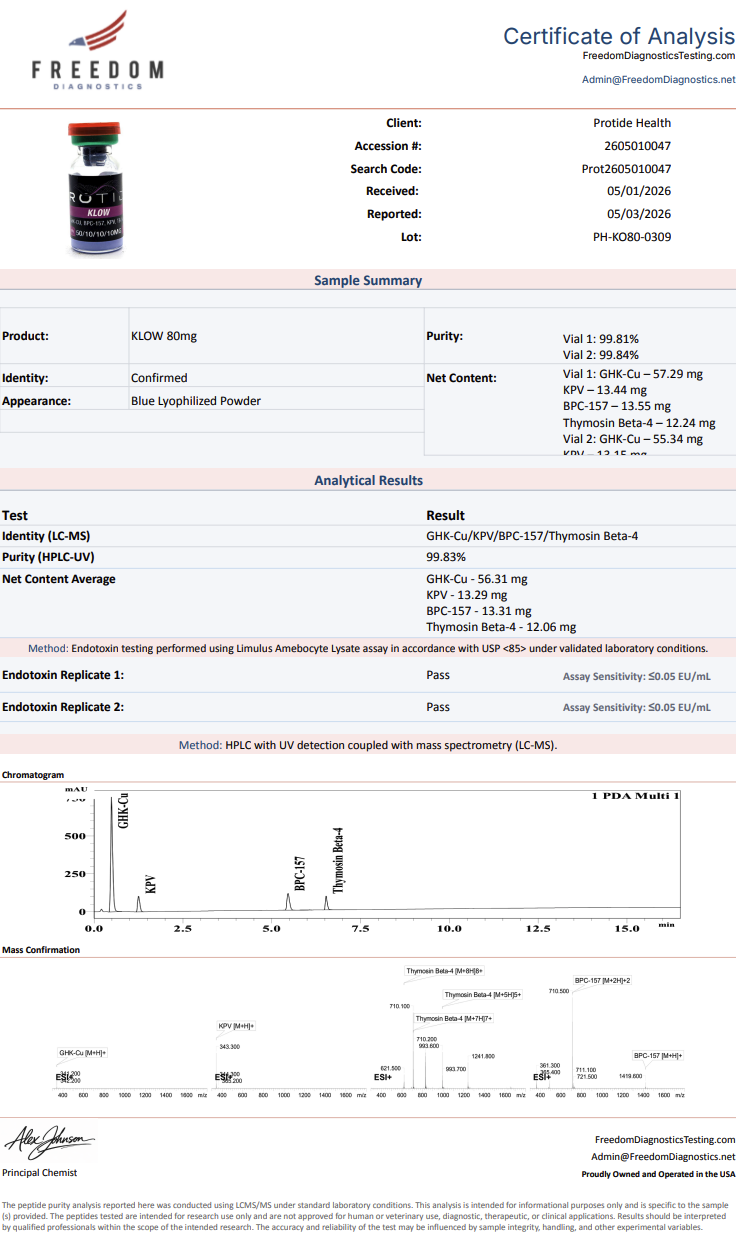
View the latest Klow Blend COA published at Protide Health. Browse our catalog to procure research peptides with transparent specs and testing.
Designing a Research Study with the Klow Blend
- Define your research question. Example: Does each component peptide in the Klow blend produce the same endpoint changes when prepared and assayed under matched conditions, compared with when prepared and assayed in isolation?
- Choose models and readouts that align with each component’s preclinical literature mechanism.
- Plan controls: vehicle, each single peptide arm, and the four-component blend arm.
- Use a peptide lab-math tool to map dilutions and aliquots.
- Document storage, handling, and blinding or randomization steps in your institutional SOP.
Klow peptide blend ingredients table
Component | Mechanism focus (models) | Research focus | Notes |
|---|---|---|---|
GHK-Cu | ECM remodeling; collagen/decorin‑related signaling | Fibroblast cultures; gene-expression shifts in ECM-related markers | Copper-binding tripeptide studied for collagen synthesis pathways and ECM markers in preclinical in-vitro fibroblast and animal skin biology models. |
KPV | NF-κB/MAPK downshift; PepT1 transport | Intestinal inflammation models; barrier-integrity endpoints | α-MSH-derived tripeptide evaluated in intestinal inflammation models for inflammatory signaling and barrier-integrity endpoints. |
BPC-157 | Angiogenesis; endothelial migration; ERK/Akt-eNOS | Rodent preclinical and in-vitro models; ECM-related endpoint research | Preclinical literature examines vascular signaling pathway markers, endothelial migration assays, and ECM-related endpoint research. |
TB-500 | Actin dynamics; cell migration; angiogenesis | Dermal fibroblast and corneal epithelial in-vitro models | Longstanding preclinical literature on actin-binding mechanisms, scratch-wound assay closure metrics, and transwell migration assays. |
Klow Peptide FAQs
What is the Klow peptide?
Klow is a four-peptide research blend that combines GHK-Cu 50 mg, KPV 10 mg, BPC-157 10 mg, and TB-500 10 mg in a single lyophilized vial. Each component is associated in published preclinical literature with distinct mechanistic pathways, and the blend format allows laboratories to prepare all four under matched conditions for parallel single-agent and combined-arm experiments. This article does not assert that the four components produce additive, synergistic, or interacting effects when combined. See the Klow Blend product page for chemical details.
What experimental endpoints do laboratories study with the Klow blend?
In laboratory settings, the Klow blend allows laboratories to evaluate four component peptides under matched preparation conditions, with each component associated in published preclinical literature with distinct mechanistic pathways.
What are the Klow peptide blend ingredients?
GHK-Cu 50 mg, KPV 10 mg, BPC-157 10 mg, and TB-500 10 mg per lyophilized vial. Batch-specific specifications and third-party HPLC and Mass Spectrometry results are documented on the Protide Health public COA library.
How do laboratories design experiments using a multi-peptide research blend?
In research contexts, investigators typically define model-specific controls, endpoints (for example, scratch-wound assay closure metrics, transwell migration, TEER and barrier-integrity markers, cytokine panels, ECM-related markers), and time points. Researchers may compare single-agent arms to the four-component blend arm under matched preparation conditions. A peptide concentration calculator can be used for laboratory math (mg-to-mL conversions and dilution series).
Where can qualified research personnel source the Klow blend in the US?
Qualified research personnel and institutions can source the Klow blend from Protide Health, the publisher of this article. The product is supplied for in-vitro laboratory characterization only and is not for human or veterinary use.
What’s in Klow Blend?
Klow Blend is a four‑peptide research formulation that combines GHK‑Cu, KPV, BPC‑157, and TB‑500 in defined amounts per vial for laboratory use.
What’s the difference between Klow and Glow peptides?
The formulation difference is the number of component peptides. Klow contains four peptides (GHK-Cu, KPV, BPC-157, TB-500). Glow contains three peptides (GHK-Cu, BPC-157, TB-500).
Klow Blend: GHK-Cu, KPV, BPC-157, TB-500
Glow Blend: GHK-Cu, BPC-157, TB-500
In research contexts, Klow introduces an additional KPV component. Both blend names are SKU identifiers and do not imply any therapeutic, cosmetic, or other in-vivo effect.
Disclaimer
Disclaimer: Products sold by Protide Health are for laboratory research purposes only and are not intended for human consumption, medical use, or veterinary use. The information provided in this article is for in-vitro laboratory research only and is not intended for human or veterinary use. Nothing in this article is medical advice. Researchers must comply with all applicable federal, state, local, and institutional regulations and must obtain all necessary approvals prior to any experimental work.
References
- Pickart L, Vasquez‑Soltero J, Margolina A. BioMed Research International, 2015. Wiley Online Library
- Dalmasso G, et al. Gastroenterology, 2008. Open access via Europe PMC. Europe PMC
- Current Reviews in Musculoskeletal Medicine, 2025. SpringerLink
- Goldstein AL, Hannappel E, Kleinman HK. Trends in Molecular Medicine, 2005. Cell Press
- American Journal of Physiology, Gastrointestinal and Liver Physiology, 2011. APS Journals
- Hsieh MJ, et al. Journal of Molecular Medicine, 2017. SpringerLink
- Pickart L. In: Textbook of Aging Skin (Springer Reference), 2015. SpringerLink