
MOTS-C Peptide: Preclinical Research on Mitochondrial Energy Pathways
Research‑Use‑Only Notice: All content on this website and all product information are for educational and informational purposes only. All products referenced are for laboratory research, analytical, and in‑vitro or preclinical in‑vivo use only. They are not medicines or drugs, have not been evaluated or approved by the FDA, and are not intended to diagnose, treat, cure, or prevent any disease. Any bodily introduction into humans or animals is strictly prohibited.
MOTS-c (Mitochondrial ORF of the 12S rRNA-c) is a 16-amino-acid mitochondrial-derived peptide investigated in preclinical models for cellular energy-sensing pathways and metabolic signaling mechanisms PubMed. Research examines its role in AMPK activation, folate-purine pathway modulation, and stress-response signaling in controlled laboratory settings.
What Is MOTS-C?
MOTS-c is encoded within a short open reading frame (sORF) of mitochondrial 12S ribosomal RNA PubMed. Unlike nuclear-encoded peptides, this mitochondrial-derived compound is studied for interactions with cellular energy metabolism, particularly through AMPK-related signaling cascades in skeletal muscle and stress-response pathways.
Molecular Characteristics
Laboratory research identifies MOTS-c as a 16-amino-acid peptide with the following properties:
- Mitochondrial origin: Encoded by mitochondrial DNA rather than nuclear genome
- Cellular targets: Studied primarily in skeletal muscle tissue and metabolic pathways
- Signaling mechanisms: Investigated for AMPK activation via folate-purine axis modulation
- Research applications: Examined in exercise-adaptation models and metabolic stress protocols
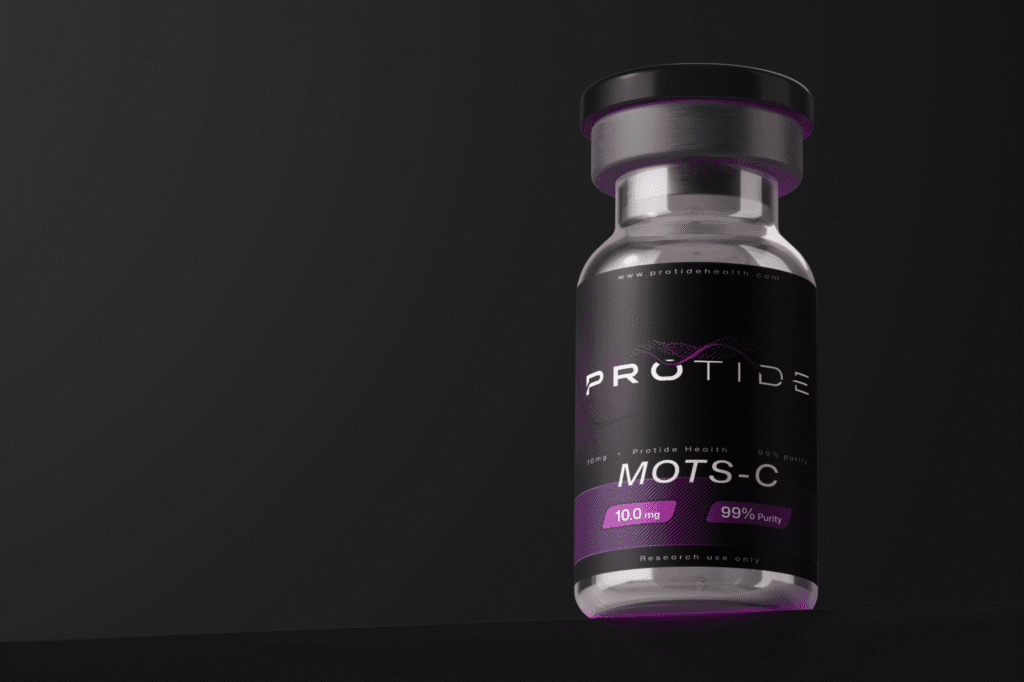
Explore research-grade MOTS-c 10mg for laboratory investigation.
Mechanisms Investigated in Laboratory Models
Folate-Purine-AMPK Pathway
Preclinical studies examine how MOTS-c interacts with the folate cycle and purine biosynthesis pathways Cell Metabolism. Research measures AICAR accumulation and subsequent AMPK phosphorylation in cell culture models. These investigations focus on signaling mechanisms rather than metabolic outcomes.
Nuclear Translocation Studies
Laboratory models investigate MOTS-c nuclear localization during metabolic stress conditions such as glucose restriction PMC. Research examines gene-expression changes and adaptive stress-response pathways in vitro. Human nuclear translocation data remains unavailable.
Exercise-Response Pathways
Animal studies measure endogenous MOTS-c expression changes following exercise protocols Nature Communications. Research investigates whether exogenous MOTS-c administration influences exercise-capacity markers in rodent models. Human interventional studies are extremely limited.
Research Applications in Preclinical Models
| Model System | Pathway Investigated | Measured Endpoints |
|---|---|---|
| C2C12 Myoblasts | AMPK/ACC phosphorylation | Protein kinase activation markers |
| Primary Adipocytes | Glucose uptake signaling | GLUT translocation, insulin pathway markers |
| Rodent Skeletal Muscle | Exercise-adaptation pathways | Endogenous MOTS-c expression, mitochondrial markers |
| Cell Cultures (Stress) | Nuclear translocation | Gene-expression profiles, stress-response elements |
Preclinical Study Parameters
Animal research typically employs:
- In vitro concentrations: Micromolar ranges in cell culture media
- Model organisms: Rodent models for metabolic and exercise studies
- Measurement endpoints: AMPK phosphorylation, gene expression, mitochondrial function markers
- Study duration: Variable based on endpoint (hours for signaling, weeks for phenotypic changes)
No standardized human research protocols exist. All evidence derives from preclinical models.
Laboratory Handling Considerations
Storage and Reconstitution
Research-grade MOTS-c is supplied as lyophilized powder requiring proper laboratory handling:
- Storage conditions: Follow manufacturer specifications for temperature and humidity
- Reconstitution: Per institutional standard operating procedures using appropriate sterile solvents
- Stability: Document stability parameters per batch-specific guidance
- Aliquoting: For volume calculations, laboratories may use tools such as a Peptide Reconstitution Tool for mathematical conversions only
Quality Standards
Laboratory-grade compounds feature:
- Third-party HPLC-MS verification for identity and purity
- Batch-specific Certificates of Analysis (COA)
- USA-based GMP-compliant manufacturing
- Transparent analytical documentation
View research-grade MOTS-c 10mg with third-party testing.
Observational Human Data
Exercise-Response Studies
Observational research reports endogenous MOTS-c expression increases in human skeletal muscle following acute and chronic exercise protocols PMC. These studies measure circulating and tissue levels as biomarkers of exercise adaptation. No human interventional trials with exogenous MOTS-c administration have been published.
Research Limitations
- Human interventional data: Absent or extremely limited
- Mechanism translation: Preclinical signaling findings do not establish human physiological effects
- Regulatory status: Not approved for human use; research-only designation
- Evidence base: Predominantly animal models and in vitro systems
Study Design Considerations for Laboratory Research
Researchers investigating MOTS-c in controlled settings typically:
- Define endpoints: AMPK/ACC phosphorylation, glucose-uptake markers, gene-expression profiles, mitochondrial function assays
- Establish controls: Vehicle-treated groups, time-course sampling, dose-response curves
- Select models: Cell lines (C2C12, 3T3-L1), primary cultures, or rodent metabolic/exercise models
- Document parameters: Concentration, exposure duration, environmental conditions, endpoint measurement protocols
- Verify compound quality: Third-party analytical testing, batch-specific COA review
Frequently Asked Questions
Explore research-grade peptides at Protide Health Shop.
What is MOTS-c?
A 16-amino-acid mitochondrial-encoded peptide (from the 12S rRNA) studied for regulating cellular energy and stress responses in preclinical systems. (PubMed)
What is MOTS-c “good for” in research?
In lab settings, MOTS-c is used to probe AMPK-centered energy sensing, insulin sensitivity, and exercise-like adaptation, including nuclear stress-response programs. It is not a medical product. (Cell)
Does exercise affect MOTS-c?
Yes. Human studies show exercise can increase endogenous MOTS-c in muscle and circulation; rodent work suggests exogenous MOTS-c can enhance physical performance. (Nature)
Is there a MOTS-c “protocol”?
Only as research-only designs. Define endpoints (e.g., AMPK/ACC phosphorylation, glucose uptake), set time points, and compare vehicle vs. MOTS-c; standardize dilutions with a dosage calculator. Avoid any human-use guidance. (Cell)
Can I buy MOTS-c in the US for research?
Yes—browse research-use peptides with transparent specifications and third-party testing at Protide Health.
Disclaimer: Products sold by Protide Health are for laboratory research purposes only and are not intended for human consumption, medical use, or veterinary use. Information provided is educational and not medical advice. Researchers must comply with all applicable regulations and institutional review protocols.
References
- Lee C, et al. The mitochondrial-derived peptide MOTS-c promotes metabolic homeostasis and reduces obesity and insulin resistance. Cell Metabolism, 2015. Cell Metabolism
- Kim KH, et al. The mitochondrial-encoded peptide MOTS-c translocates to the nucleus to regulate homeostasis and adaptation to metabolic stress. Cell Metabolism, 2018. PMC
- Reynolds JC, et al. MOTS-c is an exercise-induced mitochondrial-encoded regulator of age-dependent physical decline and muscle homeostasis. Nature Communications, 2021. Nature
- Zheng Y, et al. MOTS-c: A promising mitochondrial-derived peptide for therapeutic exploitation. Journal of Translational Medicine, 2023. BioMed Central
- Wan W, et al. Mitochondria-derived peptide MOTS-c: Effects and mechanisms in metabolic regulation. Journal of Translational Medicine, 2023. PMC
Ready to begin your research? Explore our peptide selection in the Protide Health Shop.