Peptide Gelling & Clouding Guide: Solubility Solutions
Research‑Use‑Only Notice: All content on this website and all product information are for educational and informational purposes only. All products referenced are for laboratory research, analytical, and in‑vitro or preclinical in‑vivo use only. They are not medicines or drugs, have not been evaluated or approved by the FDA, and are not intended to diagnose, treat, cure, or prevent any disease. Any bodily introduction into humans or animals is strictly prohibited.
Hydrophobic Peptide Solubility: Fix Cloudy or Gelled Solutions
Quick Laboratory Reference
- Cloudy Peptide? This is often caused by hydrophobic peptides (e.g., AOD-9604) resisting neutral water.
- The Fix: Use 0.6% Acetic Acid to protonate the side chains and dissolve the gel or precipitate.
- Stability: Store acidified solutions at 2-8°C. Do not freeze acidified samples.
Abstract
A common phenomenon observed in laboratory peptide research involves the clouding, precipitation, or gelling of high-purity lyophilized peptides upon the introduction of a solvent. While frequently interpreted as a quality defect, a cloudy peptide solution often indicates the presence of hydrophobic (water-repelling) amino acid sequences in high purity peptides, not a quality defect. This technical overview examines why high-purity peptides gel in neutral water and the chemical necessity of acetic acid in establishing a homogenous solution.
Solubility Reference Table
Refer to the chart below to select the appropriate primary solvent for your research.
| Research Peptide | Hydrophobicity Profile | Primary Solvent | Secondary Diluent |
| BPC-157 | Hydrophilic (Low) | Bacteriostatic Water | N/A |
| TB-500 | Hydrophilic (Low) | Bacteriostatic Water | N/A |
| AOD-9604 | Hydrophobic (High) | 0.6% Acetic Acid | Bacteriostatic Water |
| Fragment 176-191 | Hydrophobic (High) | 0.6% Acetic Acid | Bacteriostatic Water |
| CJC-1295 | Hydrophilic (Low) | Bacteriostatic Water | N/A |
The Chemistry of Solubility Profiles
Peptide solubility is strictly dictated by the amino acid sequence of the subject. While many research peptides are hydrophilic (water-soluble) and establish equilibrium in neutral solvents, others possess non-polar side chains that resist aqueous integration.
- Hydrophilic Sequences: Peptides containing polar residues (e.g., Arginine, Lysine) typically dissolve rapidly in standard Bacteriostatic Water.
- Hydrophobic Sequences: Peptides containing lipophilic structures exhibit strong intermolecular attraction. When introduced to neutral pH water, these molecules tend to aggregate to minimize contact with the solvent, resulting in visible clouding or gelling.
Case Study: AOD-9604 Gelling and Hydrophobic Profiles
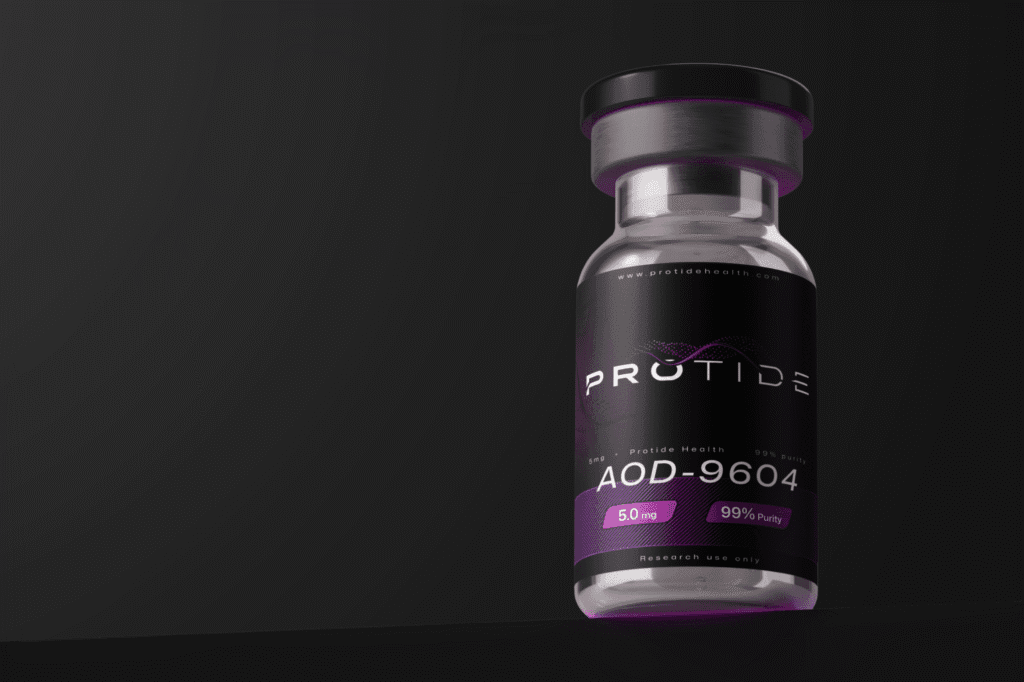
A primary example of a hydrophobic sequence is AOD-9604 (Tyrosyl-somatostatin Fragment). Due to its specific C-terminal amino acid arrangement, this peptide is known to exhibit poor solubility in neutral bacteriostatic water.
- Standard Observation: When mixing AOD-9604 with only water, researchers often observe a “cloudy” suspension, white floating particulates, or a semi-solid gel state.
- Chemical Correction: The introduction of a mild acid (as outlined in the protocol below) transitions the peptide from a gelled suspension to a clear, stable solution. This clarity confirms the high purity of the acetate salt form.
Solvent Selection: Acetic Acid Reconstitution
Standard laboratory protocols for hydrophobic peptides often fail when utilizing Bacteriostatic Water as the sole solvent. To achieve a stable liquid phase for analysis, the solvent’s pH must be modulated to overcome the peptide’s isoelectric point.
In research applications, 0.6% Acetic Acid is frequently utilized as the primary solvent for hydrophobic chains. The acidification of the environment protonates the peptide side chains, inducing electrostatic repulsion between molecules. This repulsion prevents aggregation (gelling) and allows for full dissolution.
Standard Solubilization Protocols (Laboratory Reference)
The following outlines standard chemical handling procedures for in-vitro assay preparation. This data is for educational and research purposes only.
Phase 1: Acid Introduction
Solubility is most effectively achieved when the lyophilized solid is first exposed to 0.6% Acetic Acid. Laboratory data suggests that introducing a small volume (approximately 10-20% of the total target volume) ensures the breakdown of hydrophobic interactions.
Phase 2: Dissolution Dynamics
Gentle swirling is utilized to encourage mixing without shearing the peptide bonds. Visual clarity of the solution indicates that the peptide has successfully entered the liquid phase. If turbidity (clouding) or gelling persists, the volume of acetic acid is typically increased in small increments until transparency is achieved.
Phase 3: Final Dilution
Once the peptide is fully solubilized in the acidic medium, Bacteriostatic Water is commonly added to reach the final target concentration. The initial acidification maintains the peptide in solution even after dilution with neutral water.
Troubleshooting Solubility Issues
Researchers analyzing peptide integrity often encounter the following physical states. These states are indicative of solvent mismatch, not product failure.
State A: Gelatinous Precipitate (The “Jelly” Effect)
- Observation: The solution thickens into a gel at the bottom of the vial.
- Chemical Cause: High peptide concentration combined with insufficient solvent acidity.
- Protocol Reference: This state typically requires further dilution or a higher ratio of acetic acid to disrupt the gel matrix.
State B: Particulate Suspension (Cloudy Water)
- Observation: Small white flakes or “clouds” remain floating in the liquid.
- Chemical Cause: The pH has drifted too close to the peptide’s isoelectric point, causing it to “crash out” of the solution.
- Protocol Reference: Re-acidification is often required to restore solubility.
FAQs
Why is my AOD 9604 cloudy or gelling after adding water?
AOD 9604 is a hydrophobic peptide. When mixed with neutral Bacteriostatic Water, it resists dissolution and aggregates into a gel or cloud. Standard protocol requires dissolving it in a small volume of acetic acid first to achieve clarity.
Can I use vinegar instead of acetic acid for peptides?
No. Laboratory-grade 0.6% Acetic Acid is sterile and filtered. Household vinegar contains impurities and organic matter that will contaminate the research sample and degrade the peptide.
Does acetic acid burn the research model?
In standard research protocols, the small volume of acetic acid is diluted with Bacteriostatic Water. The final concentration is generally well-tolerated in subcutaneous research models, though localized irritation is a noted variable in data sets.
Can I freeze the peptide after mixing with acetic acid?
Freezing acidified solutions is generally avoided in research protocols. The freezing process can cause “freeze-concentration,” where the acid separates and damages the peptide structure during thawing. Store at 2°C to 8°C.
Scientific References & Literature Cited
- Journal of Endocrinology and Metabolism. “AOD9604.” (Journal of Endocrinology and Metabolism)
- Sigma-Aldrich (Merck). “Solubility Guidelines for Peptides: Hydrophobicity and Charge Analysis.” (Sigma-Aldrich Technical Review)
- ACS Molecular Pharmaceutics. “Aggregation Behavior of Structurally Similar Peptides.” (ACS Publications)
- National Institutes of Health (PMC). “Influence of Hydrophobic Face Amino Acids on the Hydrogelation of β-Hairpin Peptides.” (NIH PMC)
- Journal of Pharmaceutical Sciences. “Mannitol as an Excipient for Lyophilized Injectable Formulations.” (PubMed)
Disclaimer: This article is for laboratory research purposes only and is not intended for human consumption, medical use, or veterinary use. Information provided is educational and not medical advice. Researchers must comply with all applicable regulations and obtain necessary approvals for experimental use.