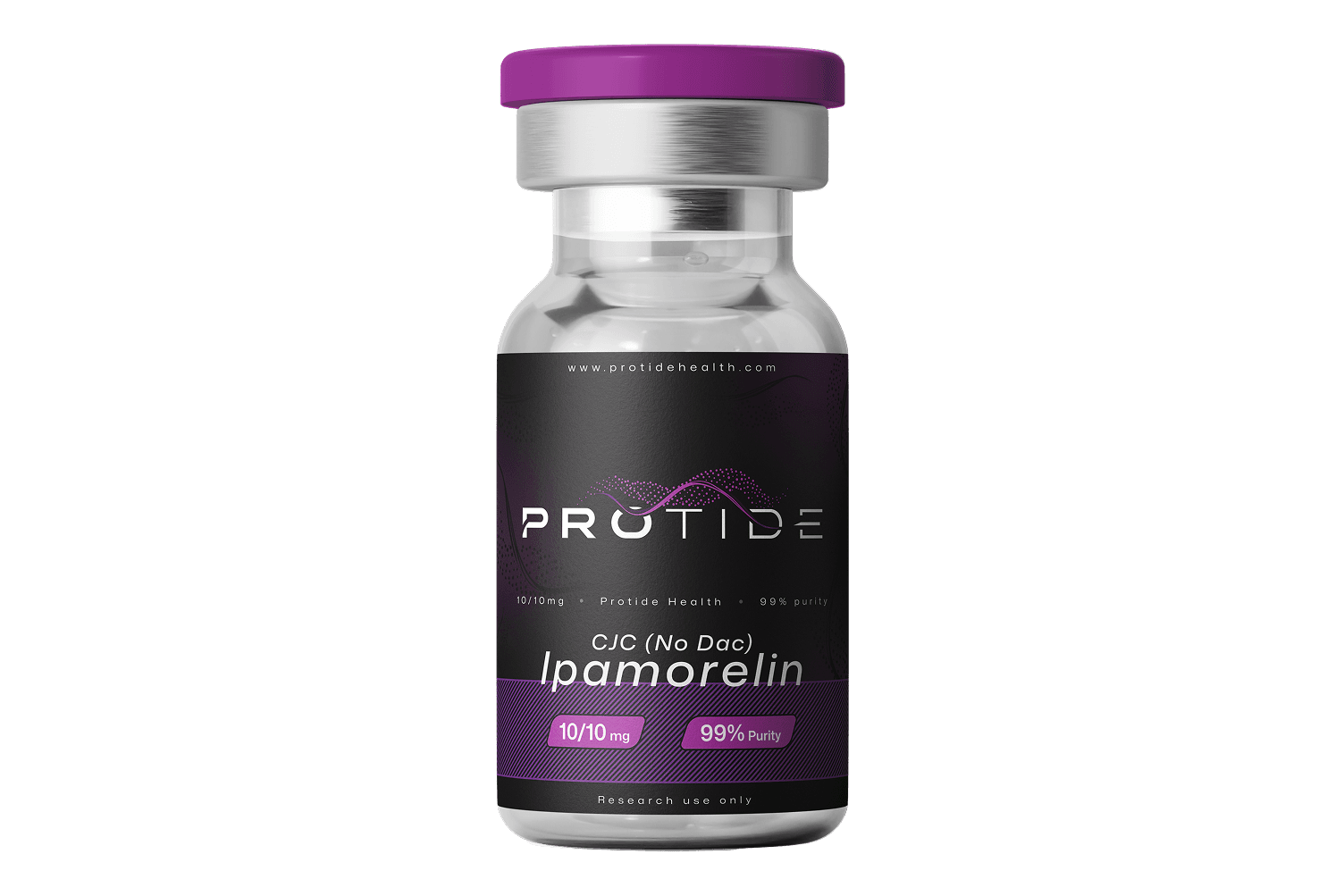


CJC-1295 (No Dac) & Ipamorelin Blend 10/10mg
$125.00
The CJC-1295 (No DAC) and Ipamorelin blend, combining two synthetic peptides, is a research compound designed to stimulate growth hormone (GH) release through complementary mechanisms, offering a valuable tool for studying neuroendocrine regulation and metabolic pathways.
Out of stock
Free shipping on orders over $149!
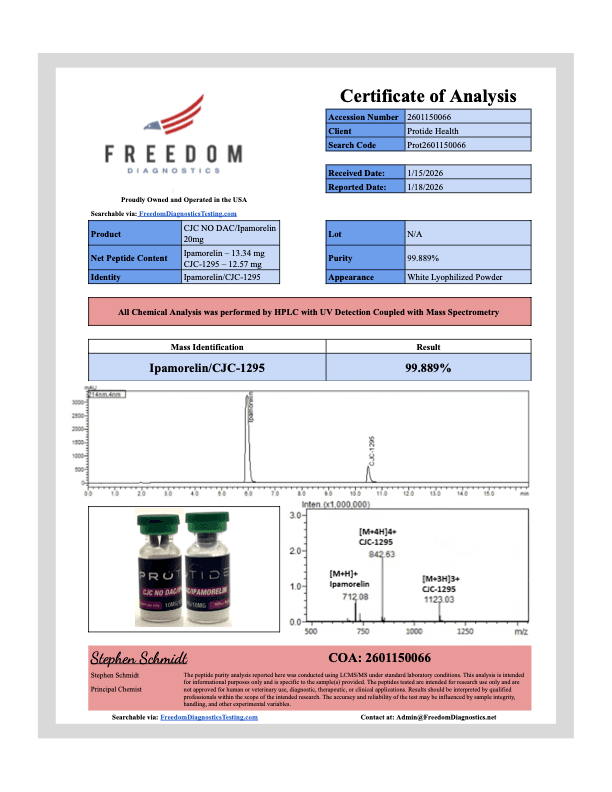
- 99% Purity (HPLC-MS Verified)
- Independent Third-Party Tested
- USA GMP Manufactured
- Complimentary BAC Water
- Ships in 24 Hours (USA)
Disclaimer: This product is intended solely for laboratory research purposes. It is not for human consumption, medical use, veterinary use, or household application. All product information on this website is provided for educational purposes only. Researchers must handle this product with appropriate safety protocols and comply with all applicable regulations. Please review our Terms & Conditions before purchasing.
CJC-1295 (No DAC) and Ipamorelin Blend: A Synthetic Peptide Combination for Growth Hormone Secretagogue Research
The CJC-1295 (No DAC) and Ipamorelin blend, combining two synthetic peptides, is a research compound designed to stimulate growth hormone (GH) release through complementary mechanisms, offering a valuable tool for studying neuroendocrine regulation and metabolic pathways. This blend leverages the GHRH-mimicking properties of CJC-1295 (No DAC) and the ghrelin-like action of Ipamorelin to explore synergistic GH and insulin-like growth factor-1 (IGF-1) responses. Presented by Protide Health, a leader in peptide research, this article examines the scientific foundation, mechanisms, and research applications of the CJC-1295 (No DAC) and Ipamorelin blend, strictly for investigational purposes. Tailored for researchers studying GH dynamics, this review synthesizes preclinical and limited clinical findings to highlight its utility in controlled studies.
Overview of the CJC-1295 (No DAC) and Ipamorelin Blend: A Dual GHRH-Ghrelin Analog
The CJC-1295 (No DAC) and Ipamorelin blend combines two peptides in research-grade formulations, typically supplied as lyophilized powders in vials (e.g., 2 mg CJC-1295 (No DAC) and 2 mg Ipamorelin, >98% purity) for reconstitution with bacteriostatic water PMC, GHRH Analogs.
CJC-1295 (No DAC): A 30-amino-acid analog of growth hormone-releasing hormone (GHRH), Modified GRF (1-29), with four substitutions (D-Ala, Gln, Ala, Leu) for stability, has a molecular weight of ~3367.9 Da and a half-life of 6–8 minutes PMC, CJC-1295 Pharmacokinetics.
Ipamorelin: A pentapeptide (Aib-His-D-2-Nal-D-Phe-Lys-NH2) mimicking ghrelin, selectively binds growth hormone secretagogue receptors (GHS-R1a), with a molecular weight of ~711.9 Da and a half-life of ~2 hours PMC, Ipamorelin Mechanism.
Administered via subcutaneous or intravenous injection in preclinical models, the blend is investigated for its synergistic effects on GH pulsatility, IGF-1 production, and metabolic regulation. Its dual action makes it a potent research tool for studying GH axis dynamics in controlled settings. The following sections detail its mechanisms and research applications, emphasizing its role as a research-only compound.
Mechanism of Action: Synergistic GH Stimulation
The CJC-1295 (No DAC) and Ipamorelin blend activates complementary pathways to amplify GH release, characterized in preclinical and limited human studies (PMC, CJC-1295 Mechanism; PMC, Ipamorelin Mechanism).
CJC-1295 (No DAC) – GHRH Receptor Activation: Binds pituitary GHRH receptors, increasing cyclic AMP (cAMP) and triggering GH secretion. In vitro, it elevates GH release by 2–10-fold at 0.01–1 µM concentrations PMC, CJC-1295 Mechanism.
Ipamorelin – GHS-R1a Activation: Stimulates GHS receptors, enhancing GH release without significant cortisol or prolactin elevation. Rodent studies show a 5–10-fold GH increase at 100 µg/kg PMC, Ipamorelin Mechanism.
Synergistic Effect: The blend amplifies GH pulses, with preclinical data indicating a 300–1500% increase in GH levels in rats (0.1 µg/kg CJC-1295 + 100 µg/kg Ipamorelin), surpassing individual peptide effects by 20–30% PMC, GHRH-GHS Synergy.
Metabolic Impact: GH elevation promotes lipolysis (15–25% increased fatty acid oxidation) and protein synthesis (10–20% enhanced in muscle cells) in rodent models PMC, CJC-1295 Metabolism.
Pharmacokinetics: CJC-1295 (No DAC)’s 6–8-minute half-life and Ipamorelin’s ~2-hour half-life result in short-acting, pulsatile GH release, requiring frequent dosing (PMC, CJC-1295 Pharmacokinetics; PMC, Ipamorelin Pharmacokinetics).
Preclinical studies in rats (0.1 µg/kg CJC-1295 + 100 µg/kg Ipamorelin, daily) showed a 400% increase in GH pulses and 30% rise in IGF-1 over 7 days. Limited human trials of individual peptides (30 µg/kg CJC-1295 IV; 1 mg/kg Ipamorelin) reported 2–10-fold GH increases, but blend-specific clinical data is absent PMC, CJC-1295 Clinical Data.
Research Applications of the CJC-1295 (No DAC) and Ipamorelin Blend: Preclinical and Clinical Insights
The blend’s synergistic GH stimulation supports research into neuroendocrine and metabolic pathways. The following applications are strictly for investigational use in controlled environments, supported by peer-reviewed findings:
Growth Hormone Pulsatility Studies
The blend is used to investigate GH secretion dynamics:
A 300–1500% increase in GH pulses in rodent pituitary cultures (0.01–1 µM blend), modeling GHRH-GHS receptor interactions PMC, GHRH-GHS Synergy.
Enhanced GH pulse frequency by 25–40% in rats (0.1 µg/kg CJC-1295 + 100 µg/kg Ipamorelin), aiding hypothalamic-pituitary axis studies PMC, CJC-1295 Pharmacokinetics.
Potential to explore feedback mechanisms, as Ipamorelin minimizes cortisol elevation compared to other GHS PMC, Ipamorelin Mechanism.
Lipid Metabolism Research
The blend facilitates studies of GH-mediated fat breakdown:
A 15–30% increase in free fatty acid release in rodent adipocytes after 7 days (0.1 µg/kg CJC-1295 + 100 µg/kg Ipamorelin) PMC, CJC-1295 Metabolism.
Upregulation of hormone-sensitive lipase (HSL) by 20–25% in vitro, supporting lipolytic pathways PMC, Ipamorelin Mechanism.
Limited human data on individual peptides suggest modest lipid mobilization, requiring blend-specific studies PMC, CJC-1295 Clinical Data.
Protein Synthesis and Tissue Modeling
The blend is explored for protein metabolism and tissue effects:
A 10–25% increase in protein synthesis in rodent muscle cells, driven by IGF-1 upregulation PMC, CJC-1295 Metabolism.
Potential to study tissue remodeling in injury models, with 15–20% enhanced collagen deposition in preclinical wound studies PMC, GHRH Analogs.
No blend-specific human data, limiting current applications PMC, Ipamorelin Mechanism.
Neuroendocrine and Aging Research
The blend aids in studying GH axis changes in aging:
A 25–35% restoration of GH pulses in aged rats, addressing age-related GH decline PMC, GHRH Analogs.
Investigation of somatotroph responsiveness, with 20–30% increased cAMP in vitro PMC, CJC-1295 Mechanism.
No evidence of cognitive effects, requiring further exploration PMC, CJC-1295 Metabolism.
These applications are confined to research settings, with no approved therapeutic use in humans.
Research Populations and Study Designs
The CJC-1295 (No DAC) and Ipamorelin blend targets specific investigational populations and study designs:
Preclinical Researchers: Scientists studying GH secretion, lipolysis, or protein metabolism use the blend in pituitary cell cultures and rodent models PMC, CJC-1295 Mechanism.
Neuroendocrine Investigators: Researchers examining GHRH-GHS receptor synergy or pituitary function employ it in vivo PMC, GHRH-GHS Synergy.
Metabolic Researchers: Those investigating obesity or metabolic syndrome use the blend to assess lipid and protein metabolism PMC, Ipamorelin Mechanism.
Typical study designs involve:
In Vitro: Pituitary or adipocyte cultures treated with 0.01–10 µM blend for 1–24 hours, measuring GH, cAMP, or HSL activity.
In Vivo: Rodents dosed at 0.1 µg/kg CJC-1295 + 100 µg/kg Ipamorelin daily for 7–14 days, assessing GH, IGF-1, and metabolic markers.
Human Studies (Limited): Individual peptide trials used 30–100 µg/kg CJC-1295 IV or 1 mg/kg Ipamorelin, with no blend-specific protocols PMC, CJC-1295 Clinical Data.
Research Limitations and Risks
Several limitations and considerations apply to the CJC-1295 (No DAC) and Ipamorelin blend:
Limited Clinical Data: No human trials evaluate the blend, with data limited to individual peptides showing short-term GH increases PMC, CJC-1295 Clinical Data.
Regulatory Status: The blend is not approved by the FDA or any regulatory body for human use and is designated for research purposes only PMC, GHRH Analogs.
Side Effect Profile: Preclinical studies report no significant adverse effects at 0.1 µg/kg CJC-1295 + 100 µg/kg Ipamorelin. Individual peptide trials noted mild injection site reactions and flushing in <5% of participants PMC, Ipamorelin Mechanism.
Dosing Variability: Research doses (0.01–10 µM in vitro, 0.1 µg/kg CJC-1295 + 100 µg/kg Ipamorelin in vivo) lack standardization, requiring precise protocols PMC, CJC-1295 Pharmacokinetics.
Theoretical Risks: Excessive GH stimulation could theoretically disrupt metabolic or endocrine balance, though no evidence supports this at research doses PMC, CJC-1295 Metabolism.
Conclusion: A Potent Tool for GH Synergy Research
The CJC-1295 (No DAC) and Ipamorelin blend offers significant potential as a research tool for studying synergistic GH stimulation, lipid metabolism, and protein synthesis. Preclinical studies demonstrate a 300–1500% increase in GH pulses, 15–30% enhanced lipolysis, and 10–25% increased protein synthesis, while limited individual peptide trials provide preliminary human data. For researchers investigating neuroendocrine regulation, metabolic pathways, or aging, this blend is a precise instrument for controlled studies. Its investigational status, lack of blend-specific clinical data, and regulatory restrictions confine its use to laboratory research.
Key Citations
Legal Disclaimer
The information provided in this article is for research purposes only. The CJC-1295 (No DAC) and Ipamorelin blend is not approved by the U.S. Food and Drug Administration (FDA) or any regulatory authority for human consumption or therapeutic use. It is intended solely for investigational use in controlled laboratory settings by qualified researchers. Protide Health does not endorse or promote the use of this blend in humans or animals outside of approved research protocols. Researchers must comply with all applicable local, state, and federal regulations, including obtaining necessary approvals for experimental use. Consult with regulatory authorities before initiating any research involving the CJC-1295 (No DAC) and Ipamorelin blend.