

DSIP
Price range: $55.00 through $100.00
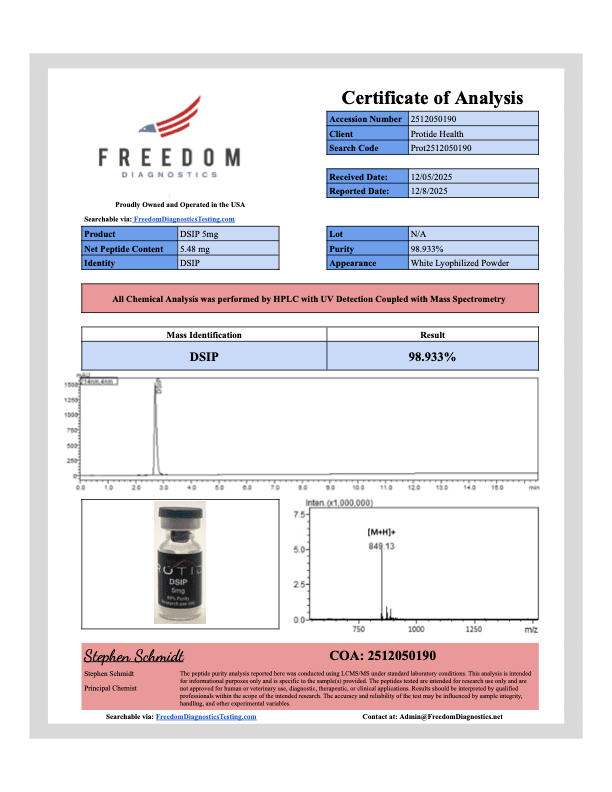
Delta Sleep-Inducing Peptide (DSIP), Potential to modulate sleep patterns, improving sleep quality, stress responses, and neuroendocrine functions in preclinical models. DSIP has been studied for its effects on slow-wave sleep (SWS), hormone regulation, and neuroprotection, offering insights into sleep physiology and stress-related disorders. Supplied as a stable 5mg or 10mg lyophilized vial. Third-party HPLC-verified >99% purity. For research use only.
Free shipping on orders over $149!
- 99% Purity (HPLC-MS Verified)
- Independent Third-Party Tested
- USA GMP Manufactured
- Complimentary BAC Water
- Ships in 24 Hours (USA)
Disclaimer: This product is intended solely for laboratory research purposes. It is not for human consumption, medical use, veterinary use, or household application. All product information on this website is provided for educational purposes only. Researchers must handle this product with appropriate safety protocols and comply with all applicable regulations. Please review our Terms & Conditions before purchasing.
DSIP (Delta Sleep-Inducing Peptide) 5mg to 10mg
Delta Sleep-Inducing Peptide (DSIP), also cataloged as Emideltide, is a highly purified, synthetic nine-amino-acid neuropeptide engineered for advanced in vitro and animal modeling. Originally identified in the cerebral venous blood of rabbits during induced slow-wave sleep, this amphiphilic compound provides researchers with a precise molecular tool for studying neuroendocrine regulation, circadian rhythm pathways, and cellular stress responses.
For investigators looking to buy DSIP peptide for their laboratory, Protide Health supplies this sequence as a stable, lyophilized powder. The 5mg formulation allows researchers to consistently evaluate dose-dependent changes in delta EEG activity and hypothalamic hormone secretion within controlled preclinical environments.
Peptide Type: Synthetic Amphiphilic Neuropeptide
Vial Content: 5mg to 10mg Delta Sleep-Inducing Peptide (DSIP)
Form: Lyophilized (Freeze-Dried) for maximum biochemical stability
Mechanism of Action: Neuromodulation and Circadian Research
DSIP is synthesized to investigate complex neuroendocrine and stress-response pathways. While the exact endogenous receptor for DSIP remains a subject of active investigation, its mechanisms of action have been thoroughly characterized across multiple in vitro and animal models.
Delta EEG Activity & Spindle Induction
In animal models, intracerebroventricular (ICV) infusion of DSIP is observed inducing specific spindle and delta EEG (electroencephalogram) activity. Researchers utilize these models to track the upregulation of slow-wave states (SWS), examining how neuropeptides modulate the architecture of the sleep-wake cycle at a neurological level.
Neuroendocrine Modulation
DSIP heavily influences the hypothalamic-pituitary-adrenal (HPA) axis in laboratory settings. Preclinical rodent studies demonstrate that DSIP administration alters the secretion of critical serum hormones, notably increasing adrenocorticotropic hormone (ACTH) and luteinizing hormone (LH) while simultaneously suppressing somatostatin.
Oxidative Stress & Cytokine Reduction
Investigators utilize DSIP in isolated neuronal cultures to study cytoprotection. Assays indicate that DSIP reduces Reactive Oxygen Species (ROS) and enhances oxidative phosphorylation in neurons, providing a framework for studying hypoxia resistance and the mitigation of pro-inflammatory cytokines (such as TNF-α).
Advanced Research Applications for DSIP Peptide
1. Chronobiology & Circadian Rhythm Modeling
Researchers looking for DSIP 5mg for sale frequently utilize it in chronobiology assays. By tracking plasma concentrations alongside EEG readouts, investigators use DSIP to explore how specific neuropeptide levels correlate with sleep initiation and circadian phase-shifting in mammalian models.
2. Ischemic Neuroprotection Assays
Because DSIP decreases excitotoxicity in neuronal cultures, it is heavily utilized in ischemic injury models. Researchers observe how DSIP-mediated reductions in ROS protect cellular integrity, utilizing the compound to study pathways involved in focal neurological stress and recovery mechanisms.
3. Cellular Senescence and Apoptosis Research
DSIP’s antioxidant effects are actively studied in preclinical models of cellular senescence. In vitro assays track how DSIP administration modulates p53 expression, allowing researchers to study the biological mechanisms that delay apoptosis and maintain cellular resilience over prolonged observational windows.
Specifications Table: DSIP (Delta Sleep-Inducing Peptide)
| Parameter | Technical Details |
|---|---|
| Product Name | DSIP (Delta Sleep-Inducing Peptide) |
| Sequence | Trp-Ala-Gly-Gly-Asp-Ala-Ser-Gly-Glu |
| Vial Weight | 5mg to 10mg (Active Peptide) |
| Molecular Weight | ~848.81 g/mol |
| Purity Grade | 99%+ (Verified via HPLC/MS) |
| Solubility | Reconstitute with Bacteriostatic Water |
| Intended Use | Laboratory Research Only |
Where can I buy DSIP online for laboratory research?
Qualified laboratories searching to buy DSIP online can acquire it directly through Protide Health. We provide high-purity DSIP 5mg vials manufactured explicitly for in vitro and preclinical animal modeling. Every batch undergoes strict third-party HPLC testing to ensure structural integrity and >99% purity.
Why do laboratories use DSIP for neuroendocrine research?
Unlike broader compounds, DSIP allows researchers to target the HPA axis directly. By measuring fluctuations in ACTH, LH, and somatostatin, investigators can accurately map how specific neuropeptide cascades influence systemic neuroendocrine communication.
How should DSIP 5mg be stored for optimal stability?
Due to its relatively short in vitro half-life when not bound to carrier proteins, pristine storage is critical. Sealed, lyophilized vials must be stored in a cool, dry, and dark environment (typically -20°C). Once reconstituted with bacteriostatic water, the solution must be handled according to strict institutional SOPs and refrigerated immediately to prevent enzymatic degradation.
Conclusion: Summary for Researchers
Delta Sleep-Inducing Peptide (DSIP) is a highly versatile synthetic nonapeptide offering significant potential as a preclinical research tool. By modulating delta EEG activity, altering HPA axis hormone secretion, and reducing oxidative stress in neuronal cultures, it provides a multifaceted platform for exploring the intersection of chronobiology, neuroprotection, and cellular senescence. Available exclusively for laboratory use, the 5mg or 10mg DSIP formulation is an indispensable asset for advancing complex neuroendocrine discovery.
Citations
Graf MV et al., 1984. Delta-sleep-inducing peptide (DSIP): an update. Peptides.
Iyer KS et al., 1988. Effect of delta sleep-inducing peptide on pituitary hormones. Neuroendocrinology.
Mikhaleva II et al., 2008. Neuroprotective action of DSIP in hypoxia and ischemia. Bulletin of Experimental Biology and Medicine.
Khvatova EM et al., 2021. DSIP and oxidative stress in focal ischemia models. Neuroscience and Behavioral Physiology.
Legal Disclaimer
Delta Sleep-Inducing Peptide (DSIP) is intended for laboratory research purposes only. It is not approved by the U.S. Food and Drug Administration (FDA) or any regulatory authority for human consumption, medical use, clinical application, or veterinary administration. It is intended solely for investigational use in controlled laboratory settings by qualified researchers. Protide Health does not endorse or promote the use of DSIP in humans or animals outside of approved research protocols. Researchers must comply with all applicable local, state, and federal regulations, including obtaining necessary approvals for experimental use.
| Select vial strength: | 5mg, 10mg |
|---|