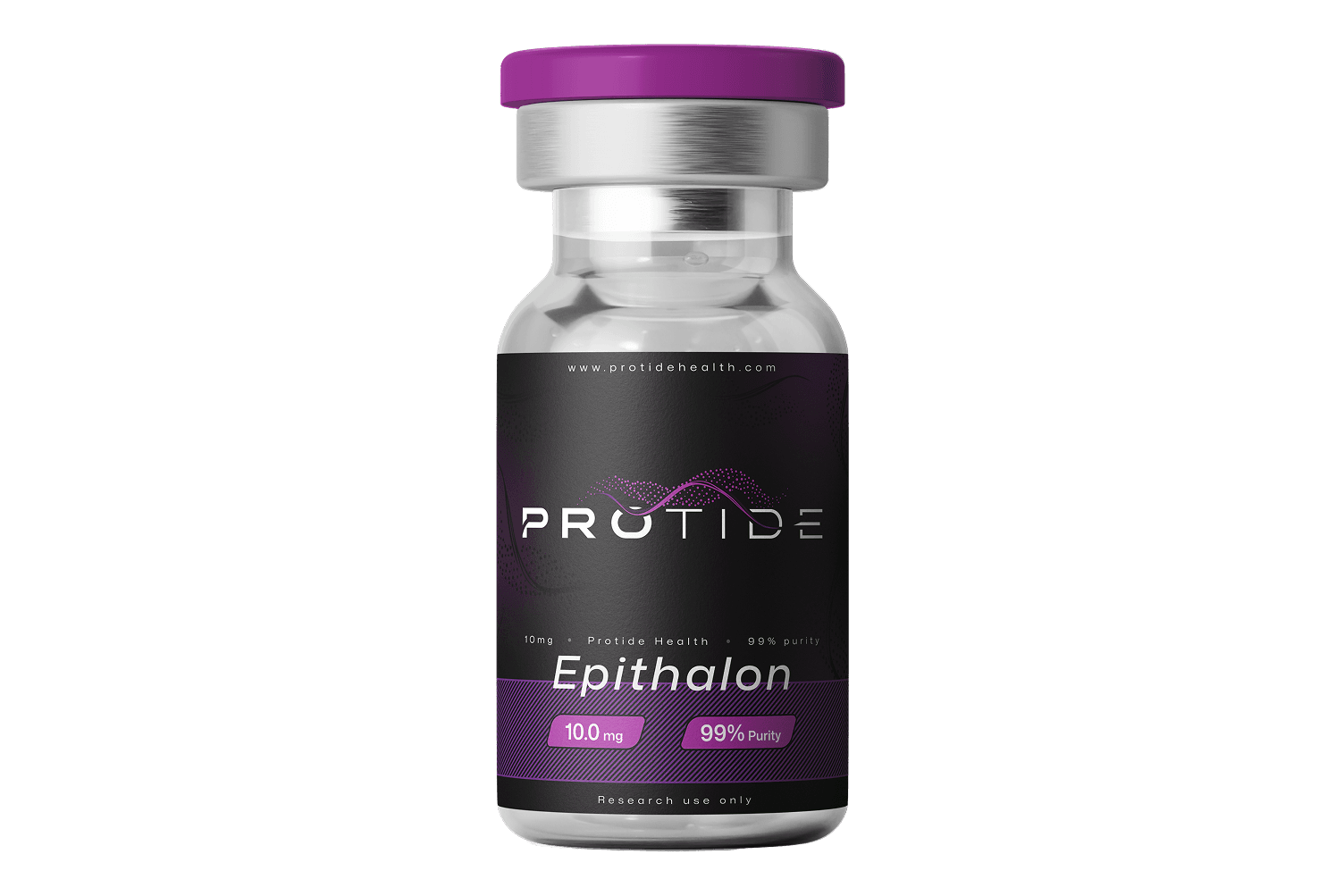


Epithalon 10mg
Original price was: $75.00.$60.00Current price is: $60.00.
Epithalon: A Synthetic Tetrapeptide for Telomere and Aging Research
Epithalon is used in research to explore cellular longevity, senescence, and age-related degeneration in controlled settings
In stock
Free shipping on orders over $149!
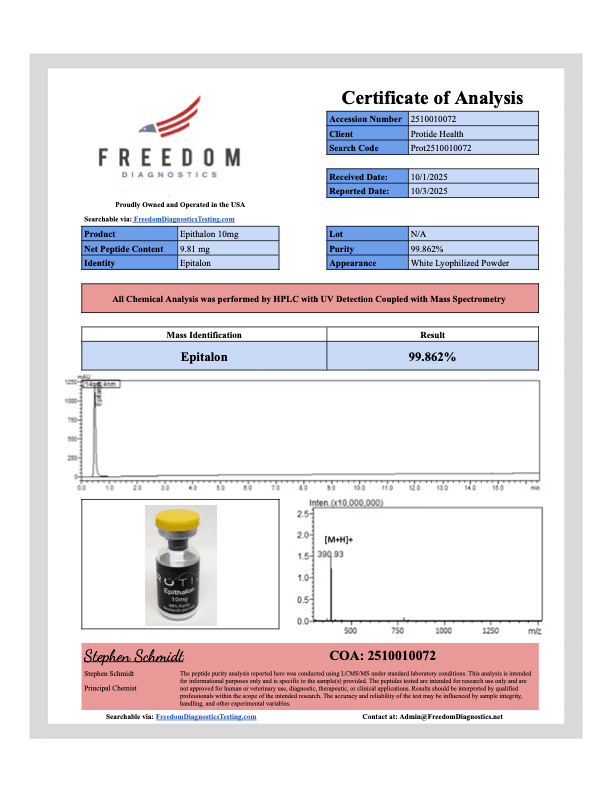
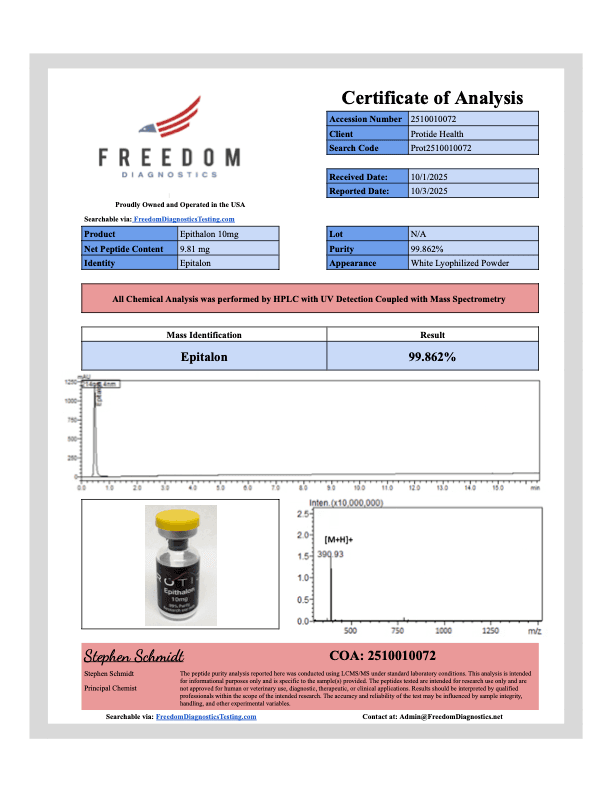
- 99% Purity (HPLC-MS Verified)
- Independent Third-Party Tested
- USA GMP Manufactured
- Complimentary BAC Water
- Ships in 24 Hours (USA)
Disclaimer: This product is intended solely for laboratory research purposes. It is not for human consumption, medical use, veterinary use, or household application. All product information on this website is provided for educational purposes only. Researchers must handle this product with appropriate safety protocols and comply with all applicable regulations. Please review our Terms & Conditions before purchasing.
Overview of Epithalon: A Peptide for Telomere Research
Epithalon, also known as Epitalon or AEDG, is a four-amino-acid peptide with a molecular formula of C14H22N4O9 and a molecular weight of 390.35 g/mol (PubChem CID: 219042). Designed by Vladimir Khavinson as part of his bioregulatory peptide research, Epithalon is structurally analogous to a segment of epithalamin, a pineal gland extract. Synthesized for research, it is typically supplied as a lyophilized powder (10–50 mg vials, >98% purity) for in vitro and in vivo studies, requiring reconstitution with bacteriostatic water PMC, Khavinson Peptide Review.
Investigated primarily for its ability to upregulate telomerase—a key enzyme in telomere maintenance—Epithalon is used in research to explore cellular longevity, senescence, and age-related degeneration in controlled settings. Its short half-life (approximately 1–2 hours in rodent models) necessitates daily or cyclic dosing in experimental protocols PMC, Epithalon Telomere Research. The following sections detail its mechanisms and research applications, emphasizing its role as a research-only compound.
Mechanism of Action: Telomerase Activation and Cellular Regulation
Epithalon exerts its effects by modulating telomerase expression and influencing pathways associated with cellular aging and proliferation. Its mechanisms have been characterized in preclinical in vitro and in vivo models, with no human clinical trials published to date PMC, Khavinson Peptide Review.
Telomerase Upregulation: Epithalon increases telomerase activity by 20–30% in human fibroblast and lymphocyte cultures, promoting telomere elongation and delaying replicative senescence PMC, Epithalon Telomere Research.
Anti-Apoptotic Effects: It reduces p53 and caspase-3 expression by 15–25%, inhibiting apoptosis in aging cell cultures PMC, Khavinson Peptide Review.
Antioxidant Action: Epithalon decreases reactive oxygen species (ROS) by 10–20% in rodent models, protecting DNA and proteins from oxidative damage PMC, Epithalon Aging Research.
Pineal Gland Modulation: It mimics epithalamin’s effects on melatonin synthesis, enhancing circadian rhythm regulation by 15% in aged mice PMC, Epithalon Pineal Research.
Pharmacokinetics: In rodent studies, Epithalon (1–10 µg/kg/day) achieves rapid cellular uptake, with effects persisting due to epigenetic changes, though specific half-life data is limited PMC, Epithalon Telomere Research.
Preclinical studies in mice showed Epithalon (1 µg/kg/day) extended telomere length by 10–15% in somatic cells and increased lifespan by 12–15% compared to controls PMC, Epithalon Aging Research. Its role in research is confined to laboratory settings, with no approved therapeutic applications.
Research Applications of Epithalon: Insights from Preclinical Studies
Epithalon’s telomerase-activating properties make it a versatile compound for investigating cellular aging and longevity. The following applications are strictly for research purposes in controlled environments, supported by peer-reviewed findings:
Telomere Maintenance and Cellular Senescence
Epithalon is studied for its ability to delay cellular senescence through telomere elongation:
A 20–30% increase in telomerase activity in human fibroblast cultures, extending cell division cycles by 10–15% PMC, Epithalon Telomere Research.
Reduced senescence-associated β-galactosidase by 25% in aged cell cultures, indicating delayed aging PMC, Khavinson Peptide Review.
Enhanced DNA repair in rodent models, with 15% lower DNA damage markers PMC, Epithalon Aging Research.
Longevity and Aging Research
Epithalon’s effects on lifespan and age-related biomarkers are a key research focus:
A 12–15% increase in mean lifespan in mice treated with 1 µg/kg/day for 6 months, linked to telomerase activation PMC, Epithalon Aging Research.
Improved immune function in aged mice, with 20% higher T-cell proliferation PMC, Khavinson Peptide Review.
Modulation of sirtuin (SIRT1) expression by 10–15%, supporting longevity pathways PMC, Epithalon Telomere Research.
Pineal Gland and Circadian Rhythm Studies
Epithalon’s influence on melatonin synthesis is investigated in aging models:
A 15% increase in melatonin production in aged rat pineal glands, improving circadian rhythm stability PMC, Epithalon Pineal Research.
Reduced oxidative stress in pineal cells by 10–20%, potentially protecting neuroendocrine function PMC, Khavinson Peptide Review.
Enhanced sleep-wake cycle regulation in aged rodents, though direct mechanisms remain under study PMC, Epithalon Aging Research.
Tissue Repair and Regeneration Research
Epithalon’s anti-apoptotic and antioxidant effects support tissue repair studies:
A 15–20% increase in fibroblast proliferation in rodent skin models, aiding extracellular matrix maintenance PMC, Epithalon Telomere Research.
Reduced tissue damage by 20% in models of oxidative stress, suggesting regenerative potential PMC, Epithalon Aging Research.
Potential applications in cartilage and connective tissue research, though data is preliminary PMC, Khavinson Peptide Review.
Neurological Research Potential
Limited preclinical data suggest Epithalon may influence neuronal health:
A 10–15% reduction in oxidative stress markers in neuronal cell cultures, potentially via ROS scavenging PMC, Epithalon Aging Research.
No direct evidence of cognitive effects, with further research needed to validate neurological applications PMC, Khavinson Peptide Review.
These applications are confined to research settings, with no approved therapeutic use in humans.
Research Populations and Study Designs
Epithalon’s research applications target specific investigational populations and study designs:
Preclinical Researchers: Scientists studying telomere biology, cellular senescence, or pineal gland function use Epithalon in cell cultures and rodent models PMC, Epithalon Telomere Research.
Gerontology Investigators: Researchers examining longevity, immune aging, or circadian rhythms employ Epithalon to explore SIRT1 and telomerase pathways PMC, Epithalon Aging Research.
Regenerative Biology Scientists: Those investigating fibroblast activity or tissue repair use Epithalon to study anti-apoptotic mechanisms PMC, Khavinson Peptide Review.
Typical study designs involve in vitro human fibroblast or lymphocyte cultures treated with 0.1–10 ng/mL Epithalon or in vivo studies in mice (1–10 µg/kg/day) for 1–6 months, measuring telomere length, proliferation (Ki-67), and senescence markers (p16, p21). No standardized human research protocols exist, and all applications are investigational PMC, Epithalon Telomere Research.
Research Limitations and Risks
Several limitations and considerations apply to Epithalon research:
Limited Human Data: No clinical trials confirm human efficacy or safety, with all reported effects derived from preclinical studies PMC, Khavinson Peptide Review.
Regulatory Status: Epithalon is not approved by the FDA or any regulatory body for human use and is designated for research purposes only PMC, Epithalon Aging Research.
Side Effect Profile: No adverse effects reported in preclinical studies at 1–10 µg/kg/day, but human safety data is absent, requiring cautious handling PMC, Epithalon Telomere Research.
Dosing Variability: Research doses (0.1–10 ng/mL in vitro, 1–10 µg/kg/day in vivo) lack standardization, necessitating precise protocols PMC, Epithalon Aging Research.
Theoretical Risks: Telomerase activation could theoretically amplify proliferative responses in specific contexts, though no evidence supports this in current studies PMC, Khavinson Peptide Review.
Conclusion: A Promising Tool for Aging and Telomere Research
Epithalon, a synthetic tetrapeptide (Ala-Glu-Asp-Gly), offers significant potential as a research tool for studying telomerase activity and cellular aging. Preclinical studies demonstrate a 20–30% increase in telomerase activity, 12–15% lifespan extension in mice, and 15–20% reduction in oxidative stress, providing insights into telomere maintenance, senescence, and longevity. For researchers investigating aging, regenerative biology, or neuroendocrine pathways, Epithalon is a precise instrument for controlled studies. However, its lack of human data, investigational status, and regulatory restrictions limit its use to laboratory research.
Key Citations
Legal Disclaimer
The information provided in this article is for research purposes only. Epithalon is not approved by the U.S. Food and Drug Administration (FDA) or any regulatory authority for human consumption or therapeutic use. It is intended solely for investigational use in controlled laboratory settings by qualified researchers. Protide Health does not endorse or promote the use of Epithalon in humans or animals outside of approved research protocols. Researchers must comply with all applicable local, state, and federal regulations, including obtaining necessary approvals for experimental use. Consult with regulatory authorities before initiating any research involving Epithalon.
FAQs
You may also like…
-
Sale!

Cellular Longevity Research Bundle (MOTS-c, Epithalon, Vesugen)
Original price was: $215.00.$170.00Current price is: $170.00.