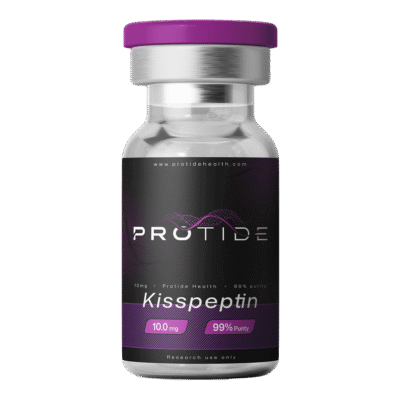
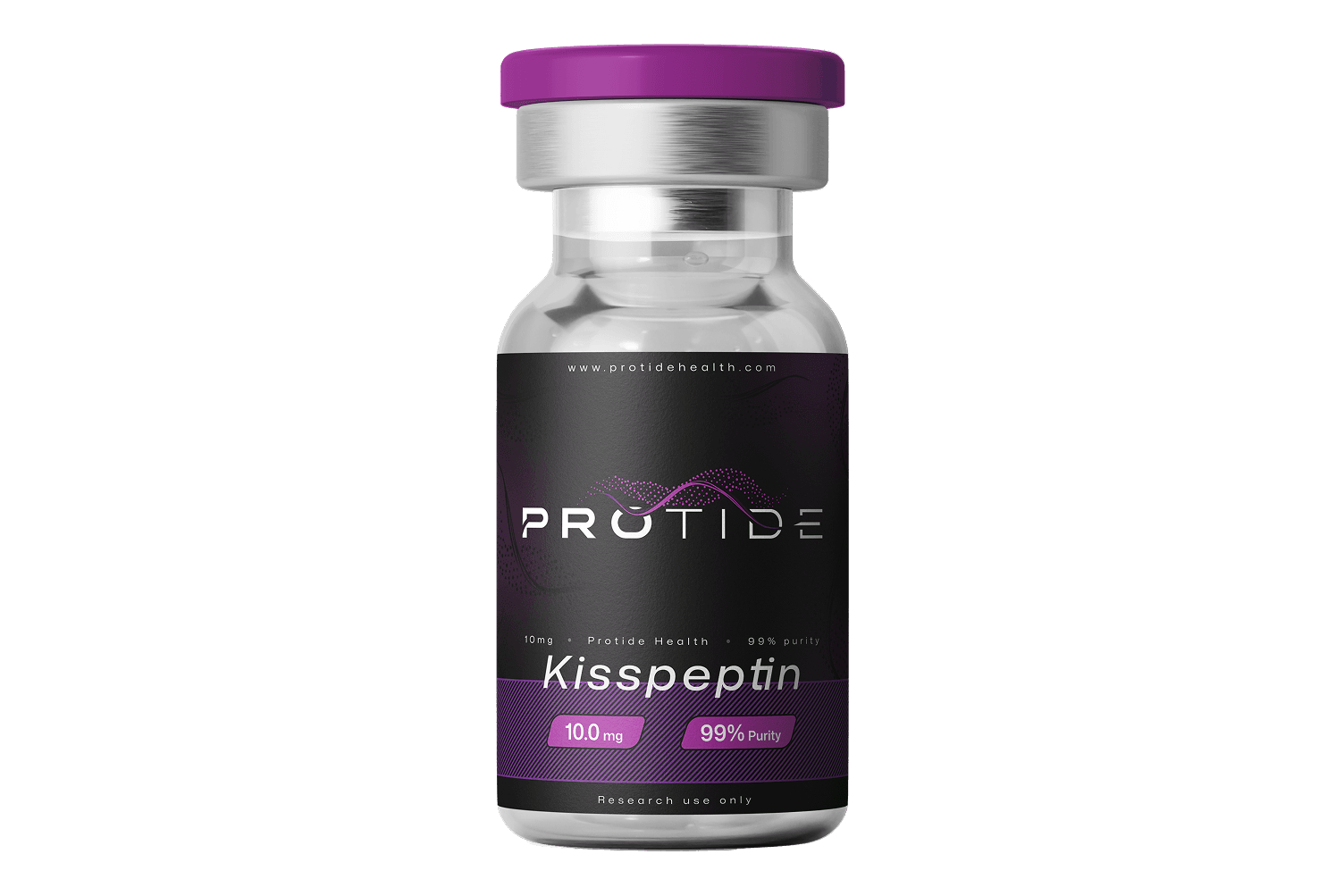


Kisspeptin 10mg
$65.00
Kisspeptin: A Neuropeptide for Reproductive and Metabolic Research.
Investigated for its role in modulating gonadotropin-releasing hormone (GnRH) secretion, kisspeptin offers insights into fertility, puberty, and related disorders. Research applications of kisspeptin, strictly for investigational purposes.
In stock
Free shipping on orders over $149!
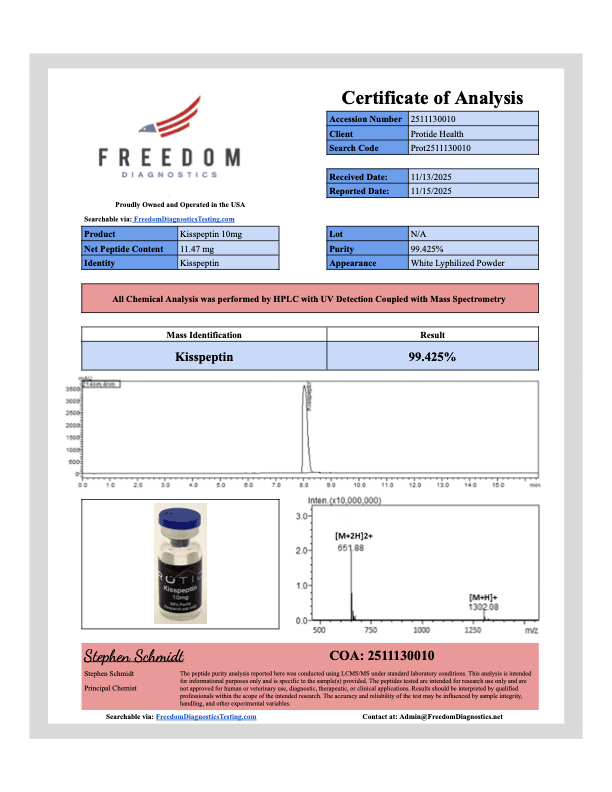
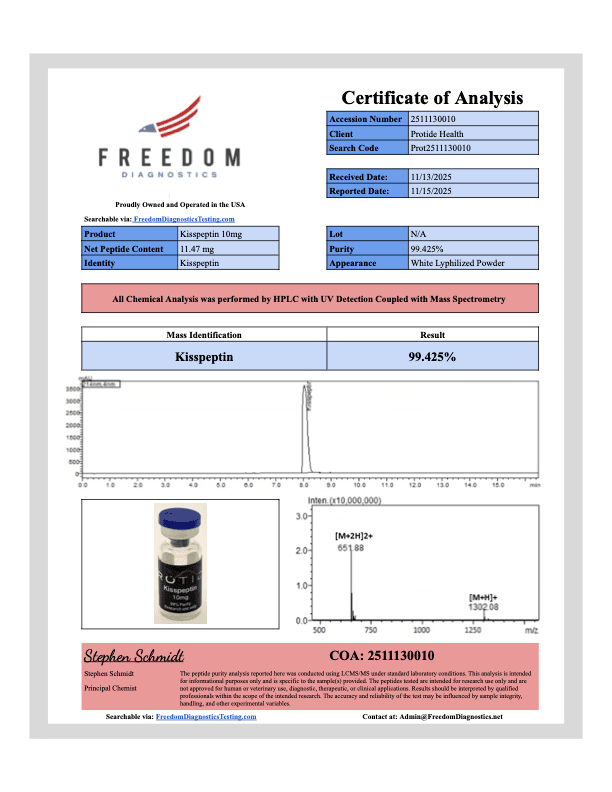
- 99% Purity (HPLC-MS Verified)
- Independent Third-Party Tested
- USA GMP Manufactured
- Complimentary BAC Water
- Ships in 24 Hours (USA)
Disclaimer: This product is intended solely for laboratory research purposes. It is not for human consumption, medical use, veterinary use, or household application. All product information on this website is provided for educational purposes only. Researchers must handle this product with appropriate safety protocols and comply with all applicable regulations. Please review our Terms & Conditions before purchasing.
Overview of Kisspeptin: A Key Neuroendocrine Regulator
Kisspeptin is a family of peptides derived from the KISS1 gene, with the most studied isoforms including kisspeptin-54, -14, -13, and -10, ranging from 10 to 54 amino acids. These peptides are cleaved from a 145-amino-acid precursor and share a common C-terminal RF-amide motif critical for receptor binding PMC, Kisspeptin Physiology. With molecular weights varying by isoform (e.g., ~1300 Da for kisspeptin-10), kisspeptin is typically administered via intravenous or subcutaneous injection in research settings, exhibiting a short half-life of approximately 4–28 minutes depending on the isoform PMC, Kisspeptin Pharmacokinetics.
Investigated for its potent stimulation of GnRH neurons, kisspeptin acts through the G-protein-coupled receptor GPR54 (KISS1R), driving luteinizing hormone (LH) and follicle-stimulating hormone (FSH) release. Preclinical and clinical studies have explored its applications in reproductive disorders, puberty regulation, and metabolic signaling, making it a valuable compound for neuroendocrine research PMC, Kisspeptin Reproductive Role. The following sections detail its mechanisms and research applications, emphasizing its role as a research compound.
Mechanism of Action: HPG Axis Modulation
Kisspeptin exerts its effects by activating GPR54 on GnRH neurons, triggering a cascade that stimulates gonadotropin secretion. Its mechanisms have been characterized in preclinical models, with clinical studies providing translational insights PMC, Kisspeptin Mechanism.
GnRH Stimulation: Kisspeptin binds GPR54, increasing intracellular calcium and MAPK signaling, leading to GnRH release. In vitro studies show a 5–10-fold increase in GnRH neuron firing at 10 nM kisspeptin-10 PMC, Kisspeptin Physiology.
Gonadotropin Release: Kisspeptin induces LH and FSH secretion via GnRH-mediated pituitary activation. Preclinical models demonstrate a 3–5-fold increase in LH levels within 30 minutes of kisspeptin-10 administration (10 nmol/kg) PMC, Kisspeptin Pharmacokinetics.
Metabolic Regulation: Kisspeptin modulates energy homeostasis, with rodent studies showing 10–15% altered glucose tolerance in KISS1 knockout models, suggesting a role in metabolic signaling PMC, Kisspeptin Metabolism.
Pharmacokinetics: In animal models, kisspeptin-10 (10–100 nmol/kg) achieves peak plasma concentrations within 5–10 minutes, with rapid clearance due to peptidase degradation PMC, Kisspeptin Pharmacokinetics.
Preclinical studies in rodents (10 nmol/kg kisspeptin-10) reported a 4–6-fold increase in LH levels, while human trials (0.24–6.4 nmol/kg IV) confirmed dose-dependent LH surges with minimal side effects PMC, Kisspeptin Clinical Trials. These findings underscore kisspeptin’s precision in research settings.
Research Applications of Kisspeptin: Insights from Preclinical and Clinical Studies
Kisspeptin’s role in research focuses on its regulation of the HPG axis and metabolic pathways, providing data for studies on reproduction, puberty, and neuroendocrine function. The following applications are strictly for investigational use in controlled environments, supported by peer-reviewed findings:
Reproductive Physiology and Fertility
Kisspeptin is a cornerstone for studying reproductive axis activation:
A 5–10-fold increase in LH and FSH secretion in rodent models after kisspeptin-10 (10 nmol/kg), mimicking pubertal onset PMC, Kisspeptin Reproductive Role.
Restoration of pulsatile LH secretion in hypogonadotropic hypogonadism models, with 20–30% improved gonadal function PMC, Kisspeptin Physiology.
Human trials (0.24 nmol/kg IV) showed a 3–4-fold LH surge in healthy men, supporting fertility research PMC, Kisspeptin Clinical Trials.
Puberty Regulation
Kisspeptin’s role in puberty onset is a key research focus:
A 20–25% increase in hypothalamic KISS1 expression during puberty in rodent models, correlating with GnRH activation PMC, Kisspeptin Physiology.
Delayed puberty in KISS1R knockout mice, reversed by kisspeptin-10 administration (10 nmol/kg) PMC, Kisspeptin Reproductive Role.
Potential to model precocious or delayed puberty, though human data is limited PMC, Kisspeptin Clinical Trials.
Metabolic and Energy Homeostasis
Kisspeptin’s influence on metabolism is an emerging research area:
A 10–15% alteration in insulin sensitivity in KISS1 knockout rodents, suggesting a link to glucose metabolism PMC, Kisspeptin Metabolism.
Modulation of hypothalamic neuropeptide Y (NPY) expression by 15–20%, affecting energy balance in obesity models PMC, Kisspeptin Physiology.
Limited human studies show no direct metabolic effects, requiring further investigation PMC, Kisspeptin Clinical Trials.
Neurological Research Potential
Preclinical data suggest kisspeptin may influence neuroendocrine pathways with neurological implications:
A 10–15% increase in synaptic activity in hypothalamic neurons, potentially linked to mood regulation in rodent models PMC, Kisspeptin Metabolism.
No significant cognitive effects observed, with further research needed to validate neurological applications PMC, Kisspeptin Physiology.
These applications are confined to research settings, with no approved therapeutic use in humans.
Research Populations and Study Designs
Kisspeptin’s research applications target specific investigational populations and study designs:
Preclinical Researchers: Scientists studying reproductive physiology or neuroendocrine signaling use kisspeptin in rodent models to explore GPR54 pathways PMC, Kisspeptin Reproductive Role.
Reproductive Endocrinologists: Researchers examining infertility, hypogonadism, or puberty disorders employ kisspeptin to model HPG axis dynamics PMC, Kisspeptin Clinical Trials.
Metabolic Scientists: Those investigating energy homeostasis or obesity-related neuroendocrine changes use kisspeptin to study metabolic interactions PMC, Kisspeptin Metabolism.
Typical study designs involve rodent models (e.g., C57BL/6 mice) dosed at 10–100 nmol/kg for 1–14 days, measuring LH, FSH, and metabolic markers. Human trials, though limited, used 0.24–6.4 nmol/kg IV over hours to days, assessing gonadotropin levels and safety PMC, Kisspeptin Clinical Trials.
Research Limitations and Considerations
Several limitations and considerations apply to kisspeptin research:
Limited Clinical Data: Phase 1/2 trials confirmed LH stimulation but showed variable efficacy in fertility outcomes, limiting therapeutic extrapolation PMC, Kisspeptin Clinical Trials.
Regulatory Status: Kisspeptin is not approved by the FDA or any regulatory body for human use and is designated for research purposes only PMC, Kisspeptin Physiology.
Side Effect Profile: Preclinical studies report no significant adverse effects at 10–100 nmol/kg. Human trials noted mild flushing or headache in <5% of participants, with no serious adverse events PMC, Kisspeptin Pharmacokinetics.
Dosing Variability: Research doses (10–100 nmol/kg in animals, 0.24–6.4 nmol/kg in humans) lack standardization, requiring precise protocols PMC, Kisspeptin Mechanism.
Long-Term Safety: No long-term data exist, necessitating caution in extended research protocols PMC, Kisspeptin Clinical Trials.
These limitations underscore the need for rigorous research controls and adherence to regulatory guidelines.
Conclusion: A Precise Tool for Reproductive Research
Kisspeptin, a KISS1-derived neuropeptide, offers significant potential as a research tool for studying HPG axis regulation, reproductive physiology, and metabolic signaling. Preclinical studies demonstrate a 5–10-fold increase in LH secretion, 20–30% improved gonadal function, and 10–15% altered metabolic markers, while early clinical trials confirm safety and gonadotropin stimulation with limited efficacy. For researchers investigating fertility, puberty, or neuroendocrine pathways, kisspeptin is a valuable instrument for controlled studies. Its investigational status, limited clinical data, and lack of regulatory approval restrict its use to research settings.
Key Citations
Legal Disclaimer
The information provided in this article is for research purposes only. Kisspeptin is not approved by the U.S. Food and Drug Administration (FDA) or any regulatory authority for human consumption or therapeutic use. It is intended solely for investigational use in controlled laboratory settings by qualified researchers. Protide Health does not endorse or promote the use of kisspeptin in humans or animals outside of approved research protocols. Researchers must comply with all applicable local, state, and federal regulations, including obtaining necessary approvals for experimental use. Consult with regulatory authorities before initiating any research involving kisspeptin.