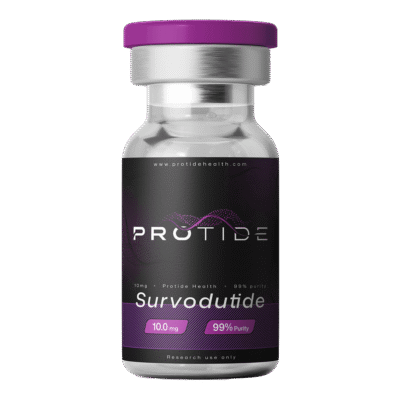
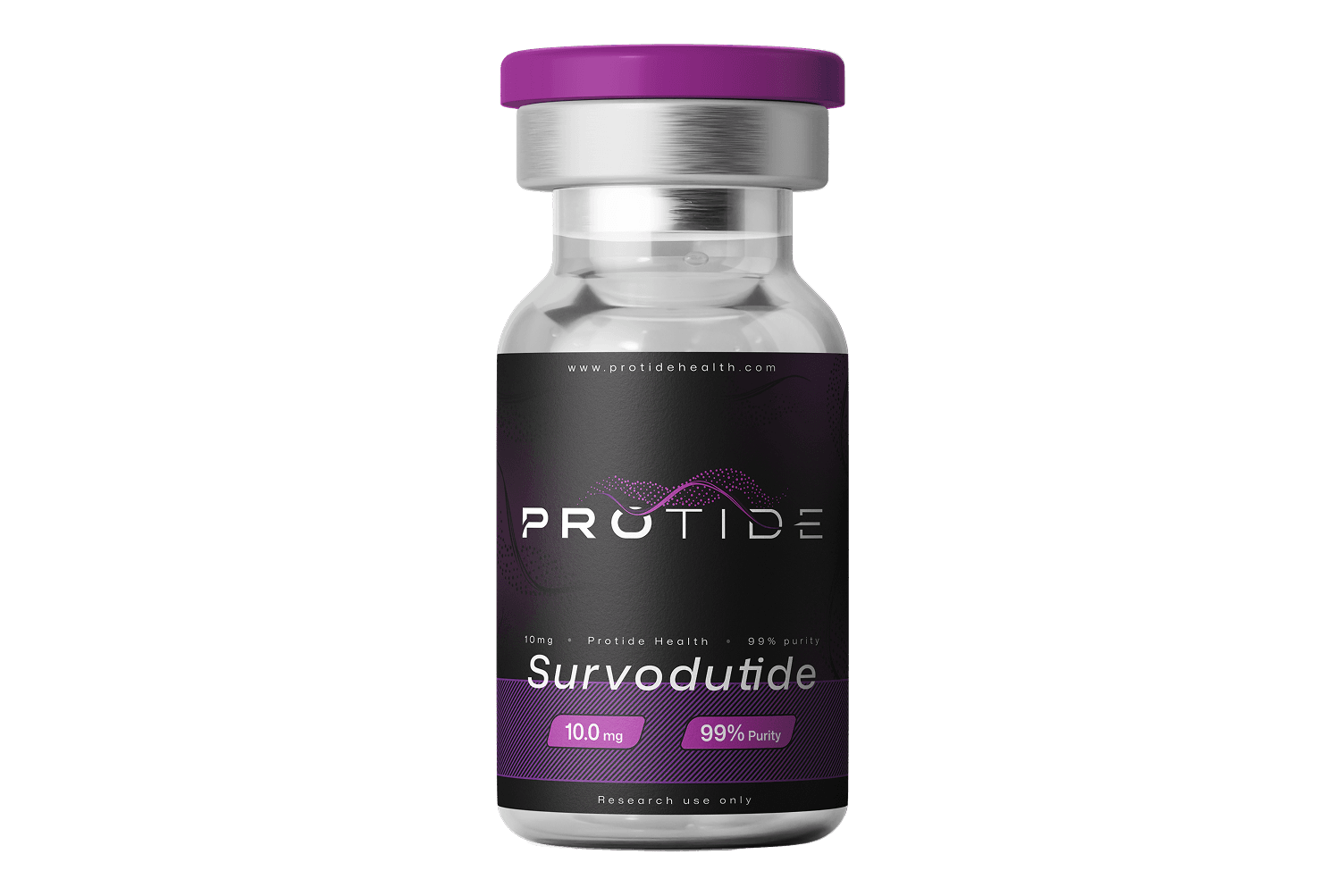
Survodutide 10mg
$110.00
In stock
Free shipping on orders over $149!
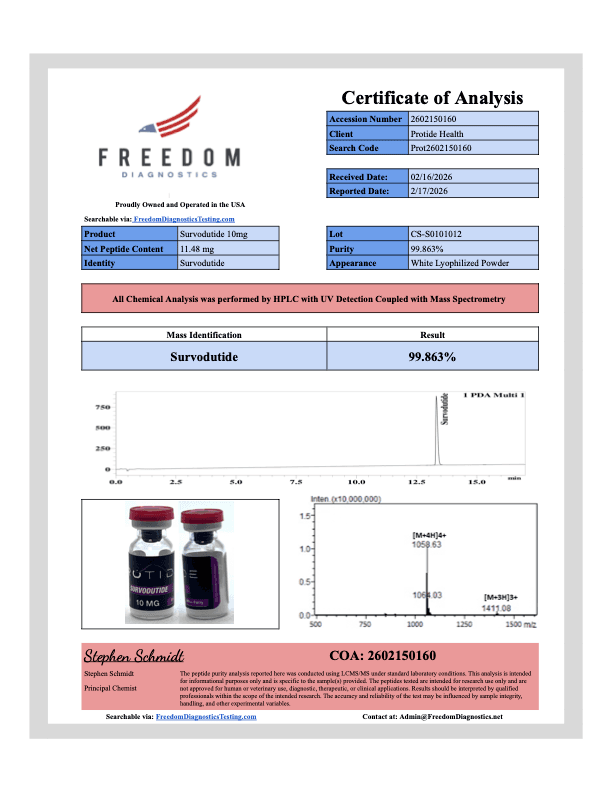
- 99% Purity (HPLC-MS Verified)
- Independent Third-Party Tested
- USA GMP Manufactured
- Complimentary BAC Water
- Ships in 24 Hours (USA)
Disclaimer: This product is intended solely for laboratory research purposes. It is not for human consumption, medical use, veterinary use, or household application. All product information on this website is provided for educational purposes only. Researchers must handle this product with appropriate safety protocols and comply with all applicable regulations. Please review our Terms & Conditions before purchasing.
Survodutide Peptide Research Guide
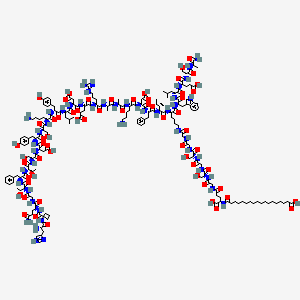
Survodutide peptide is a synthetic 29-amino-acid compound designed for laboratory investigation. It functions as a dual receptor agonist, targeting both the glucagon receptor (GCGR) and the glucagon-like peptide-1 receptor (GLP-1R). Researchers investigate this molecule to understand its signaling pathways in metabolic and cellular models.
Survodutide Overview and Properties
Laboratory investigation of Survodutide (BI 456906) focuses on its modified glucagon sequence. Scientists evaluate its structural stability and binding affinity in preclinical models. Researchers examine these mechanisms across various peptide categories to understand receptor interactions.
Studies investigate:
Energy expenditure pathways (calorie burning mechanisms)
Receptor binding longevity via an attached C18 diacid chain (PubMed)
Structural differences from naturally occurring oxyntomodulin (PubMed)
Human evidence remains limited, and the compound holds no regulatory approval.
Mechanism of Action in Animal Studies
In vitro studies examine how Survodutide peptide interacts with specific cellular receptors. The dual agonist design allows researchers to measure concurrent signaling cascades.
The GLP-1 receptor is observed in pancreatic, neural, and gastric tissue models. Laboratory investigation tracks how activation of this pathway influences gastric emptying rates and insulin secretion markers (PubMed).
The glucagon receptor is primarily evaluated in hepatic (liver) and adipose (fat) tissue models. Preclinical models measure how GCGR activation initiates lipid metabolism pathways and energy expenditure metrics (PubMed).
Primary Areas of Survodutide Research
Current literature documents Survodutide evaluation across several scientific domains. Studies measure specific physiological markers rather than clinical outcomes.
Body Composition Models
Animal studies assess the compound in diet-induced obese (DIO) murine (mouse) models. Researchers measure food intake suppression alongside energy expenditure metrics (PubMed). Additional data emerges from isolated controlled human trials observing body mass markers, though human evidence is limited (PubMed).
Glycemic Regulation Studies
Laboratory investigation explores how dual agonism affects blood glucose markers. Preclinical models evaluate HbA1c levels and insulin sensitivity metrics over set observation periods (PubMed). Meta-analyses of these controlled trials catalog these metabolic shifts (PubMed). Review our peptide guides for more information on these biological pathways.
Hepatic Function Pathways
A significant portion of survodutide research examines metabolic dysfunction-associated steatohepatitis (MASH) models. Studies measure lipid accumulation and fibrosis (scarring) markers in hepatic tissues (PubMed). Scientists evaluate how GCGR signaling influences lipid processing at the cellular level (PubMed).
Survodutide Peptide Specifications
Reference the table below for standard handling and identification parameters. All materials are restricted to laboratory environments. Visit our shop for research materials.
| Parameter | Details |
|---|---|
| Peptide Name | Survodutide peptide |
| Structure | Single synthetic peptide |
| Format | 10mg lyophilized (freeze-dried) powder |
| Storage | Cool, dry, dark environment per lab SOPs |
| Intended Use | Research purposes only |
What pathways does Survodutide target?
Survodutide acts upon the glucagon receptor (GCGR) and the glucagon-like peptide-1 receptor (GLP-1R). Animal studies measure the resulting shifts in metabolic and hepatic (liver) signaling.
How is the compound stored in laboratories?
Facilities store the lyophilized (freeze-dried) powder in climate-controlled, dark environments. Following reconstitution, standard procedures require aliquoting (dividing) and freezing to maintain molecular stability. Contact us via our contact page for handling inquiries.
How does it differ from natural oxyntomodulin?
While inspired by endogenous (naturally occurring) oxyntomodulin, this synthetic molecule possesses distinct modifications.
Research examines:
Increased binding affinity at both receptor sites
Extended half-life via fatty acid chain addition
Resistance to rapid enzymatic degradation
Where can researchers find this compound?
Investigators can procure high-purity materials directly from our online catalog. Navigate to the main Protide Health homepage to explore available research molecules.
Survodutide Peptide Summary
Survodutide peptide remains a prominent subject in contemporary metabolic research. The compound allows scientists to observe simultaneous GLP-1 and glucagon receptor activation.
References
Zimmermann T et al., 2022. BI 456906: Discovery and preclinical pharmacology of a novel GCGR/GLP-1R dual agonist with robust anti-obesity efficacy. Molecular Metabolism. PubMed
Bossart M et al., 2023. Perspectives in weight control in diabetes — Survodutide. Diabetes Research and Clinical Practice. PubMed
Thomas M et al., 2024. The dual GCGR/GLP-1R agonist survodutide: Biomarkers and pharmacological profiling for clinical candidate selection. Diabetes, Obesity and Metabolism. PubMed
le Roux CW et al., 2024. Glucagon and GLP-1 receptor dual agonist survodutide for obesity: a randomised, double-blind, placebo-controlled, dose-finding phase 2 trial. The Lancet Diabetes & Endocrinology. PubMed
Blüher M et al., 2024. Dose-response effects on HbA1c and bodyweight reduction of survodutide compared with placebo in type 2 diabetes. Diabetologia. PubMed
Sanyal AJ et al., 2024. A phase 2 randomized trial of survodutide in MASH and fibrosis. New England Journal of Medicine. PubMed
Wharton S et al., 2025. Survodutide for treatment of obesity: rationale and design of SYNCHRONIZE-1 and -2. Obesity. PubMed
Wan H et al., 2024. Effect of survodutide on weight loss: a meta-analysis of randomized controlled trials. Diabetology & Metabolic Syndrome. PubMed
Legal Disclaimer for Survodutide Peptide
The information provided in this description is for research purposes only. The Survodutide peptide is not approved by the U.S. Food and Drug Administration (FDA) or any regulatory authority for human consumption or therapeutic use. It is intended solely for investigational use in controlled laboratory settings by qualified researchers. Protide Health does not endorse or promote the use of Survodutide peptide in humans or animals outside of approved research protocols. Researchers must comply with all applicable local, state, and federal regulations, including obtaining necessary approvals for experimental use. Consult with regulatory authorities before initiating any research involving Survodutide peptide.
Products sold by Protide Health are for laboratory research purposes only and are not intended for human consumption, medical use, or veterinary use.