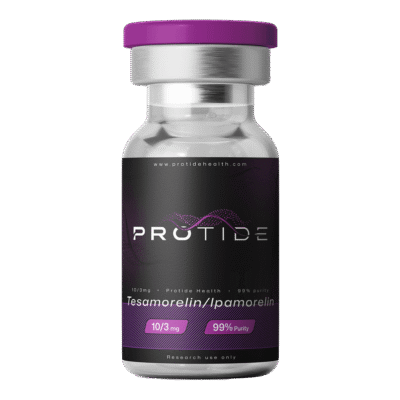
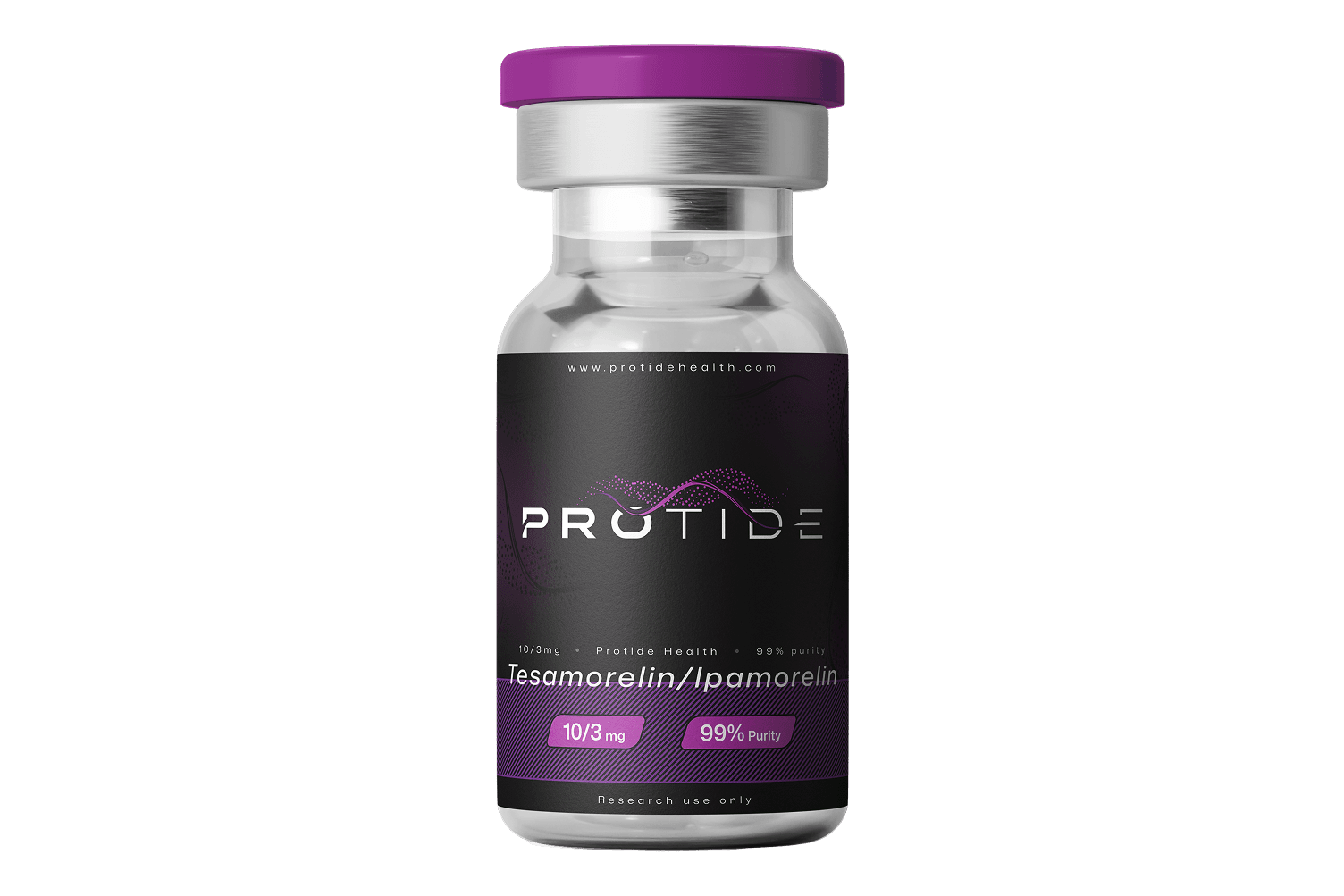
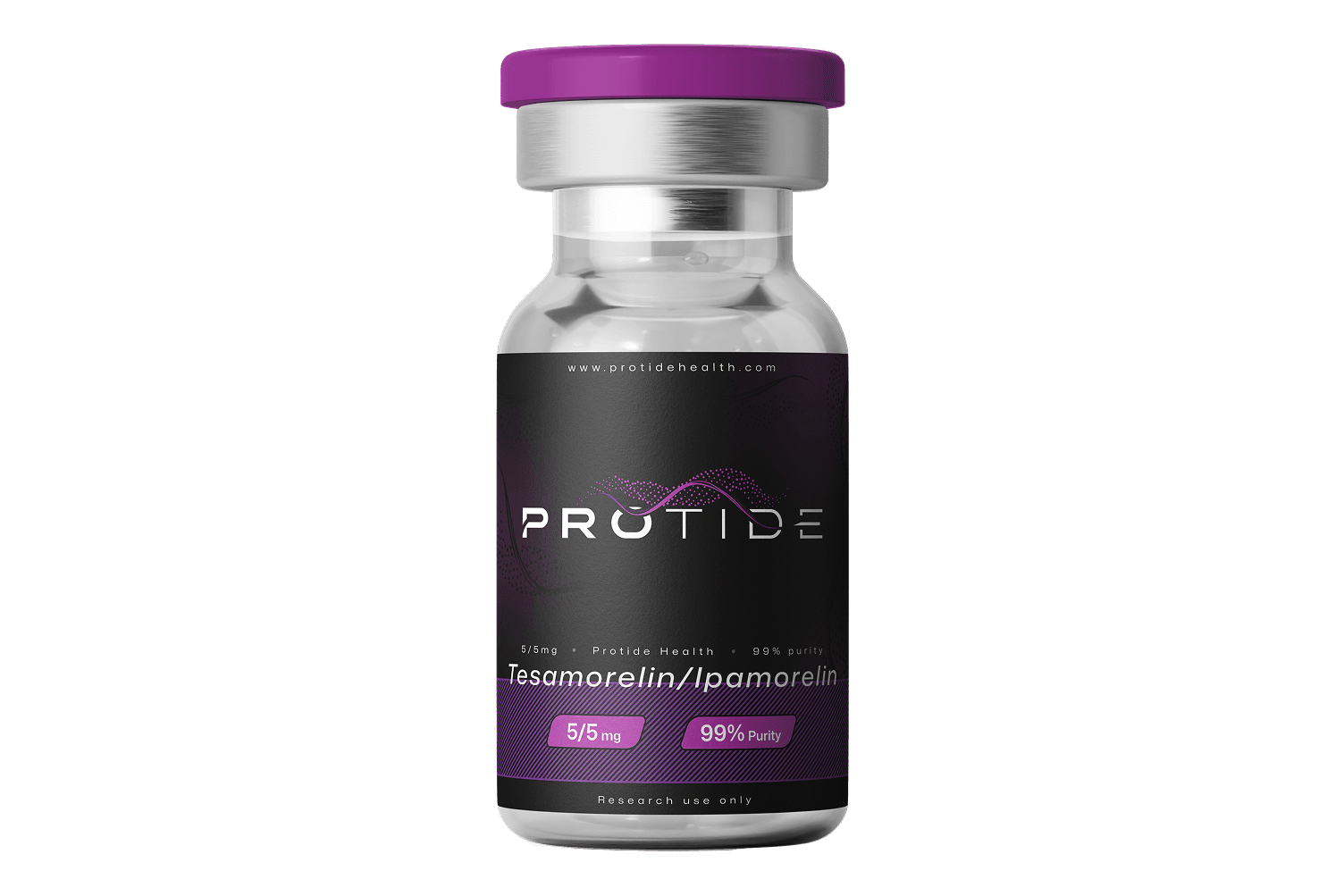


Tesamorelin & Ipamorelin Blend
Price range: $110.00 through $140.00
Tesamorelin / Ipamorelin dual-pathway blend (GHRH analog + GHSR-1a agonist) investigated in preclinical neuroendocrine synergy, adipose tissue metabolism, and GH pulsatility models. Available in 10/3mg and 5/5mg lyophilized vials. Third-party HPLC-verified >99% purity. For research use only.
Free shipping on orders over $149!
- 99% Purity (HPLC-MS Verified)
- Independent Third-Party Tested
- USA GMP Manufactured
- Complimentary BAC Water
- Ships in 24 Hours (USA)
Disclaimer: This product is intended solely for laboratory research purposes. It is not for human consumption, medical use, veterinary use, or household application. All product information on this website is provided for educational purposes only. Researchers must handle this product with appropriate safety protocols and comply with all applicable regulations. Please review our Terms & Conditions before purchasing.
Tesamorelin / Ipamorelin Blend (Dual-Pathway GH Secretagogue)
The Tesamorelin and Ipamorelin Blend is a sophisticated, multi-peptide formulation engineered for advanced preclinical studies of the central endocrine system. Often referred to in laboratory shorthand as a tesa ipa blend, this investigational compound pairs a stabilized growth hormone-releasing hormone (GHRH) analog with a highly selective ghrelin receptor (GHSR-1a) agonist. This allows researchers to interrogate two complementary pituitary pathways that regulate pulsatile growth hormone (GH) release.
For investigators looking to buy tesamorelin & ipamorelin blend formulations for their laboratory, Protide Health supplies this stable, lyophilized powder in two distinct synergistic ratios to accommodate varied experimental protocols. Unlike a broader tripartite tesamorelin & mod grf & ipamorelin blend, this specific dual-agonist formulation provides a highly targeted, two-pathway approach for complex metabolic and cellular modeling.
Peptide Type: GHRH Analog & Selective GHSR-1a Agonist Blend
Vial Content: Tesamorelin / Ipamorelin Blend – 10mg/3mg OR 5mg/5mg
Form: Lyophilized (Freeze-Dried) for maximum biochemical stability
Tesamorelin & Ipamorelin: Technical Overview & Synergy
This tesamorelin ipamorelin blend is synthesized to investigate the synergistic signaling properties of specific neuroendocrine receptors. Research indicates that co-administration of a GHRH analog with a GH secretagogue results in a convergent release of GH that is significantly greater than the sum of either peptide administered alone.
Tesamorelin: A 44-amino-acid peptide modified at the N-terminus to resist enzymatic degradation. It selectively activates GHRH receptors on pituitary somatotrophs, stimulating adenylate cyclase and increasing cAMP levels.
Ipamorelin: A highly selective pentapeptide that binds the GHSR-1a (ghrelin) receptor. It mobilizes intracellular calcium and activates PKC signaling pathways, demonstrating strong targeted action with minimal off-target activation of ACTH or cortisol in laboratory models.
Core Research Properties:
Molecular Stability: Dual-lyophilization ensures the structural integrity of both distinct peptide chains during transit and storage.
Handling: Intended for precise laboratory reconstitution.
Primary Models: Dual-pathway endocrine physiology, adipose tissue metabolism assays, and myogenic cellular regeneration.
Mechanism of Action: Convergent Pituitary Signaling
In in vitro and animal models, the tesa ipa combination engages both the GHRH and ghrelin pathways simultaneously. The convergent signaling of cAMP/PKA (via Tesamorelin) and Gq/PLC/Ca²⁺ (via Ipamorelin) effectively lowers the GH-release threshold while augmenting the amplitude of the pulse. By boosting pulsatile GH, this dual-pathway activation elevates downstream hepatic insulin-like growth factor-1 (IGF-1). Researchers track this signaling cascade to observe shifts in lipid flux (favoring cellular lipolysis) and glucose-lipid handling within isolated experimental environments.
Advanced Research Applications for the Dual-Peptide Blend
1. Adipose Tissue Metabolism & Lipid Flux
The tesamorelin & ipamorelin blend provides a primary tool for studying the biochemistry of ectopic fat and visceral adiposity. Laboratory research focuses on how synergistic GH/IGF-1 signaling modulates hormone-sensitive lipase (HSL) activation, tracking reductions in lipid accumulation within hepatic and adipose tissue cultures.
2. Musculoskeletal Cellular Assays
Researchers utilize this dual-agonist blend to investigate tissue repair and structural regeneration. Preclinical models examine the upregulation of myogenic markers (such as MyoD) and collagen turnover, observing how the combination supports lean tissue proxies and cellular resilience without driving excessive cortisol responses.
3. Neuroendocrine Synergy & GH Pulsatility
This formulation serves as an elite model for studying GH axis dynamics. Investigators map GH deconvolution (pulse amplitude and frequency) in animal models to understand how receptor complementarity (GHRH-R + GHSR-1a) mimics or enhances natural neuroendocrine rhythms.
Specifications Table: Tesamorelin / Ipamorelin Blend
| Parameter | Technical Details |
|---|---|
| Product Name | Tesamorelin & Ipamorelin Blend |
| Components | Tesamorelin (GHRH Analog), Ipamorelin (GHSR-1a Agonist) |
| Available Ratios | Tesamorelin 10mg Ipamorelin 3mg OR 5mg/5mg (Active Peptide) |
| Purity Grade | 99%+ (Verified via HPLC/MS) |
| Solubility | Reconstitute with Bacteriostatic Water |
| Storage Temperature | -20°C (Frozen) |
| Intended Use | Laboratory Research Only |
Where can I find the Tesamorelin & Ipamorelin blend for sale?
Qualified researchers looking for a highly purified tesamorelin ipamorelin blend for sale can purchase both the 10/3mg and 5/5mg lyophilized vials directly through Protide Health. Every batch undergoes strict third-party testing to ensure >99% purity via HPLC verification.
What is the shipping policy for this ipamorelin blend?
Protide Health ensures rapid logistics for research facilities. Every ipamorelin blend order includes complimentary bacteriostatic water, and shipping occurs within 24 business hours. Orders over $149 qualify for free expedited US shipping.
Why combine Tesamorelin and Ipamorelin for research?
In isolated laboratory models, utilizing a GHRH analog alongside a ghrelin receptor agonist engages complementary signaling pathways. This synergy potentiates GH amplitude and AUC (Area Under the Curve) more effectively than investigating either peptide in isolation.
What is the difference between the 10/3mg and 5/5mg variants?
The tesamorelin / ipamorelin blend – 10mg/3mg is heavily weighted toward GHRH receptor activation, making it ideal for studies prioritizing sustained cAMP signaling. The 5/5mg ratio offers a balanced dual-pathway activation model. Researchers select the ratio that best aligns with their specific pharmacokinetic study designs.
Conclusion: Summary for Researchers
The Tesamorelin / Ipamorelin Blend represents a highly targeted, complementary research tool for exploring complex growth hormone regulation. By integrating well-documented GHRH receptor activation with selective ghrelin receptor agonism, it provides a multifaceted platform for exploring the intersection of lipid metabolism, tissue regeneration, and neuroendocrine signaling. Available exclusively for laboratory use in 10/3mg and 5/5mg variants, this blend is a vital asset for advancing preclinical discovery.
Citations
Bowers CY, 1998. GH-releasing peptides and synergy with GHRH. Annals of Endocrinology.
Raun K et al., 1998. Ipamorelin, the first selective GH secretagogue. Journal of Endocrinology.
Casanueva FF et al., 2008. GHRH interacts with GHS-R1a signaling and endocytosis. Proceedings of the National Academy of Sciences.
Stanley TL et al., 2019. Metabolic effects of Tesamorelin in preclinical and clinical models. Journal of Clinical Endocrinology & Metabolism.
Legal Disclaimer
The Tesamorelin and Ipamorelin Blend is intended for laboratory research purposes only. It is not approved by the FDA for human consumption, medical use, or self-administration. All research must be conducted by qualified professionals within a controlled environment. Researchers must comply with all applicable local, state, and federal regulations, including obtaining necessary approvals for experimental use. Products sold by Protide Health are for laboratory research purposes only and are not intended for human consumption, medical use, or veterinary use.
| Select vial strength: | 10/3mg, 5/5mg |
|---|
FAQs
You may also like…
-

GLP-3
Price range: $140.00 through $330.00Select options This product has multiple variants. The options may be chosen on the product page -
Sale!
BPC-157
Price range: $60.00 through $220.00Select options This product has multiple variants. The options may be chosen on the product page