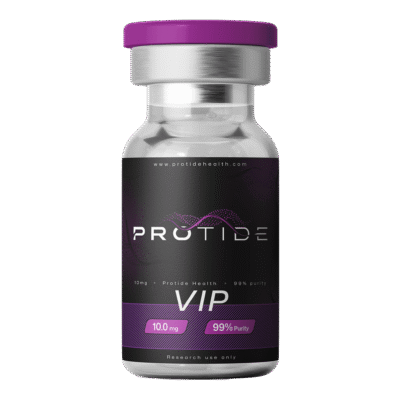
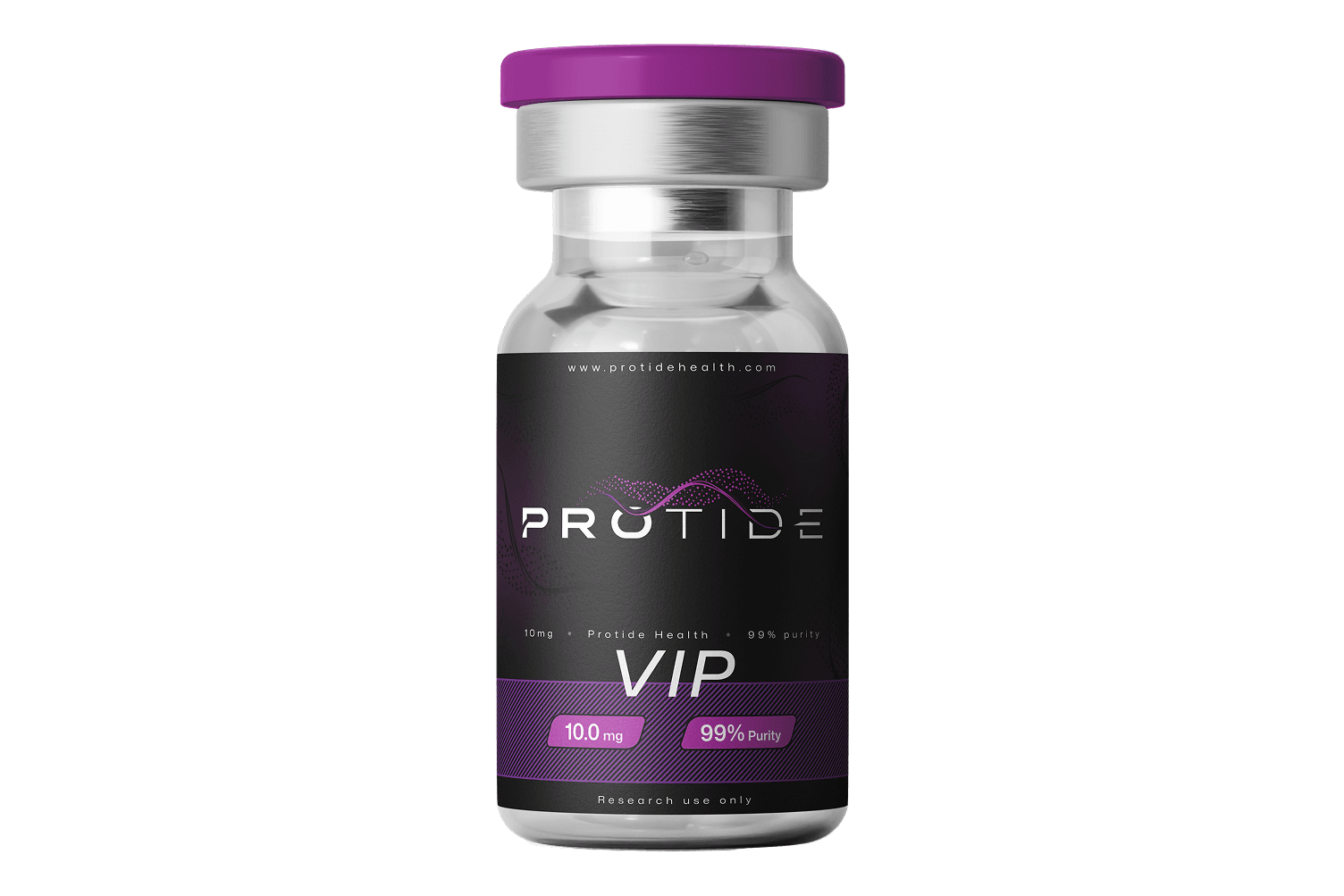


VIP 10mg
$75.00
In stock
Free shipping on orders over $149!
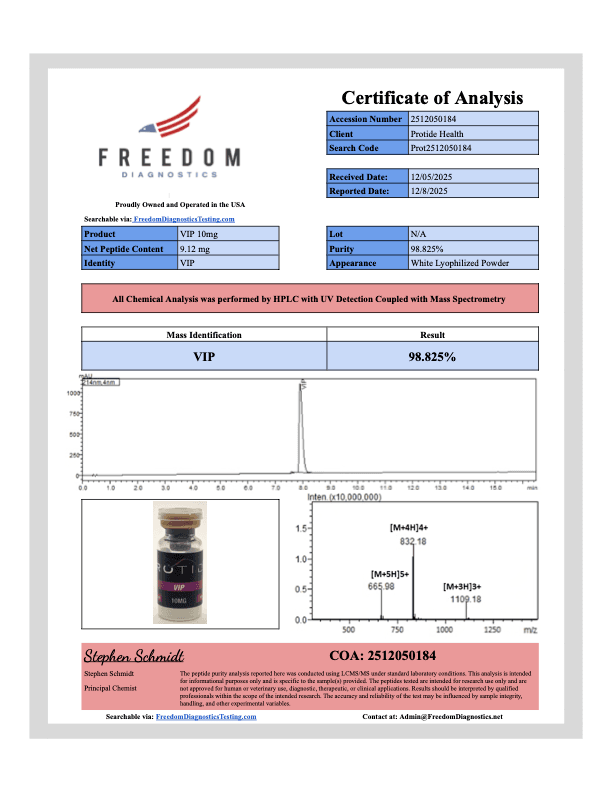
- 99% Purity (HPLC-MS Verified)
- Independent Third-Party Tested
- USA GMP Manufactured
- Complimentary BAC Water
- Ships in 24 Hours (USA)
Disclaimer: This product is intended solely for laboratory research purposes. It is not for human consumption, medical use, veterinary use, or household application. All product information on this website is provided for educational purposes only. Researchers must handle this product with appropriate safety protocols and comply with all applicable regulations. Please review our Terms & Conditions before purchasing.
What is VIP?
VIP is a naturally occurring neuropeptide (short protein) best known as vasoactive intestinal peptide, studied for its roles in blood vessels, nerves, and immune signaling. VIP peptide 10 mg per vial is supplied as a high-purity research peptide for controlled lab use, typically reconstituted and used in preclinical models that explore vascular tone, immune balance, and brain health pathways.(PMC)
In biology, VIP peptide has been investigated as a signaling messenger that helps relax smooth muscle, widen blood vessels, and modulate immune cell activity in cell and animal models.(PMC) Researchers often include VIP 10 mg per vial alongside other research peptides to map complex neurovascular and immune networks, not for human consumption.
- Peptide type: Single peptide; endogenous neuropeptide analog studied for vascular, immune, and neurobiology models.
- Vial content: 10 mg per vial, supplied as lyophilized (freeze-dried) powder.
- Primary research focus: Vascular tone and smooth muscle models; immune and neuroinflammation models; neuroprotection and brain signaling models.
VIP Peptide Overview & Key Properties
VIP peptide is a synthetic version of a naturally occurring 28-amino-acid peptide from the glucagon family. It is widely expressed in the gut, brain, lungs, and immune system, where it functions as a signaling molecule in many preclinical studies.(PMC)
Structurally, VIP peptide acts through class B G-protein–coupled receptors called VPAC1 and VPAC2, which are found on many cell types, including vascular smooth muscle cells and immune cells.(PMC) In research settings, VIP peptide 10 mg per vial is supplied as a lyophilized powder and is typically stored cold, dry, and protected from light according to standard lab SOPs for research peptides.
- Peptide class or family: Endogenous neuropeptide in the glucagon/secretin family, studied for vasodilation (widening blood vessels), smooth muscle relaxation, and immune modulation.(PMC)
- Vial content and typical lab handling: 10 mg lyophilized powder per vial; labs usually reconstitute with bacteriostatic water or buffer and handle under sterile conditions.
- Suggested storage concept in lab settings: Keep sealed vials cool, dry, and away from light; follow institutional SOPs for temperature control and stability.
- Common research models: In vitro cell culture, ex vivo vessel and tissue baths, small-animal vascular models, immune cell assays, and neurodegeneration models.(PMC)
VIP Mechanism of Action
VIP Mechanism of Action
VIP peptide mainly signals by binding to VPAC1 and VPAC2 receptors on the cell surface. These receptors activate intracellular messengers like cyclic AMP (cAMP), which in turn switch on protein kinase A (PKA) and related pathways that control how cells relax, contract, move, and release signaling molecules.(PMC)
In vascular models, this cAMP-driven signaling helps relax smooth muscle in blood vessel walls and airways, supporting vasodilation and airflow in preclinical work.(PubMed) In immune and brain models, the same receptors help tune T-cell activity, inflammatory cytokine release, and microglial activation, which may support immune balance and neuronal resilience in cell and animal studies.(PMC)
VIP Peptide Research
1. VIP and Vascular Function Models
Many studies look at VIP peptide in blood vessel and lung circulation models. VIP knockout mice (mice that lack the VIP gene) can develop features of pulmonary arterial hypertension, including remodeled pulmonary arteries and strain on the right side of the heart, suggesting that VIP signaling helps maintain normal pulmonary vascular tone in these animal models.(PMC)
Other work shows that VIP acts as a potent vasodilator in isolated vessel and smooth muscle preparations, where it raises cAMP, activates PKA, and relaxes vascular smooth muscle.(PubMed) These studies support ongoing interest in VIP peptide for research on pulmonary circulation, systemic blood pressure, and airway smooth muscle behavior—strictly at the preclinical level.
2. VIP and Immune / Inflammation Models
VIP peptide has been widely explored as an immunomodulatory neuropeptide. Classic work showed that VIP can shape lymphocyte (white blood cell) function, influencing how T cells respond and how they produce inflammatory signaling molecules in vitro.(PubMed)
More recent studies highlight that VIP receptors on CD4 T cells, especially VPAC2, are upregulated during activation and can shift T-cell responses toward a more regulated, tolerance-supporting profile.(Nature) In these models, researchers observed that VIP may lower production of pro-inflammatory cytokines and support regulatory T cells, all within controlled experimental settings, not as approved medical therapy.
3. VIP and Neuroprotection & Brain Models
VIP peptide has been studied in neurodegeneration models, including Parkinson’s disease and Alzheimer-type toxicity. In MPTP models of Parkinson’s disease in mice, VIP administration reduced dopaminergic neuron loss and microglial activation, suggesting a possible protective effect in this specific toxin-induced setup.(FASEB Journal)
Similarly, VIP has shown protective effects against β-amyloid–related toxicity in cell and animal models used to study Alzheimer-type processes, where it helped limit neuron death and inflammatory responses.(ScienceDirect) These findings have driven interest in VIP peptide for research into neuroinflammation, glial biology, and brain resilience—but they do not translate directly into approved use in humans.
VIP Peptide Dosing Concepts for Lab Research
This section is educational, not prescriptive.
In laboratory research, VIP peptide dosing is usually guided by prior in vitro or animal studies, pilot experiments, and institutional protocols. Researchers may test a range of concentrations across cell cultures or animal models and then measure how vascular tone, immune markers, or neuronal survival change over time. The aim is to understand dose-response behavior and keep results reproducible, not to define any kind of human regimen.(PMC)
- Focus: Standardizing how much peptide each model receives so results are easier to compare across experiments and time points.
- Study design: Using time-course sampling (early vs later measurements) and comparing VIP peptide alone with control conditions or other signaling peptides, depending on the hypothesis.
- Use the peptide dosage calculator to plan vial reconstitution and aliquots.
VIP Peptide Specifications Table
| Parameter | Details |
|---|---|
| Peptide name | VIP peptide |
| Vial content | 10 mg per vial (lyophilized powder) |
| Peptide type | Single peptide |
| Typical use case | Vascular, immune, and neurobiology preclinical research models |
| Storage guidance | Cool, dry, dark; follow lab SOPs |
| Intended use | Laboratory research only, not for human use |
VIP Peptide FAQs
What is VIP peptide used for in research?
In research settings, VIP peptide is used to explore how blood vessels relax, how immune cells respond, and how brain cells handle stress or injury in controlled models. Studies have looked at pulmonary circulation, T-cell signaling, and neurodegeneration models in cells and animals.(PMC) It is not intended or approved for human use.
How is VIP peptide typically stored in a lab?
Most labs keep VIP peptide vials frozen or refrigerated in a dry, dark place before reconstitution, following their own stability and safety SOPs. After reconstitution, solutions are often divided into small aliquots and stored cold to reduce repeated freeze–thaw cycles. Exact conditions depend on each facility’s validated protocols and study design.
Is VIP peptide similar to any other well-known peptides?
VIP peptide is part of the same broader family as PACAP (pituitary adenylate cyclase–activating polypeptide), and both signal through related receptors like VPAC1 and VPAC2.(PMC) While they share some overlapping actions, such as effects on cAMP and neuroimmune signaling, each peptide has its own receptor preferences and research profile.
Does VIP peptide affect both the immune system and the brain in models?
Yes. Studies show VIP can modulate T-cell activation and inflammatory cytokine release, and it may support regulatory T-cell responses in immune models.(PMC) In brain and neurodegeneration models, VIP has been studied for its ability to reduce microglial activation and support neuron survival under stress, again only in controlled research settings.(FASEB Journal)
Is VIP peptide 10 mg per vial suitable for beginners in lab research?
VIP peptide 10 mg per vial is a common size for preclinical work, giving labs enough material to run multiple small-scale experiments. However, any researcher working with VIP peptide should be trained in handling bioactive compounds, sterile technique, and relevant regulations. Laboratory supervisors and institutional review boards set the standards for who is qualified to use these materials.
Where to buy VIP online?
You can buy VIP online in the United States at Protide Health. Every compound is clearly labeled, third-party tested, and offered for laboratory research only. Researchers can also explore other research peptides through the same storefront to design combined or comparative studies.
Conclusion: Summary of VIP Peptide for Research
VIP peptide is a lab-grade version of vasoactive intestinal peptide, an endogenous signaling molecule that connects vascular, immune, and nervous system pathways. Supplied as VIP peptide 10 mg per vial, it is designed for controlled preclinical experiments that examine how cAMP-linked receptors shape blood vessel tone, immune balance, and neuronal stress responses.(PMC)
Current research highlights VIP’s roles in vascular remodeling models, immune regulation, and neuroprotection in cell and animal studies, but these findings do not equal approved medical use. VIP peptide is intended strictly for qualified researchers working in appropriate laboratory environments, not for human consumption or therapeutic application.
Citations
- Iwasaki M et al., 2019. Recent advances in vasoactive intestinal peptide physiology. Frontiers in Endocrinology / PMC (PMC)
- NCBI Gene. VIP vasoactive intestinal peptide (human). NCBI Gene (NCBI)
- Langer I, 2022. Signal transduction by VIP and PACAP receptors. Frontiers in Endocrinology / PMC (PMC)
- Gomariz RP et al., 2019. VPAC receptors in immune regulation and rheumatoid arthritis. Frontiers in Endocrinology (Frontiers)
- Pozo D et al., 2007. Tuning immune tolerance with vasoactive intestinal peptide. Journal of Molecular Medicine / PMC (PMC)
- Delgado M et al., 2003. Neuroprotective effect of VIP in MPTP models of Parkinson’s disease. FASEB Journal (FASEB Journal)
- Offen D et al., 2000. VIP prevents neurotoxicity in β-amyloid models. Brain Research (ScienceDirect)
- Vuckovic A et al., 2009. VIP/PACAP receptors in pulmonary hypertension models. Pediatric Research / Nature (Nature)
- Maarman G et al., 2013. VIP−/− mice and pulmonary arterial hypertension. Journal of the American Heart Association / PMC (PMC)
- Jansen MI et al., 2022. VIP and PACAP in neurological comorbidities of multiple sclerosis. Journal of Integrative Neuroscience (IMR Press)
Legal Disclaimer for VIP Peptide
The information provided in this description is for research purposes only. The VIP peptide is not approved by the U.S. Food and Drug Administration (FDA) or any regulatory authority for human consumption or therapeutic use. It is intended solely for investigational use in controlled laboratory settings by qualified researchers. Protide Health does not endorse or promote the use of VIP peptide in humans or animals outside of approved research protocols. Researchers must comply with all applicable local, state, and federal regulations, including obtaining necessary approvals for experimental use. Consult with regulatory authorities before initiating any research involving VIP peptide.
Products sold by Protide Health are for laboratory research purposes only and are not intended for human consumption, medical use, or veterinary use.