CJC-1295 & Ipamorelin Peptide Blend Research Overview
Research‑Use‑Only Notice: All content on this website and all product information are for educational and informational purposes only. All products referenced are for laboratory research, analytical, and in‑vitro or preclinical in‑vivo use only. They are not medicines or drugs, have not been evaluated or approved by the FDA, and are not intended to diagnose, treat, cure, or prevent any disease. Any bodily introduction into humans or animals is strictly prohibited.
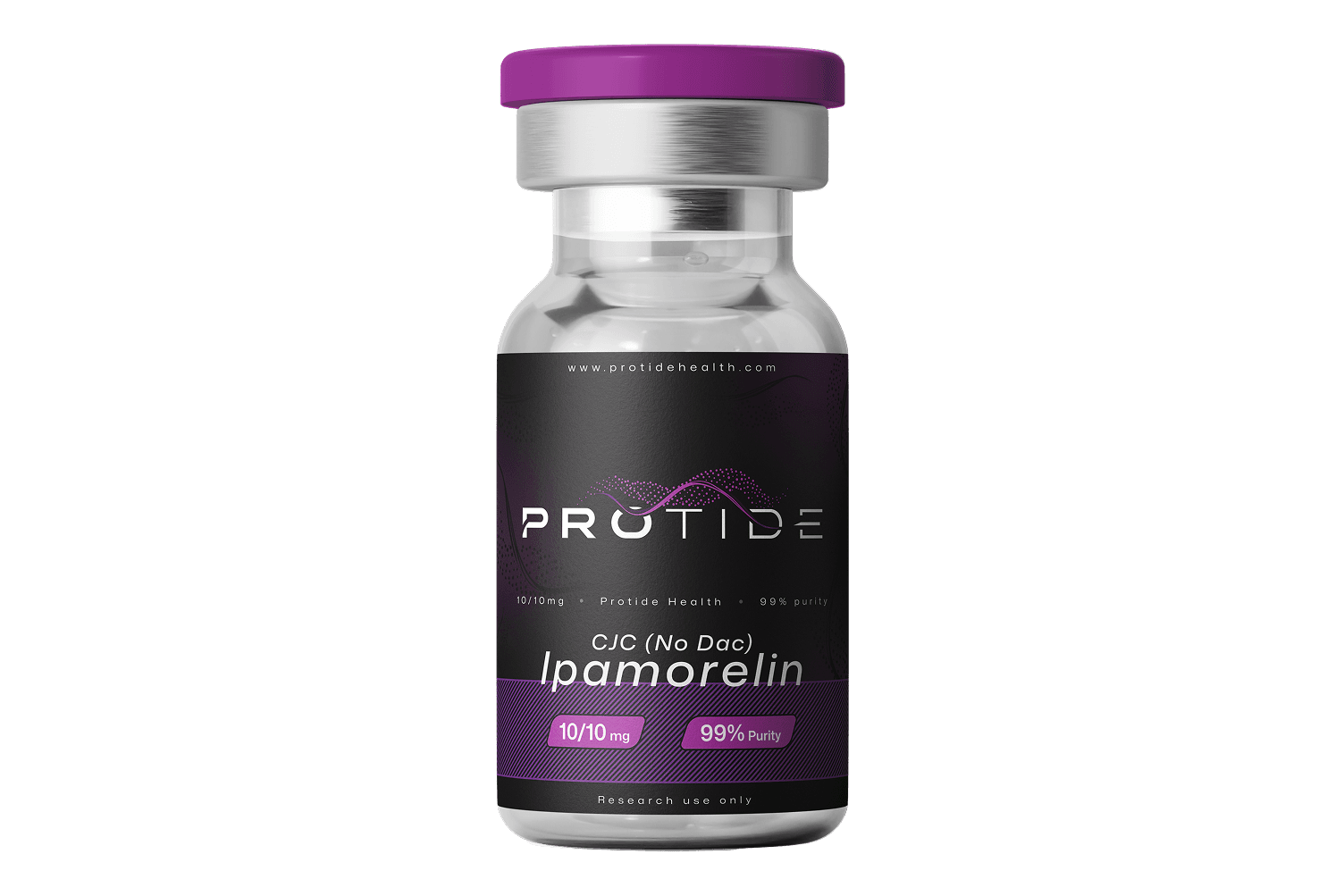
The CJC-1295 (No DAC) / Ipamorelin blend is one of the most frequently studied peptide combinations in growth hormone axis research. This pairing of a GHRH receptor agonist with a selective ghrelin receptor agonist allows researchers to investigate synergistic GH secretion, pulsatile endocrine signaling, and downstream IGF-1 regulation in preclinical models.
But what actually makes this combination worth studying? Why do researchers pair these specific peptides instead of using them independently? And what does the published evidence actually show?
This guide breaks down the science: the receptor pathways, the preclinical data, the pharmacokinetic profiles, and the critical distinctions that matter for laboratory research. Every claim is grounded in peer-reviewed literature, with 14 PubMed-cited references so you can verify the evidence yourself.
Protide Health provides materials for laboratory research with transparent analytical documentation, third-party HPLC and mass spectrometry testing, and ISO 9001:2015 certified manufacturing. Shop the CJC-1295 (No DAC) / Ipamorelin 10mg Blend at Protide Health.
What Is the CJC-1295 / Ipamorelin Peptide Blend?
The CJC-1295 / Ipamorelin blend combines two mechanistically distinct growth hormone secretagogues that target complementary receptor systems on anterior pituitary somatotroph cells. This is not a random pairing. It is grounded in the physiology of how the GH axis is regulated through dual inputs.
Here is the fundamental logic of the combination:
CJC-1295 (No DAC), also known as Modified GRF (1–29), is a tetrasubstituted GHRH analog that binds the GHRH receptor (GHRHR) and activates cAMP/PKA-mediated GH synthesis. It mimics the hypothalamic “release” signal but with enhanced stability against enzymatic degradation (Jetté et al., 2005).
Ipamorelin is a synthetic pentapeptide that selectively binds the ghrelin receptor (GHS-R1a), triggering calcium-dependent signaling that amplifies GH pulse amplitude. Critically, it does this without significantly raising ACTH, cortisol, prolactin, or other pituitary hormones, a selectivity profile that distinguishes it from earlier secretagogues like GHRP-6 and GHRP-2 (Raun et al., 1998).
Together, the blend engages both the cAMP pathway (via GHRHR) and the calcium signaling pathway (via GHS-R1a) simultaneously on the same somatotroph cell population, producing a dual-receptor model for studying synergistic GH pulsatility.
This makes the CJC-1295 / Ipamorelin blend a preferred research tool for investigating growth hormone axis regulation through coordinated receptor activation, not because one peptide is “better,” but because the two address mechanistically distinct inputs to the same physiological output.
Shop the research-grade CJC/Ipamorelin Blend at Protide Health →
How the CJC-1295 / Ipamorelin Blend Works: Mechanism of Action
Understanding why researchers combine CJC-1295 (No DAC) with Ipamorelin requires a closer look at the two signaling pathways converging on pituitary somatotrophs.
CJC-1295 (No DAC): The GHRH Receptor Pathway
CJC-1295 (No DAC), also referred to as Modified GRF (1–29) or Mod GRF, is a 29-amino acid synthetic analog of the bioactive N-terminal region of endogenous GHRH (1–44). Four targeted amino acid substitutions (D-Ala², Gln⁸, Ala¹⁵, Leu²⁷) give it dramatically improved resistance to DPP-IV proteolytic cleavage compared to native GRF (1–29), which has a half-life of under 10 minutes.
The signaling cascade:
GHRHR binding → Gs protein activation → adenylate cyclase stimulation → intracellular cAMP increase → PKA-linked phosphorylation → GH gene transcription and secretion
In preclinical models, this pathway drives both the synthesis of new GH within somatotrophs and the release of stored GH in a pulsatile pattern. Jetté et al. (2005) identified CJC-1295 as a long-lasting GRF analog that produced a 4-fold increase in GH area under the curve compared to native hGRF(1–29) in rat models. These findings were observed in rodent pharmacokinetic studies and do not translate to clinical efficacy conclusions.
Ipamorelin: The Ghrelin Receptor (GHS-R1a) Pathway
Ipamorelin (Aib-His-D-2-Nal-D-Phe-Lys-NH₂) is a pentapeptide originally developed by Novo Nordisk through systematic modification of the GHRP-1 peptide series. It binds the same GHS-R1a receptor as ghrelin, GHRP-6, GHRP-2, and MK-677, but with a critical difference.
The selectivity advantage:
In the landmark study by Raun et al. (1998), ipamorelin released GH from pituitary cells with potency comparable to GHRP-6 (EC₅₀ = 1.3 nmol/L vs. 2.2 nmol/L). But when tested in conscious swine for hormonal specificity, ipamorelin produced no significant elevation of ACTH or cortisol, even at concentrations exceeding 200-fold the ED₅₀ for GH release. By contrast, both GHRP-6 and GHRP-2 produced measurable increases in both stress hormones at GH-releasing doses.
This selectivity makes ipamorelin a preferred research tool when investigators need to study GH-axis effects in isolation, without the confounding multi-hormonal stimulation seen with less selective secretagogues.
The Synergy: Why Dual-Receptor Activation Matters
The scientific rationale for combining these peptides is not just additive. It is based on the established physiology of GH regulation through two complementary inputs:
- GHRH (via CJC-1295 No DAC) primarily drives GH synthesis and pulse amplitude, meaning how much GH is made and how high each pulse peaks
- Ghrelin/GHS-R1a agonism (via Ipamorelin) primarily modulates GH pulse frequency and timing, meaning when pulses occur and how they are triggered
When both pathways are activated simultaneously, research models show GH release amplitudes greater than either peptide alone, while the pulsatile secretion pattern, considered important for many of GH’s physiological effects, is preserved. Ionescu and Frohman (2006) specifically confirmed that GH pulsatility persisted even during continuous GHRH-type stimulation.
CJC/Ipamorelin Blend Research Applications
Laboratory researchers investigate the CJC-1295 (No DAC) / Ipamorelin peptide blend in these experimental contexts:
- Growth hormone axis signaling, studying pulsatile GH release amplitude and frequency through dual-receptor activation
- Receptor cross-talk investigation, examining GHRHR and GHS-R1a pathway interactions on pituitary somatotrophs
- Second messenger pathway evaluation, including cAMP-dependent (via GHRHR) and calcium-dependent (via GHS-R1a) signaling cascades
- IGF-1 axis investigation, including downstream metabolic signaling and insulin-like growth factor regulation
- Bone metabolism and mineral content research, including glucocorticoid-induced bone loss models and bone mineral density studies
- Body composition and nitrogen balance in preclinical catabolic state models
- Gastrointestinal motility, including gastric emptying and intestinal transit pathway research
- Peptide pharmacokinetics, including half-life characterization, receptor binding kinetics, and distribution studies
Individual Peptide Specifications
CJC-1295 (No DAC), Modified GRF (1–29)
- Molecular Formula: C₁₅₂H₂₅₂N₄₄O₄₂
- Molar Mass: ~3,368.7 g/mol
- Structure: 29-amino acid tetrasubstituted GHRH analog (D-Ala², Gln⁸, Ala¹⁵, Leu²⁷)
- Synonyms: Mod GRF (1–29), Modified GRF, CJC-1295 without DAC
- Target Receptor: GHRHR (class B GPCR)
- Signaling Pathway: Gs → adenylate cyclase → cAMP → PKA
- Half-Life: ~30 minutes
Ipamorelin (NNC 26-0161)
- Molecular Formula: C₃₈H₄₉N₉O₅
- Molar Mass: ~711.9 g/mol
- Structure: Pentapeptide (Aib-His-D-2-Nal-D-Phe-Lys-NH₂)
- Target Receptor: GHS-R1a (ghrelin receptor)
- Signaling Pathway: Gq/11 → calcium mobilization → GH pulse amplification
- Half-Life: ~2 hours (terminal)
Research-Grade Quality Markers for CJC/Ipamorelin Sourcing
Reliable suppliers should demonstrate third-party HPLC testing confirming 99% purity, mass spectrometry identity verification, and batch-specific Certificates of Analysis that are unique to each lot rather than shared or generic. Manufacturing should occur in ISO 9001:2015 certified, GMP-compliant, with credit card acceptance signalling that the vendor has passed independent payment processor vetting.
Transparent documentation should be available before purchase, with stability-optimized lyophilized packaging, and clear storage guidance included with the product. Protide Health meets all of these standards with ISO 9001:2015 certified, GMP-compliant manufacturing, third-party HPLC and mass spectrometry testing, and batch-specific COAs published openly in our COA Library for every product.
Shop the CJC-1295 (No DAC) / Ipamorelin 10mg Blend at Protide Health →
Laboratory Storage & Handling Protocols
Proper storage directly impacts peptide integrity and experimental reproducibility:
- Lyophilized (unreconstituted): Store frozen at −20°C (−4°F). Stable for extended periods in sealed, desiccated packaging.
- Reconstituted solutions: Refrigerate at 2–8°C (35.6–46.4°F). Use within recommended timeframe.
- Light protection: Store away from direct light to prevent photodegradation.
- Freeze-thaw cycles: Avoid repeated freezing and thawing of reconstituted solutions — aliquot into single-use volumes when possible.
- Reconstitution medium: Bacteriostatic water is standard for preparing working solutions.
- Sterile technique: Implement appropriate aseptic procedures during all measurement and transfer steps.
Frequently Asked Questions: CJC-1295 / Ipamorelin Research
What is the CJC-1295 / Ipamorelin peptide blend?
The CJC-1295 (No DAC) / Ipamorelin blend is a combination of two growth hormone secretagogues that activate complementary receptor systems. CJC-1295 (No DAC) targets the GHRH receptor via cAMP-dependent signaling, while Ipamorelin selectively activates the ghrelin receptor (GHS-R1a) via calcium-dependent pathways. Together, they provide a dual-receptor model for studying synergistic GH axis stimulation in laboratory settings. Both peptides are for research use only and are not FDA-approved for any therapeutic indication (PubMed, PubMed).
What is the difference between CJC-1295 with DAC and without DAC?
These are pharmacokinetically distinct compounds. CJC-1295 with DAC includes a Drug Affinity Complex that enables covalent albumin binding, extending half-life to ~6–8 days and producing sustained, continuous GH elevation. CJC-1295 without DAC (Modified GRF 1–29) lacks this modification, yielding a ~30-minute half-life and transient, pulsatile GH stimulation that more closely resembles endogenous secretion patterns. The No DAC variant is specifically paired with Ipamorelin to study pulsatile dynamics, since both peptides have relatively short half-lives.
Has ipamorelin been studied in bone metabolism research?
Yes, in animal models. Andersen et al. (2001) demonstrated that ipamorelin counteracted glucocorticoid-induced bone formation decreases in adult rats, with periosteal bone formation rate increased four-fold when ipamorelin was added to glucocorticoid treatment. Svensson et al. (2000) separately showed increased bone mineral content in rats treated with ipamorelin over 12 weeks. These results were observed in rodent models and have not been replicated in human research populations.
Why combine CJC-1295 (No DAC) with Ipamorelin specifically?
The combination targets two distinct receptor systems (GHRHR and GHS-R1a) that converge on the same somatotroph cells. GHRH pathway activation primarily drives GH synthesis and pulse amplitude, while ghrelin receptor agonism primarily modulates pulse frequency and timing. This dual-pathway approach produces mechanistically interpretable results without the confounding of competitive binding that would occur when combining two peptides targeting the same receptor.
Disclaimer
All products sold by Protide Health are intended for laboratory research purposes only. These materials are not for human consumption, medical use, diagnostic purposes, or veterinary applications. This article provides educational information only and does not constitute medical advice, protocol recommendations, or therapeutic guidance. Researchers should consult appropriate institutional review and safety protocols before beginning experimental work.
References
- Jetté L, Léger R, Thibaudeau K, et al. “Human growth hormone-releasing factor (hGRF)1-29-albumin bioconjugates activate the GRF receptor on the anterior pituitary in rats: identification of CJC-1295 as a long-lasting GRF analog.” Endocrinology. 2005;146(7):3052-3058. https://pubmed.ncbi.nlm.nih.gov/15817669/
- Teichman SL, Neale A, Lawrence B, Gagnon C, Castaigne JP, Bhatt RS. “Prolonged stimulation of growth hormone (GH) and insulin-like growth factor I secretion by CJC-1295, a long-acting analog of GH-releasing hormone, in healthy adults.” J Clin Endocrinol Metab. 2006;91(2):799-805. https://pubmed.ncbi.nlm.nih.gov/16352683/
- Ionescu M, Frohman LA. “Pulsatile secretion of growth hormone (GH) persists during continuous stimulation by CJC-1295, a long-acting GH-releasing hormone analog.” J Clin Endocrinol Metab. 2006;91(12):4792-4797. https://pubmed.ncbi.nlm.nih.gov/17018654/
- Alba M, Fintini D, Sagazio A, et al. “Once-daily administration of CJC-1295, a long-acting growth hormone-releasing hormone (GHRH) analog, normalizes growth in the GHRH knockout mouse.” Am J Physiol Endocrinol Metab. 2006;291(6):E1290-E1294. https://pubmed.ncbi.nlm.nih.gov/16822960/
- Raun K, Hansen BS, Johansen NL, et al. “Ipamorelin, the first selective growth hormone secretagogue.” Eur J Endocrinol. 1998;139(5):552-561. https://pubmed.ncbi.nlm.nih.gov/9849822/
- Andersen NB, Malmlöf K, Johansen PB, Andreassen TT, Ørtoft G, Oxlund H. “The growth hormone secretagogue ipamorelin counteracts glucocorticoid-induced decrease in bone formation of adult rats.” Growth Horm IGF Res. 2001;11(5):266-272. https://pubmed.ncbi.nlm.nih.gov/11735244/
- Svensson J, Lall S, Dickson SL, et al. “The GH secretagogues ipamorelin and GH-releasing peptide-6 increase bone mineral content in adult female rats.” J Endocrinol. 2000;165(3):569-577. https://pubmed.ncbi.nlm.nih.gov/10828840/
- Johansen PB, Nowak J, Skjaerbaek C, et al. “Ipamorelin, a new growth-hormone-releasing peptide, induces longitudinal bone growth in rats.” Growth Horm IGF Res. 1999;9(2):106-113. https://pubmed.ncbi.nlm.nih.gov/10373343/
- Greenwood-Van Meerveld B, Tyler K, Mohammadi E, Pietra C. “Efficacy of ipamorelin, a ghrelin mimetic, on gastric dysmotility in a rodent model of postoperative ileus.” J Exp Pharmacol. 2012;4:149-155. https://pubmed.ncbi.nlm.nih.gov/27186128/
- Beck DE, Sweeney WB, McCarter MD; Ipamorelin 201 Study Group. “Prospective, randomized, controlled, proof-of-concept study of the Ghrelin mimetic ipamorelin for the management of postoperative ileus in bowel resection patients.” Int J Colorectal Dis. 2014;29(12):1527-1534. https://pubmed.ncbi.nlm.nih.gov/25331030/
- Gobburu JV, Agersø H, Jusko WJ, Ynddal L. “Pharmacokinetic-pharmacodynamic modeling of ipamorelin, a growth hormone releasing peptide, in human volunteers.” Pharm Res. 1999;16(9):1412-1416. https://pubmed.ncbi.nlm.nih.gov/10496658/
- Ishida J, Saitoh M, Ebner N, Springer J, Anker SD, von Haehling S. “Growth hormone secretagogues: history, mechanism of action, and clinical development.” JCSM Rapid Communications. 2020;3(1):25-37. https://onlinelibrary.wiley.com/doi/full/10.1002/rco2.9
- Sinha DK, Balasubramanian A, Tatem AJ, et al. “Beyond the androgen receptor: the role of growth hormone secretagogues in the modern management of body composition in hypogonadal males.” Transl Androl Urol. 2020;9(Suppl 2):S149-S159. https://pmc.ncbi.nlm.nih.gov/articles/PMC7108996/
- World Anti-Doping Agency (WADA). 2025 Prohibited List. https://www.wada-ama.org/en/prohibited-list