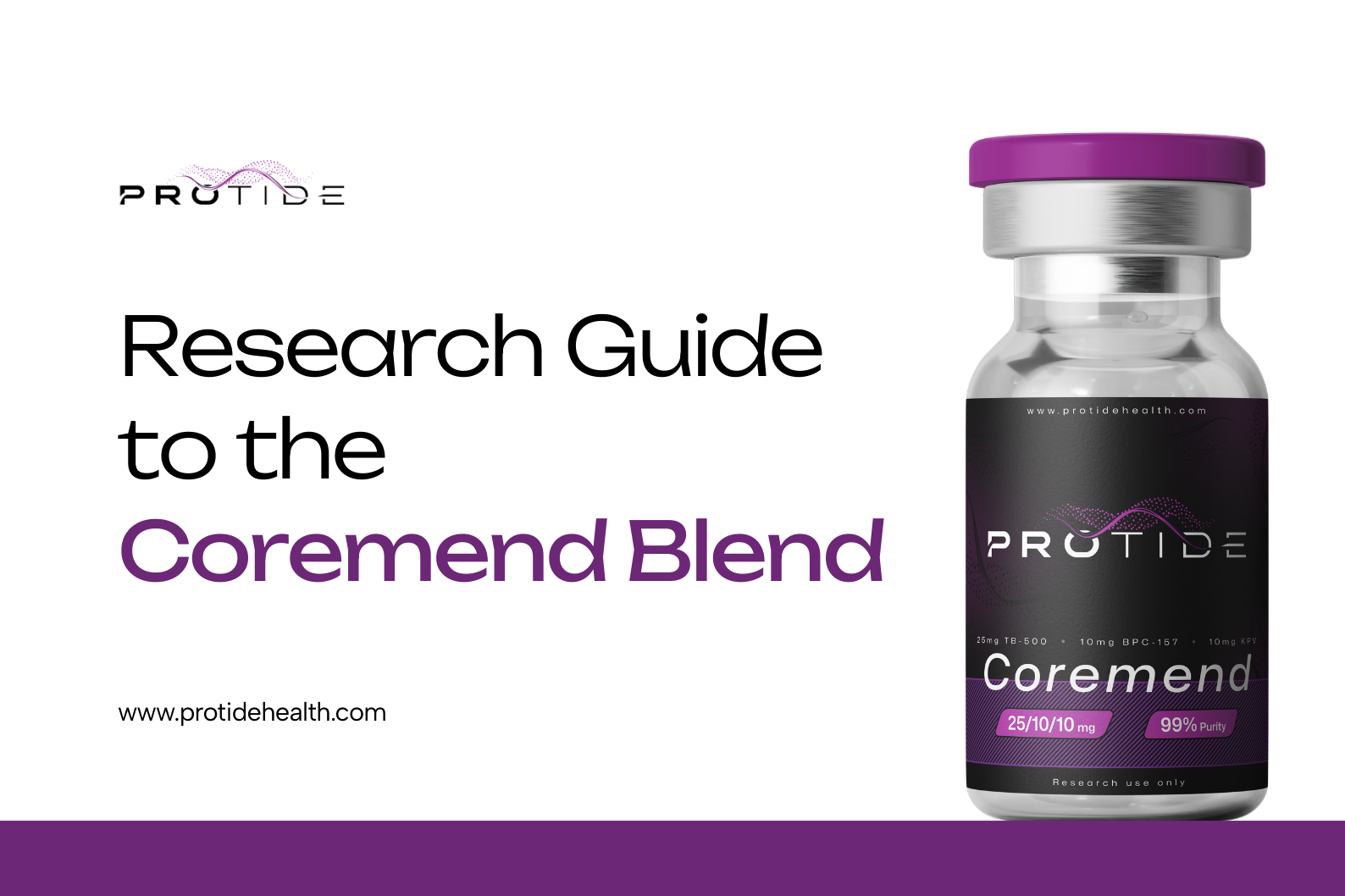
Coremend Peptide: Research Guide to the Coremend Blend
Research‑Use‑Only Notice: All content on this website and all product information are for educational and informational purposes only. All products referenced are for laboratory research, analytical, and in‑vitro or preclinical in‑vivo use only. They are not medicines or drugs, have not been evaluated or approved by the FDA, and are not intended to diagnose, treat, cure, or prevent any disease. Any bodily introduction into humans or animals is strictly prohibited.
Curious about the Coremend peptide blend and why it is utilized in multi-phase tissue and inflammatory research models? You’re in the right place. Below, this guide explains what the Coremend blend is, which peptides it contains, how each component functions in a laboratory setting, and how to approach experimental design in in-vitro and animal studies.
Summary: The Coremend blend combines TB-500 25 mg, BPC-157 10 mg, and KPV 10 mg in one lyophilized vial for research use only, designed to study a sequential biological cascade involving inflammatory resolution, angiogenesis, and structural tissue repair in controlled laboratory models.
What is the Coremend peptide?
The Coremend peptide is a specialized three-peptide research formulation. It includes:

This formulation allows laboratories to model complex, overlapping biological systems simultaneously, tracking molecular sequences from early inflammatory regulation to structural regeneration. See the product page for specifications: Coremend (TB-500, BPC-157, KPV).
Key takeaways
- Built strictly for bench research, not for human or veterinary use.
- Each peptide is investigated at a distinct phase of the cellular repair cascade: immune signaling, vascular supply, and structural rebuild.
- The blend supports hypothesis testing on how suppressing early inflammatory cascades alters the trajectory of structural and vascular signaling in in-vitro and animal models.
How Coremend Peptide works (simple science)
Coremend introduces a structured, three-axis approach to tissue research:
Phase 1 (Suppress) – KPV: A tripeptide fragment of α-MSH that modulates immune signaling. In laboratory models, studies examine its ability to downshift NF-κB/MAPK pathways and resolve the initial inflammatory cascade. (Europe PMC)
Phase 2 (Supply) – BPC-157: A gastric-derived pentadecapeptide explored for angiogenesis pathways. Research examines how it upregulates VEGFR2/Akt/eNOS signaling, which drives the construction of new vascular networks in preclinical systems. (SpringerLink)
Phase 3 (Rebuild) – TB-500: An actin-binding peptide (fragment of Thymosin β4) studied for cellular migration mechanisms. Laboratory assays investigate its role in managing actin sequestration and mobilizing fibroblasts to rebuild structural integrity. (Cell)
Together, the Coremend blend enables researchers to investigate a complex continuum of tissue repair, observing how inflammatory pathway modulation (KPV) interacts synergistically with pro-angiogenic signaling (BPC-157) and actin-driven cell movement (TB-500).
Potential research findings and applications for Coremend Peptide
Animal/in vitro focus
- KPV studies investigate nanomolar NF-κB inhibition, measuring shifts in prolonged inflammatory responses and cytokine panels in barrier studies.
- BPC-157 literature describes angiogenesis pathway investigations. Studies measure VEGFR2/Akt-eNOS signaling markers and endothelial migration rates during dermal and soft-tissue assays.
- TB-500 research examines actin-mediated cellular migration metrics and re-epithelialization rates in preclinical dermal and epithelial repair contexts.
Coremend peptide blend experiments
This section is educational for model planning only.
Laboratories typically design pilot exposure ranges based on published in-vitro concentrations. Experimental inputs should be planned to standardize dilutions, aliquots, and per-assay quantities for research solutions only. Consider time-course sampling to differentiate early inflammatory resolution signals (KPV phase) from late structural repair signals (TB-500 phase). Researchers frequently compare single-agent arms to the multi-compound Coremend arm to characterize synergistic interactions.
Tip: Predefine endpoints such as variations in re-epithelialization rates, transwell migration, and cellular multi-tissue cytoprotection to align with the distinct mechanisms of the three peptides.
Safety, quality, and sourcing
- Utilize clearly labeled, HPLC-verified research compounds. Coremend is verified at 99% purity.
- Store lyophilized material in dry, cold conditions per lab SOPs to preserve the stability of the three distinct compounds.
Coremend peptide blend ingredients table
| Component | Mechanism focus (models) | Research focus | Notes |
|---|---|---|---|
| TB-500 (25mg) | Actin sequestration; cellular migration | Structural rebuild (Phase 3) | Preclinical literature investigates actin dynamics and fibroblast mobilization. |
| BPC-157 (10mg) | VEGFR2/Akt/eNOS upregulation; angiogenesis | Vascular supply (Phase 2) | Pentadecapeptide examined for vascular networks and endothelial migration. |
| KPV (10mg) | NF-κB/MAPK suppression; immune signaling | Inflammatory resolution (Phase 1) | Minimal α-MSH fragment evaluated for resolving early inflammatory cascades. |
Coremend Peptide FAQs
What is the Coremend peptide?
Coremend is a three-peptide research blend combining TB-500 25mg, BPC-157 10mg, and KPV 10mg. It allows laboratories to test sequential biological cascades from inflammatory resolution to structural regeneration. See the Coremend product page for details.
What is Coremend stack peptide good for?
In laboratory settings, the Coremend blend is utilized to investigate a three-phase cellular repair model: modulating immune signaling (KPV), driving angiogenesis (BPC-157), and managing cellular migration (TB-500) within in-vitro and animal models.
What are the Coremend peptide blend ingredients?
TB-500 (25mg), BPC-157 (10mg), and KPV (10mg) per single lyophilized vial. See the Coremend page for HPLC-verified purity specifications.
Can I buy the Coremend blend in the US for research?
Yes. You can buy the Coremend blend from Protide Health with fast domestic US shipping.
What’s the difference between Coremend and Wolverine Blend?
The Wolverine Blend contains two peptides: BPC-157 and TB-500. Coremend builds upon this foundation by adding KPV. In research models, the addition of KPV introduces a specific “Phase 1” focus on suppressing early inflammatory cascades, which investigators study in environments where unchecked inflammation might otherwise hinder the subsequent regenerative signaling of BPC-157 and TB-500.
Disclaimer
Disclaimer: Products sold by Protide Health are for laboratory research purposes only and are not intended for human consumption, medical use, or veterinary use.
References
- Dalmasso G, et al. PepT1-Mediated Tripeptide KPV Uptake Reduces Intestinal Inflammation. Gastroenterology, 2008. (Europe PMC)
- Current Reviews in Musculoskeletal Medicine. Regeneration or Risk? A Narrative Review of BPC-157 for Musculoskeletal Healing, 2025. (SpringerLink)
- Trends in Molecular Medicine. Thymosin β4: actin-sequestering protein moonlights to repair injured tissues, 2005. (Cell)
- J Mol Med. BPC-157 associated with VEGFR2 activation and angiogenic signals, 2017. (SpringerLink)
- American Journal of Physiology. Role of PepT1; KPV noted as anti-inflammatory α-MSH fragment, 2011. (Physiology Journals)