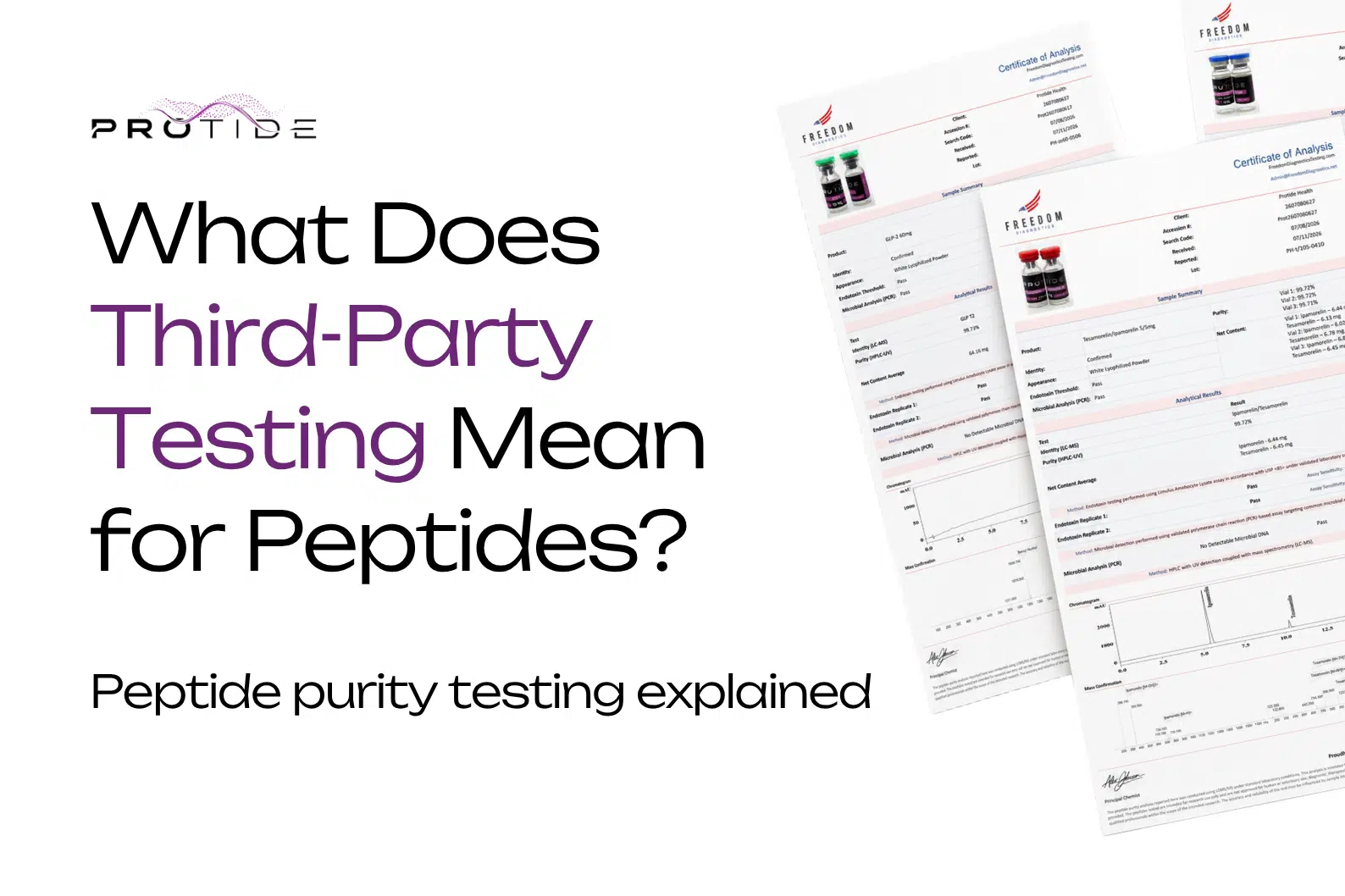
What Does Third-Party Testing Mean for Peptides?
Third-party testing means an independent laboratory, one with no financial stake in the sale, verifies a peptide’s identity and purity and documents the results on a Certificate of Analysis (COA). It is the difference between a vendor telling you a compound is 99% pure and an outside lab proving it. For qualified researchers comparing peptides, purity testing is the single most useful signal of whether a product matches its label.
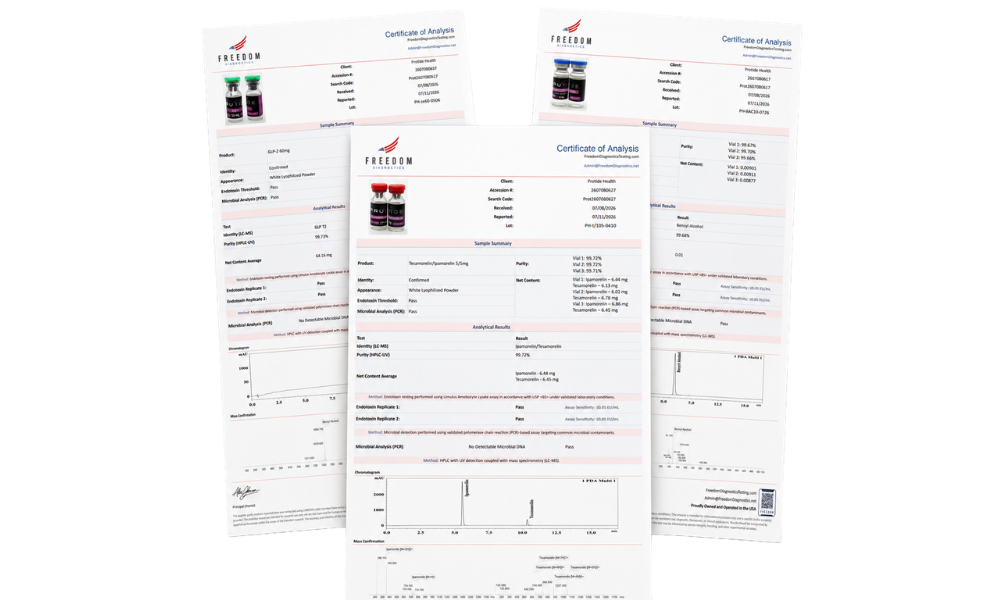
Legitimate research peptide suppliers like Protide Health will provide samples of each batch of peptides to a neutral independent laboratory and publish those third-party test results. This allows qualified researchers to verify the compounds before they purchase. At Protide Health, all COAs are publicly posted on the peptide test results page, and can be searched for in the COA library. Independent verification is how quality becomes visible instead of assumed.
This guide explains what third-party testing actually involves, how the two core methods (HPLC and mass spectrometry) work, how to read a COA line by line, and how to confirm that a vendor’s testing is real. Everything here is written for research and scientific context only.
Third-Party Testing vs. In-House Testing: What the Terms Mean
Third-party testing is analysis performed by an independent lab, while in-house testing is analysis a manufacturer runs on its own products. Both can use identical instruments, so the distinction is not the science; it is the incentive.
An in-house result is only as trustworthy as the company reporting it, because the same organization with financial stake also controls the data. A third-party result removes that conflict: the testing lab is paid to measure, not to sell. This is why “third-party tested peptides” has become a shorthand for credibility in the research market, and why the phrase appears on nearly every reputable vendor’s homepage.
It is worth being precise about language. “Third-party tested” describes who ran the test. “Purity testing” describes what was measured. A batch can be tested in-house for purity and still lack independent verification, and a vendor can commission a single third-party test years ago and imply that all current stock is covered. Neither situation is the same as batch-by-batch independent testing, which is the standard we uphold at Protide Health, and what’s worth looking for.
How Peptides Are Tested for Purity
Peptides are tested using two complementary analytical methods: high-performance liquid chromatography (HPLC) measures how pure a sample is, and mass spectrometry (MS) confirms that the compound is the one on the label. Neither method is sufficient alone, and reputable COAs include both.
HPLC: Measuring Purity
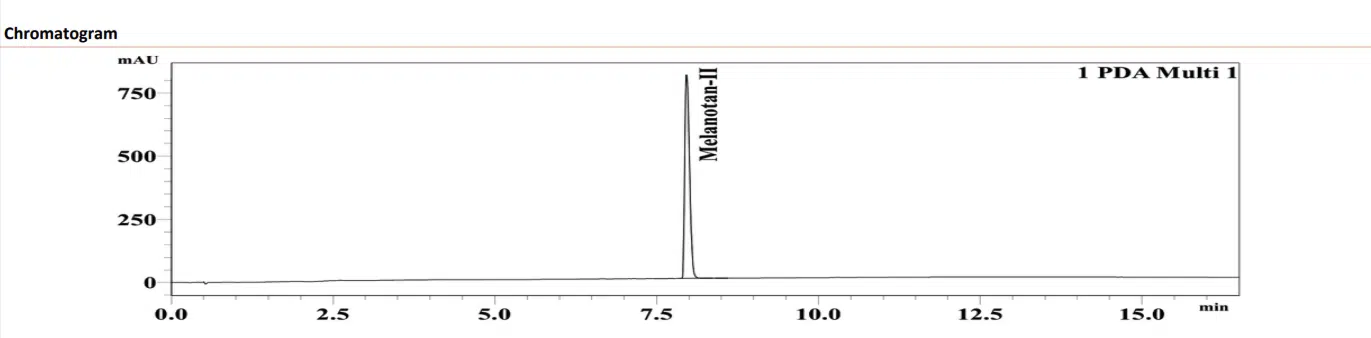
High-performance liquid chromatography separates the components of a sample by pushing it through a column under high pressure, most commonly using reverse-phase HPLC, which sorts molecules by how strongly they interact with the column based on hydrophobicity. Each component leaves the column at a different time and registers as a peak on a chromatogram.
Purity is calculated from the area of those peaks. The instrument compares the area of the main peptide peak against the total area of every detected peak, and reports the result as a percentage such as 99.83%. In practical terms, a 99% HPLC purity figure means that 99% of the UV-absorbing material the detector saw corresponds to the target peptide, and the remaining 1% is peptide-related impurities such as deletion sequences from incomplete synthesis, oxidation products, or dimers.
Mass Spectrometry: Confirming Identity
Mass spectrometry ionizes a sample and measures the mass-to-charge ratio (m/z) of the resulting ions. A single peptide usually appears at more than one m/z value because it can carry more than one charge, so a report will often show the singly charged ion [M+H]+ and the doubly charged ion [M+2H]2+ of the same molecule. From those peaks the molecular weight is calculated and compared against the theoretical weight of the labeled peptide.
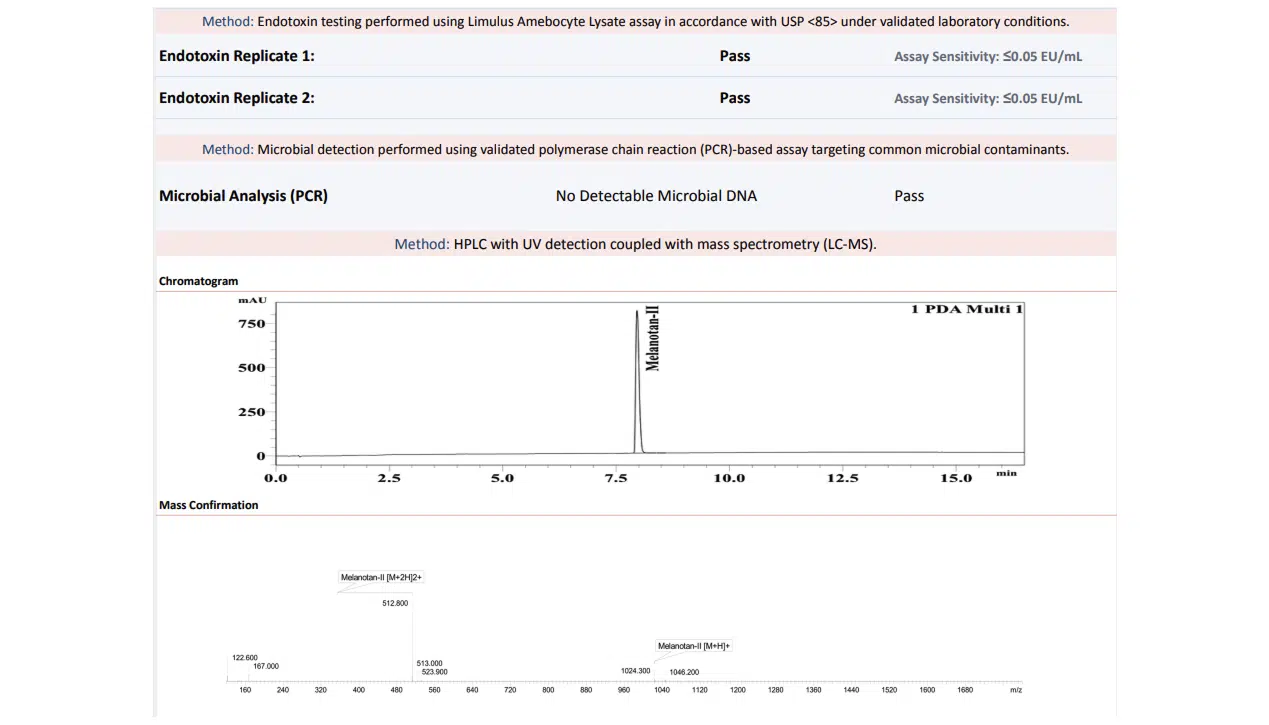
In practice this is usually done as LC-MS, meaning the mass spectrometer is coupled directly to the chromatography step rather than run as a separate test. The same separation feeds a UV detector for purity and the mass spectrometer for identity, which is why a COA may list “Purity (HPLC-UV)” and “Identity (LC-MS)” as two results from one coupled method.
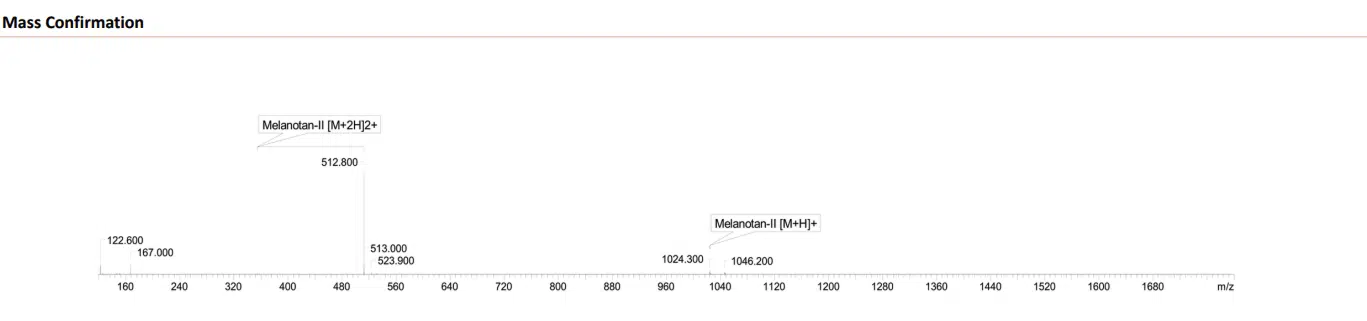
A match within roughly 0.1 Da on a high-resolution instrument, or within about 1 Da on a low-resolution instrument, is treated as identity confirmation.
The point of pairing MS with HPLC is that purity and identity are different questions. A sample can be 99% pure by HPLC-UV and still be the wrong molecule if the vial was mislabeled, which UV purity alone cannot catch. Coupling the two as LC-MS also helps flag a different mass co-eluting under a single UV peak, an impurity that purity percentage by itself would miss.
The Supporting Assays
Beyond HPLC and MS, a thorough analysis can include several additional measurements that describe what else is in the vial, such as:
- Net peptide content: the proportion of the vial’s gross weight that is actual peptide.
- Endotoxin and sterility: contamination checks, relevant for any material handled in a laboratory setting.
- Microbial analysis (PCR): polymerase chain reaction screening that detects bacterial or fungal DNA in a sample, flagging microbial contamination that endotoxin assays alone may miss.
What “99% Purity” Actually Means (and What It Leaves Out)
The practical takeaway is not that purity percentages are meaningless. It is that a percentage with no COA behind it is meaningless. A number printed on a product page with no chromatogram, no lab name, and no batch reference is a marketing claim, while the same number attached to a dated, batch-specific report from a named lab is evidence. When you compare research peptides, the document matters more than the digits.
How to Read a Peptide Certificate of Analysis (COA)
A peptide COA is the report that records a batch’s test results, and reading one comes down to checking several fields: the compound name, the batch or lot number, the test date, the methods used, the purity result, and the name of the testing lab. If any of those are missing, the document is incomplete.
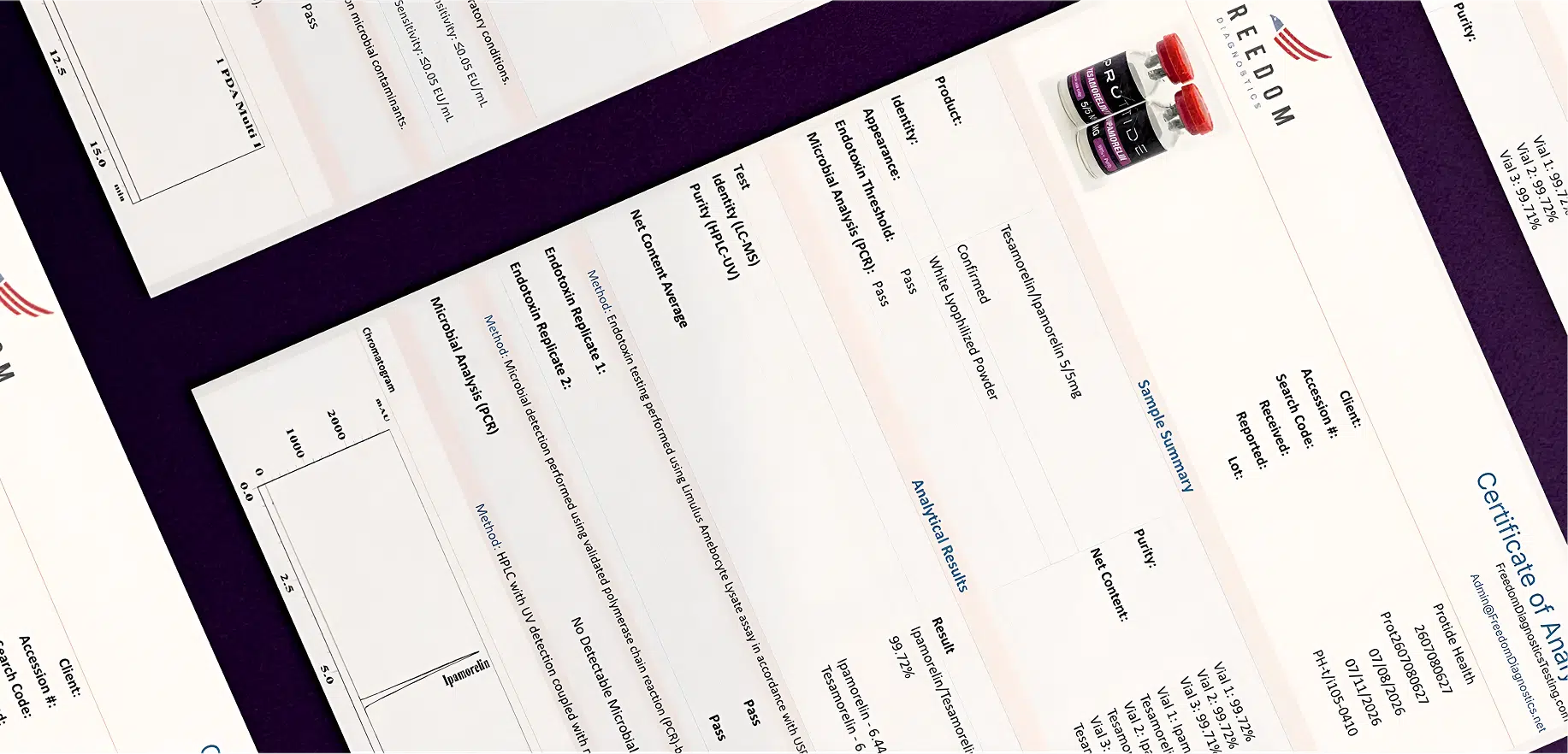
Work through a COA in this order:
- Compound. Confirm the peptide name matches the product.
- Batch or lot number. This should tie the report to a specific production run. A COA with no batch number cannot be matched to the vial in front of you.
- Test date. A recent date indicates the batch was tested, not that an old report is being reused for new stock.
- Methods. Look for both HPLC and MS. HPLC alone tells you purity without confirming identity.
- Purity result. The chromatogram should be visible, not just a typed percentage, so you can see the peaks the number is based on.
- Testing laboratory. A named, independent lab is the entire point of third-party testing. “Tested in-house” is not the same claim.
The single strongest red flag is a generic or stock COA: one report displayed for every batch of a product, or a document with the batch number blanked out. Independent testing is inherently batch-specific, so a COA that cannot be tied to a lot number defeats its own purpose.
How to Verify a Vendor Is Genuinely Third-Party Tested
To confirm a vendor’s testing is real, check that the COA names an independent lab, matches a specific batch, carries a recent date, and includes both HPLC and mass spectrometry data. Vendors that test seriously tend to publish a full COA library rather than a single example.
Use this checklist when evaluating a source:
- Named independent lab. The report should identify the testing facility, not just say “third-party verified.”
- Batch-matched COA. The lot number on the report should match the lot you can buy.
- Recent testing date. Current batches should have current reports.
- Both methods shown. HPLC for purity and MS for identity, ideally with the chromatogram visible.
- Public COA library. A searchable archive of reports across products signals routine testing rather than one-off marketing.
- Consistency across the catalog. Spot-check several products; transparency should not stop at the best sellers.
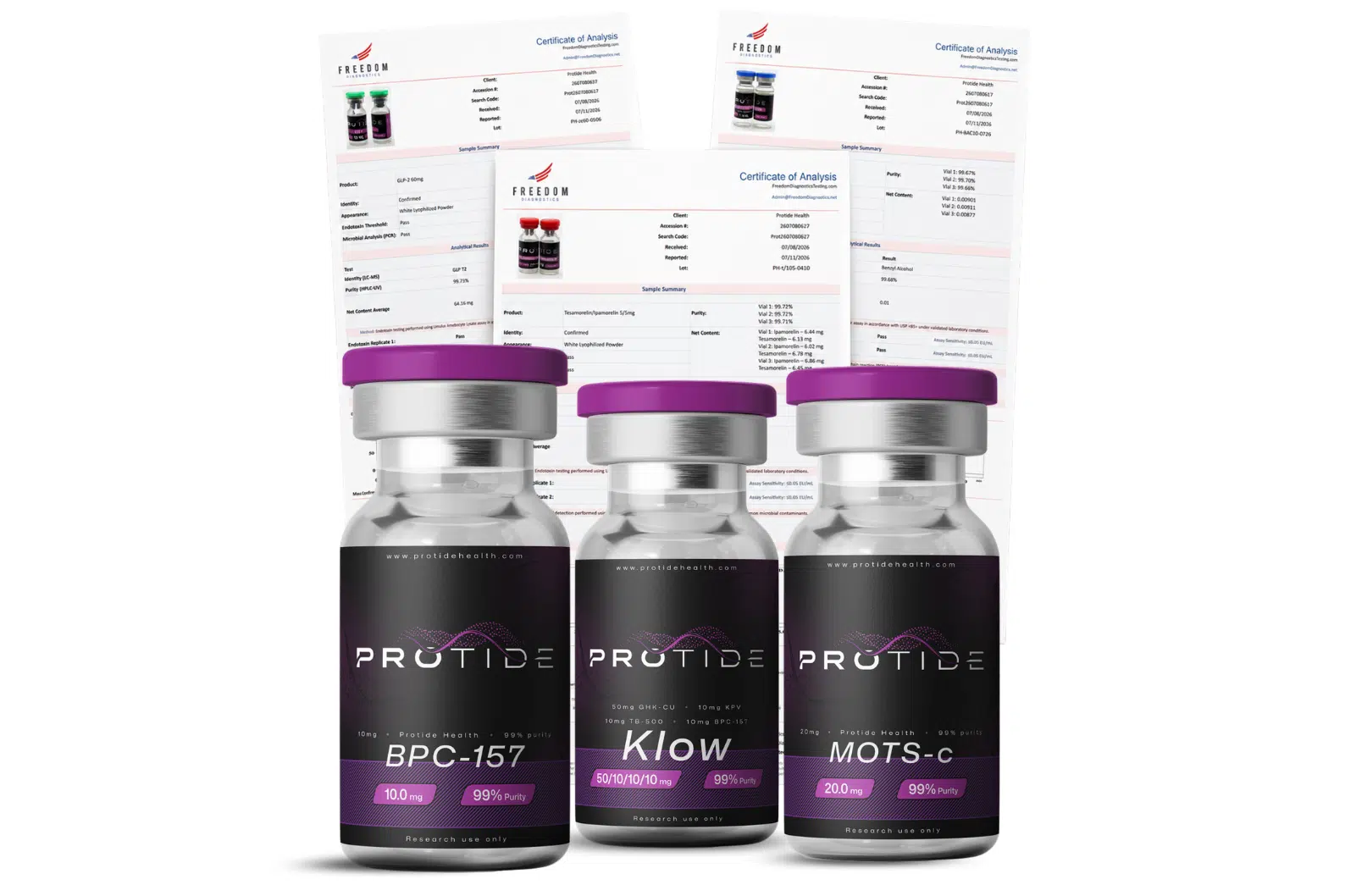
This checklist is how qualified researchers tell if the compounds are legit and which peptide companies are actually, independently third-party tested. The verification is the same regardless of which compound you are looking at, whether that is BPC-157, or a peptide blend.
Getting Peptides Independently Tested
Researchers can send samples to independent peptide testing labs for verification, and the cost typically runs a few hundred dollars per sample depending on the methods requested.
A basic HPLC purity run sits at the lower end of that range, while adding mass spectrometry, net peptide content, or endotoxin screening raises both the cost and the completeness of the picture.
For laboratories and qualified researchers that prepare samples and store material themselves, testing is only one part of maintaining sample integrity. Proper storage and handling practices also affect whether a sample stays true to its tested state.
Red Flags and Common Gaps
The most common warning signs are a purity claim with no document behind it, a COA with no lab name, a report showing HPLC but no mass spectrometry, and a single generic COA reused across every batch. Any one of these turns a testing claim into an unverifiable assertion.
Two gaps deserve particular attention. The first is the identity gap: vendors that publish an HPLC purity figure but omit mass spectrometry are proving how pure something is without proving what it is. The second is the freshness gap: a COA dated years before the current stock says nothing about the batch you would actually receive. Neither gap is subtle once you know to look for it, and both are common enough that checking for them separates legitimate suppliers from the rest.
Frequently Asked Questions
What does third-party tested mean for peptides?
It means an independent laboratory, separate from the seller, has analyzed the peptide and documented its purity and identity on a Certificate of Analysis. The independence is what gives the result its weight, because the testing lab has no incentive tied to the sale.
How can I tell if peptides are legit?
Look for a batch-specific COA from a named third-party lab, dated close to the current stock, showing both HPLC purity and mass spectrometry identity data. A visible chromatogram and a public COA library are strong additional signals.
What is the difference between HPLC and mass spectrometry testing?
HPLC measures purity by separating a sample into peaks and calculating the target peptide’s share of the total. Mass spectrometry measures molecular weight to confirm identity. Purity and identity are different questions, so credible COAs report both.
What does a peptide Certificate of Analysis show?
A complete COA shows the compound name, batch or lot number, test date, analytical methods, the purity result with a chromatogram, and the name of the testing laboratory. Some also report net peptide content, microbial analysis, and endotoxin results.
How much does peptide purity testing cost?
Independent testing generally costs a few hundred dollars per sample. The exact figure depends on the lab and the methods requested.
References
- Reference Standards to Support Quality of Synthetic Peptide Therapeutics. Pharmaceutical Research (2023). PubMed Central: PMC10338602 · Springer
- United States Pharmacopeia (USP), documentary standards for identity, purity, and content of drug substances: usp.org
Disclaimer (Research‑Use‑Only Notice): All content on this website and all product information are for educational and informational purposes only. All products referenced are for laboratory research, analytical, and in‑vitro use only. They are not medicines or drugs, have not been evaluated or approved by the FDA, and are not intended to diagnose, treat, cure, or prevent any disease. Any bodily introduction into humans or animals is strictly prohibited. This content does not constitute medical, health, or usage guidance of any kind.