Where to Buy Klow Peptide Blend in 2026: 9 Research Suppliers Compared
Reviewed and updated on August 5th, 2026
Where to buy Klow peptide blend in 2026 comes down to what a supplier will put in writing before anyone orders: a certificate tied to the lot in the vial, the name of the laboratory that ran it, an accounting of all four peptides rather than one, and a test panel that goes beyond a single purity figure. Protide Health ranks first on that standard among the nine suppliers compared here. Only five of the nine checked in August 2026 name their testing laboratory, and only two publish measured content for all four components.
Ranking criteria: Fourteen research peptide suppliers listing Klow for laboratory use were checked against their live product pages on August 5, 2026. Nine hold stock and publish documentation a first-time visitor can open; five were excluded due to product page contradictions or lack of testing. Rankings rest on five criteria a reader can verify independently: whether a certificate is matched to the lot in the vial, whether the testing laboratory is named, whether all four components are documented by measured mass, whether superseded lots stay published, and internal consistency across the product page.
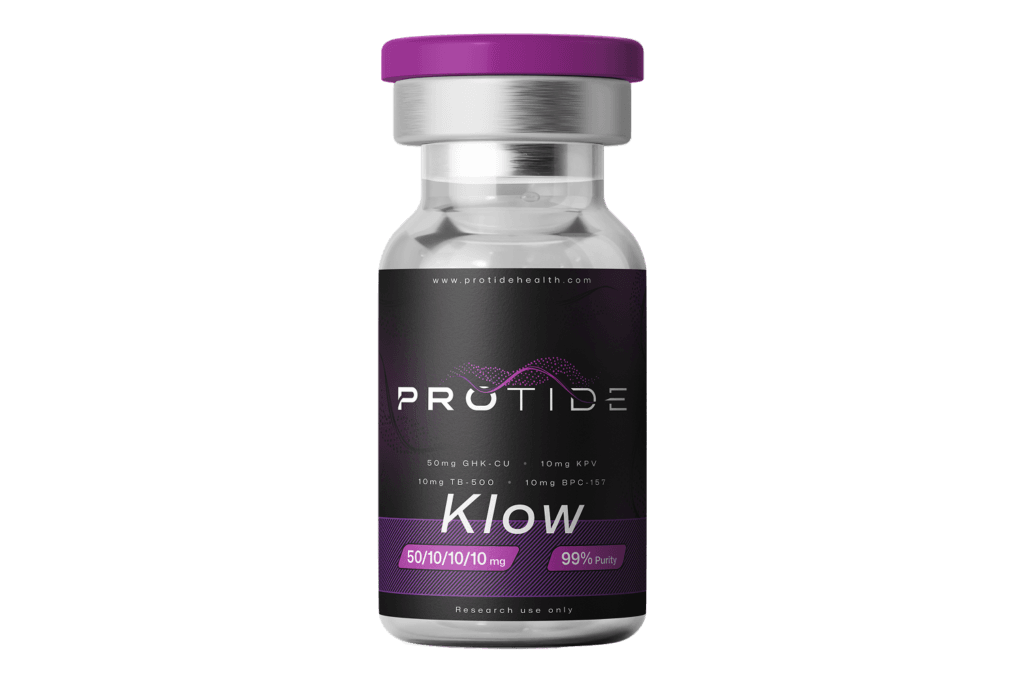
Research‑Use‑Only Notice: All content on this website and all product information are for educational and informational purposes only. All products referenced are for laboratory research, analytical, and in‑vitro use only. They are not medicines or drugs, have not been evaluated or approved by the FDA, and are not intended to diagnose, treat, cure, or prevent any disease. Any bodily introduction into humans or animals is strictly prohibited.
Where to Buy Klow Peptide: Quick Comparison for 2026
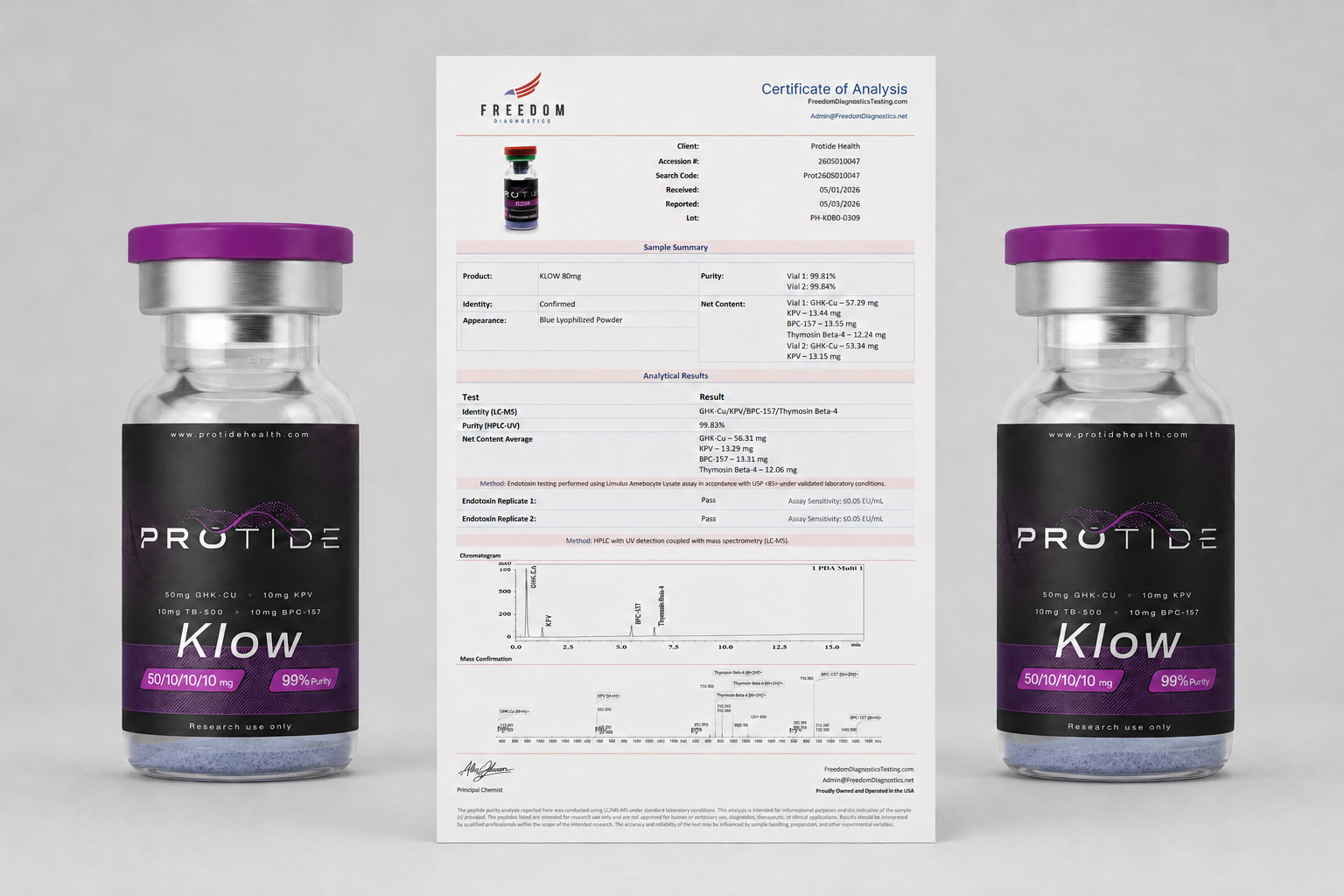
Protide Health ranks first among the nine Klow blend suppliers compared here, on the depth of the analytical panel published against a specific lot. Its August 2026 certificate reports purity by HPLC with UV detection, identity by LC-MS, bacterial endotoxin by Limulus Amebocyte Lysate assay, and measured net peptide content for all four components, from Freedom Diagnostics, a named laboratory, with two vials assayed independently rather than pooled. Three lot certificates stay publicly readable. Current lot data from Protide Health for the Klow Blend 80mg research vial was used against that criteria.
Verified Peptides ranks second as the only supplier publishing measured milligram content for each of the four peptides on the product page itself, and Bluum Peptides third for lot-specific certificates from two separately named laboratories.
|
Rank |
Supplier |
Best For |
Testing Lab Named |
Purity Published |
Component Masses |
COA Access |
|---|---|---|---|---|---|---|
|
1 |
Protide Health (Best Overall) |
Deepest published test panel |
Freedom Diagnostics |
99.83% blend, HPLC-UV |
Measured, all four, per vial |
Public, pre-purchase, 3 lots retained |
|
2 |
Verified Peptides |
Component-level measured content |
Janoshik Analytical |
~99% |
Measured, on product page |
Public, archive since 2019 |
|
3 |
Bluum Peptides |
Multi-lab verification |
Horizon Analytical, Freedom Diagnostics |
99.32% per component |
Label spec published |
Public, 2 downloadable lots |
|
4 |
Ascension Peptides |
Two independent labs per batch |
Kovera Labs, MZ Biolabs |
Not published |
Label spec published |
Public, 2 batches |
|
5 |
Pure Health Peptides |
Strictest buyer verification |
Not named in copy |
≥99% |
Slash string, unmapped |
Public, lot-specific |
|
6 |
Averix Labs |
Broadest test panel |
Not named |
99.61% |
Label spec published |
Public, 6-point panel |
|
7 |
Cenexa Labs |
Subscription ordering |
Not named |
Exceeds 99% |
Label spec published |
Public PDFs, no lot ID inside |
|
8 |
NGPeptide |
Two lots from a named lab |
Freedom Diagnostics |
99.92% |
Label spec published |
Public, 2 lots |
|
9 |
American Peptides |
COA verification tool |
Not named |
≥99% |
Not published |
Public, lot PDF plus SDS |
How These Klow Peptide Suppliers Were Ranked
Five criteria separate these suppliers, all checkable before ordering, ordered by the weight each carried.
Lot-Matched Certificates, Not Catalog-Wide Claims
A lot-matched certificate reports what one production run measured; a catalog-wide purity claim reports a target. Eight of the nine suppliers publish at least one certificate carrying a lot or batch identifier, from Protide Health’s lot PH-KO80-0309 through NGPeptide’s KLW-06 and American Peptides’ KLOW80-0616. Cenexa Labs is the exception. A useful certificate carries a lot number, its own accession number, a reporting date inside the last year, and a link that opens without an account, which is the substance of what a peptide Certificate of Analysis actually shows. A certificate that names no lot is a brochure with a chromatogram printed on it.
A Named Laboratory, Not “Third-Party Tested”
Only five of the nine suppliers compared here name the laboratory that ran their analysis. Protide Health and NGPeptide name Freedom Diagnostics, Verified Peptides names Janoshik Analytical, Bluum Peptides names Horizon Analytical and Freedom Diagnostics across two lots, and Ascension Peptides names Kovera Labs and MZ Biolabs. Pure Health Peptides is a partial case, with a laboratory name in the certificate filename but not the page copy. Cenexa Labs, Averix Labs, and American Peptides describe third-party testing without naming a third party. This is the strongest differentiator in the category, because a name is falsifiable and a phrase is not. A named laboratory can be looked up, checked against independent third-party testing for peptides norms. An unnamed one cannot be asked anything.
Four Components Documented, Not One Total Mass
A four-peptide blend needs four masses, and most certificates in this category report one total. The 50/10/10/10 split is fully standardized: every supplier publishing a breakdown lists GHK-Cu at 50mg, KPV at 10mg, BPC-157 at 10mg, and TB-500 at 10mg, with GHK-Cu accounting for 62.5 percent of the labeled mass. Only American Peptides declines to publish the breakdown. Two suppliers go further and publish measured content rather than label content: Verified Peptides reports KPV at 10.80mg, BPC-157 at 11.51mg, TB-500 at 11.59mg, and GHK-Cu at 62.47mg on the product page, and Protide Health reports measured net content for all four on the certificate, per vial.
Retained Batch History, Not Just the Current Lot
Most suppliers replace a certificate when a new lot arrives, which quietly erases the record for anyone holding an older vial. Four here do not. Protide Health keeps three lots readable, including superseded ones from February 2026 and November 2025. Bluum Peptides, Ascension Peptides, and NGPeptide each keep two.
Retention matters for a practical reason: a laboratory that bought material three months ago needs the certificate covering that lot, not the batch currently in stock. It is also the hardest signal here to fake, because an archive accumulates.
Internal Consistency Across the Product Page
Contradictions on a product page do not change what is in the vial, but they change how much weight the rest of the page can carry. Averix Labs lists 107761-42-2 as the CAS number for TB-500, which is Tesamorelin’s, against the correct 77591-33-4, and gives 13454-32-7 for KPV against the correct 67727-97-3. Ascension Peptides lists TB-500 at 4921 g/mol against the roughly 4963 g/mol in the PubChem record for the thymosin beta-4 sequence. NGPeptide’s specification table omits both TB-500 and BPC-157. Together these describe how carefully a supplier proofreads what a researcher is asked to rely on.
The 9 Best Places to Buy Klow Peptide Blend in 2026
Each entry states what the supplier publicly documents and what it does not. Criticism attaches only to published contradictions.
1. Protide Health (Best Overall)
Best for: Researchers who want a named laboratory, measured content for all four components, and superseded lots left publicly readable rather than replaced.
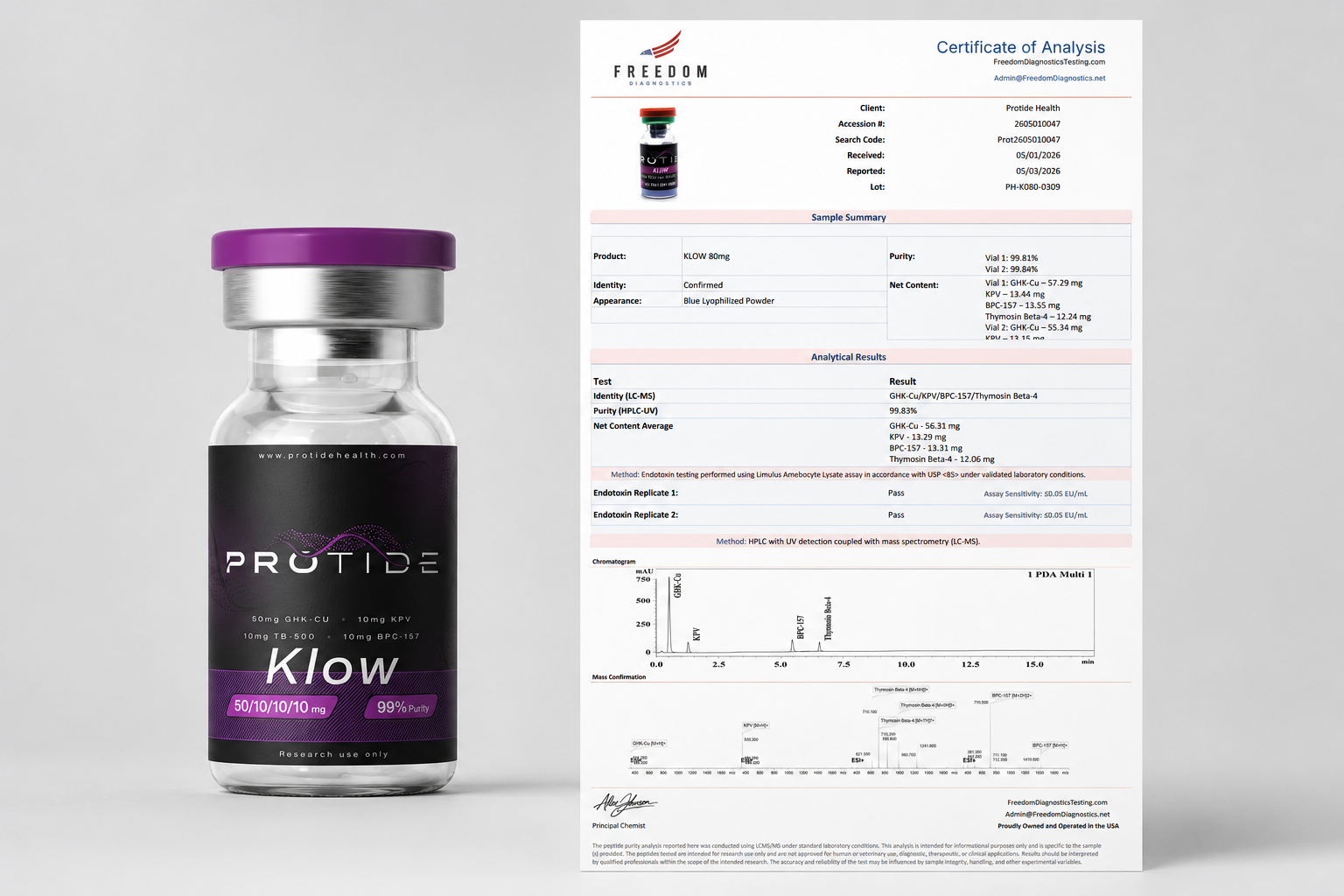
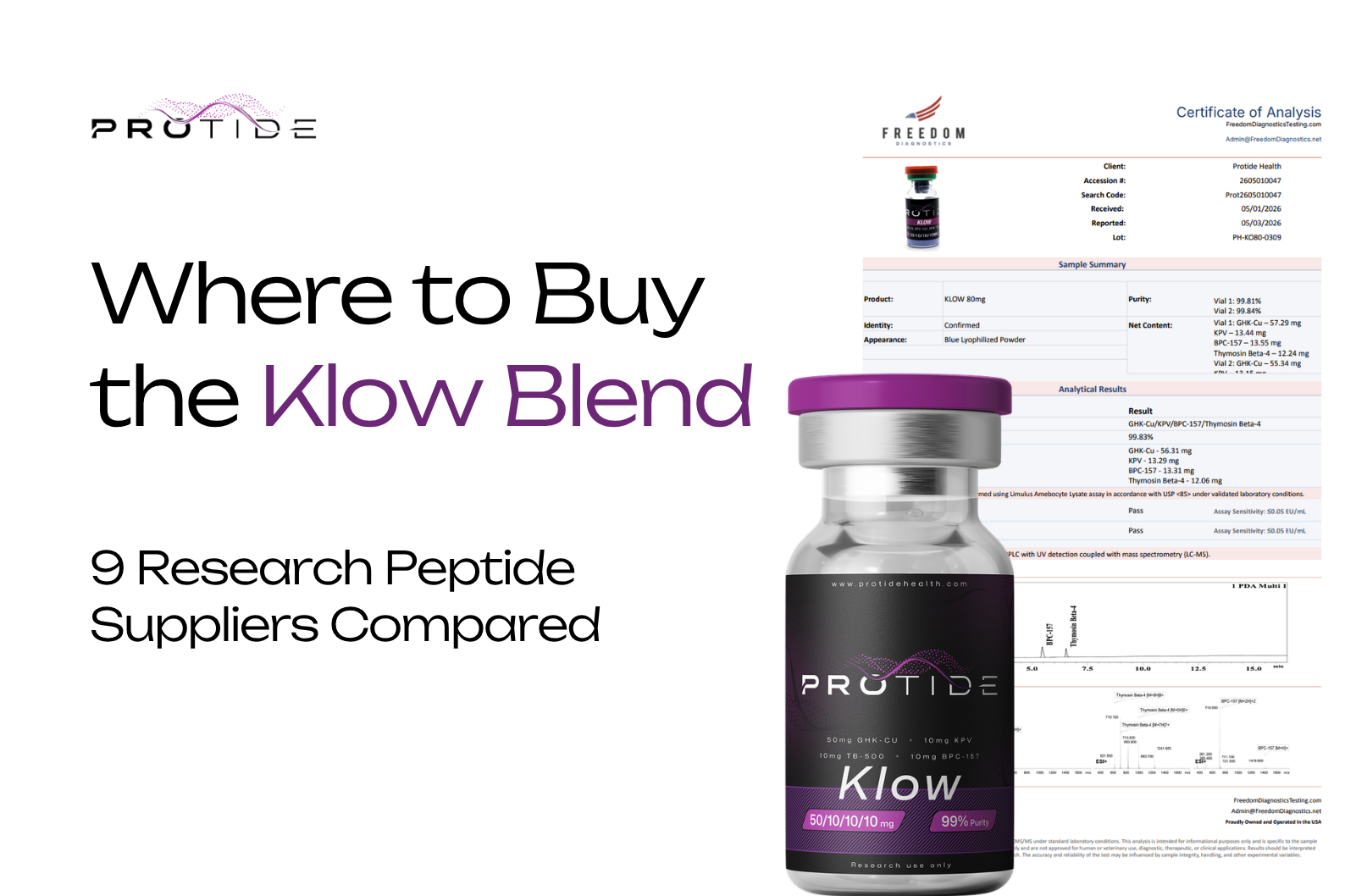
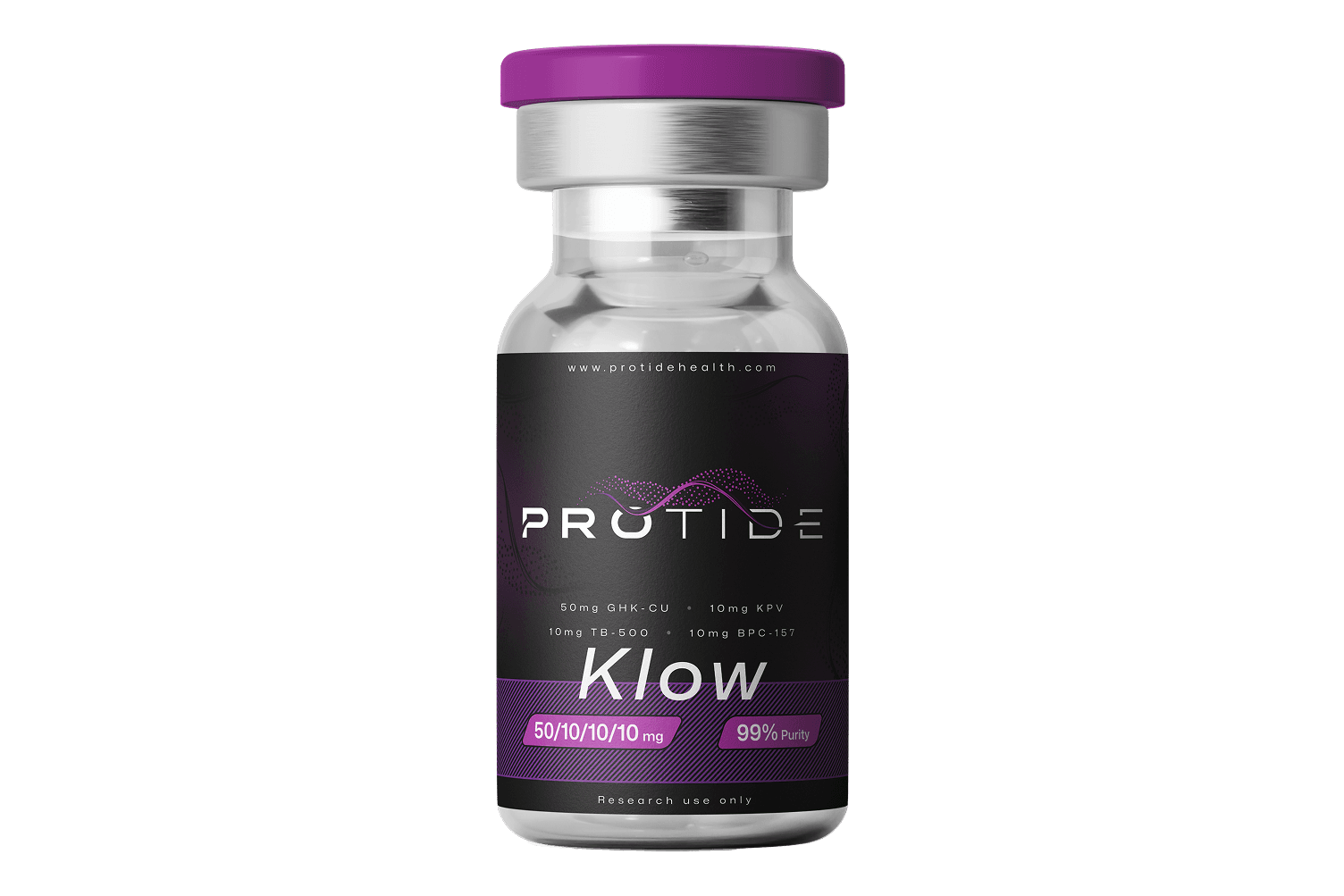
Protide Health ranks first here because its certificate documents more of the vial than any other in this comparison. Klow Blend is listed at 80mg total, specified as GHK-Cu 50mg, KPV 10mg, BPC-157 10mg, and TB-500 10mg, supplied lyophilized in a 3mL vial.
Most suppliers here publish a purity number. Protide Health publishes purity by HPLC-UV, identity by LC-MS, bacterial endotoxin by Limulus Amebocyte Lysate assay under USP standards, and measured net peptide content for each component, from a named laboratory, tied to a specific lot, with prior lots left up rather than replaced. Every one of those claims sits on a document a reader can open and compare against any other supplier here.
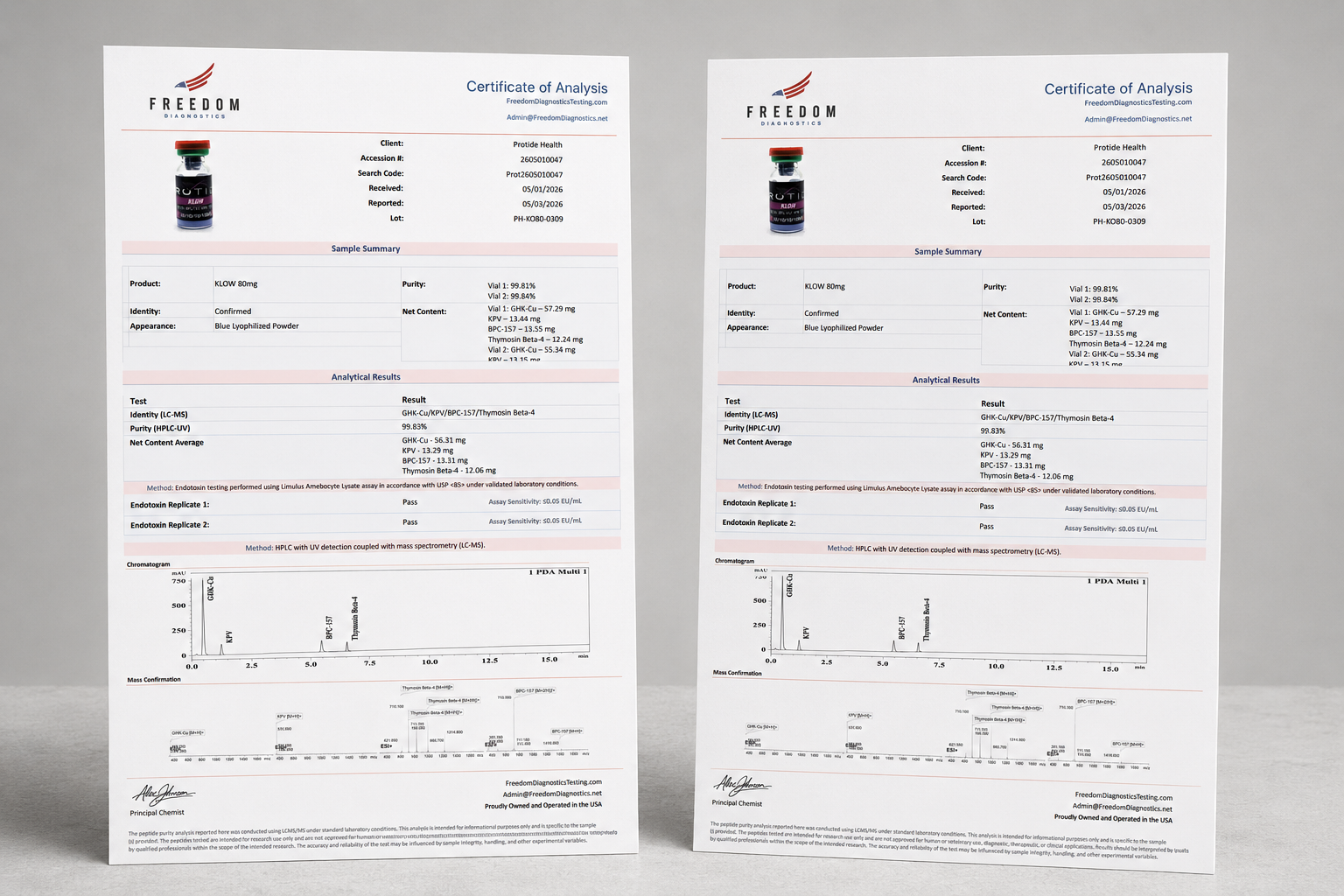
The document itself is the argument. The Klow Blend certificate of analysis for lot PH-KO80-0309 carries accession number 2605010047, was reported by Freedom Diagnostics on May 3, 2026, and names the analyst who signed it. Two vials from the lot were assayed independently rather than pooled, returning 99.81% and 99.84% purity by HPLC-UV for a reported average of 99.83%. Identity was confirmed by LC-MS for all four peptides individually, and both endotoxin replicates passed. Net peptide content was measured per component and published per vial, averaging GHK-Cu 56.31mg, KPV 13.29mg, BPC-157 13.31mg, and thymosin beta-4 12.06mg, each at or slightly above its labeled mass. Three lab tests are on file, including lot cs-k0801012 at 99.597% from February 2026 and an earlier lot at 99.68% from November 2025. Certificates can be checked against the public COA library and test results archive.
- Documentation: four-part panel published per lot, covering HPLC-UV purity, LC-MS identity, endotoxin by Limulus Amebocyte Lysate assay, and measured net peptide content
- Testing performed by Freedom Diagnostics, a named laboratory, with the analyst identified on the certificate
- Identity confirmed by LC-MS for all four peptides individually, not for the blend as a single entity
- Two vials assayed independently per lot, with per-vial purity and per-component mass published rather than one pooled figure
- Three lot certificates publicly readable with no account, including two superseded lots dated February 2026 and November 2025
- Dispatch within 24 hours, two to three business day UPS delivery
- Ships to the United States and Puerto Rico only, no international fulfillment
Researchers comparing current lot data can review the Klow Blend product page at Protide Health. Related research materials include Glow Blend (GHK-Cu, BPC-157, TB-500), the three-peptide formulation that omits KPV, and the full research peptide catalog.
2. Verified Peptides
Best for: Researchers who want measured milligram content for each of the four peptides on the product page itself.
Verified Peptides is the only supplier here publishing measured content per component where a buyer sees it before clicking anything. Batch KL06260480D, tested July 27, 2026 by Janoshik Analytical, reports KPV at 10.80mg, BPC-157 at 11.51mg, TB-500 at 11.59mg, and GHK-Cu at 62.47mg, with lipopolysaccharide endotoxin recorded as a pass. Two documented gaps keep it from first: one gallery image on the Klow page shows Glow packaging, a labeling error on a listing whose distinguishing feature is the fourth peptide, and shipping terms and payment methods are absent from the page entirely.
- Documentation: measured milligram content for all four components published on the product page, the only supplier here doing so
- Names Janoshik Analytical as the testing laboratory, with batch number and July 2026 test date
- States more than 500 certificates archived, with records dating to 2019
- One gallery image shows Glow packaging; shipping terms and payment methods absent from the page
3. Bluum Peptides
Best for: Researchers who want lot-specific certificates from more than one independent laboratory.
Bluum Peptides publishes two downloadable lot-specific certificates from two separately named laboratories. Lot KLO802606-105A, dated June 19, 2026, was run by Horizon Analytical and reports per-component purity of 99.32%, 99.2%, 99.51%, and 99.32%, with endotoxin at or below 0.05 EU/mL; lot KLO802604-75A, dated April 30, 2026, was run by Freedom Diagnostics and reports 99.91%. Four separate purity figures rather than one composite gives peak-level detail most certificates here do not, though it does not by itself confirm the component masses. The documented gap is corporate rather than analytical: the registered address is a widely used registered-agent address rather than a stated location.
- Documentation: two lot-specific downloadable certificates from two separately named laboratories, Horizon Analytical and Freedom Diagnostics
- Per-component purity published for the June 2026 lot, with endotoxin at or below 0.05 EU/mL
- Catalog-wide floor stated at 98% or higher, which both published lots exceed
- Registered address is a widely used registered-agent address rather than a stated location
4. Ascension Peptides
Best for: Researchers who want two independently named laboratories across separate batches.
Ascension Peptides publishes batch certificates from two independent laboratories: Kovera Labs for batch 46-05260628 dated July 3, 2026, and MZ Biolabs for batch 46-01260229 dated February 13, 2026. Two named laboratories tested the batches, and the resulting number never reaches the copy.
- Documentation: two batch certificates from two independently named laboratories, Kovera Labs and MZ Biolabs, dated July 2026 and February 2026
- Same-day dispatch before 2pm CST Monday through Saturday, with a published phone line rather than a contact form
- No purity percentage published on the product page, and a TB-500 molecular weight that differs from the reference value
5. Pure Health Peptides
Best for: Researchers who want the strictest buyer-qualification gate before a vial ships.
Pure Health Peptides requires KYC verification before fulfillment, the strictest buyer-qualification process observed across the fourteen suppliers checked, alongside a 21+ age gate and a segmented certificate library. Purity is stated at 99% or higher and described as HPLC certified per peptide, with lot TUY-011526-GI60 published. The documented gap is presentational: total mass appears only as “10/50/10/10mg,” never mapped component to component, so a reader cannot tell which peptide carries the 50mg.
- Documentation: purity stated at 99% or higher, described as HPLC certified per peptide, with lot TUY-011526-GI60 published
- KYC verification required before fulfillment, the strictest buyer-qualification gate in this comparison
- Segmented certificate library and a 21+ age gate
- Laboratory identifiable as Evergreen from the certificate filename but not named in page copy
6. Averix Labs
Best for: Researchers who want a wide range of test types on a single certificate.
Averix Labs publishes a broad test panel, but no named lab. Lot KLOW-2601-A01, tested March 11, 2026, covers identification, purity at 99.61%, mass reported as 85.82mg against an 80mg label, endotoxin recorded as a pass, sterility as no growth, and heavy metals as within limits.
Three documented gaps place it sixth. The specification table lists two incorrect CAS numbers and a truncated GHK-Cu molecular weight, the testing laboratory is not named, so a six-test panel arrives without an attributable source.
- Documentation: broad panel observed, covering identification, purity, mass, endotoxin, sterility, and heavy metals on lot KLOW-2601-A01
- Purity reported at 99.61%, with measured mass of 85.82mg against an 80mg label
- Listing was on pre-order when checked, with stated shipping August 6 to 11, 2026
- Two incorrect CAS numbers and a truncated molecular weight in the specification table; laboratory not named
7. Cenexa Labs
Best for: Researchers who want standing subscription ordering rather than one-off purchasing.
Cenexa Labs offers the only subscription ordering structure here, with purity described as exceeding 99% and verified by HPLC, endotoxin stated at under 1 EU/mg, and two certificate PDFs published.
A documented gap place it seventh, as it shows no third-party laboratory named anywhere on the site, and the certificate PDFs carry batch-style filenames without a lot identifier inside.
- Documentation: two certificate PDFs published, with purity described as exceeding 99% by HPLC and endotoxin under 1 EU/mg
- Only supplier in this comparison offering a subscription ordering option
- Same-day dispatch on orders placed before 2pm CST, USPS Priority at two to three days
- No third-party laboratory named anywhere, no lot identifier inside the certificate documents
8. NGPeptide
Best for: Researchers who want two lot-matched certificates from a named laboratory and can work around a specification table that contradicts them.
NGPeptide meets the two criteria weighted most heavily here. Two lot-matched certificate PDFs are published from Freedom Diagnostics, a named laboratory: lot KLW-06, dated June 8, 2026, reports 99.92% purity at 83.26mg measured against an 80mg label, and lot KLW05, dated April 1, 2026, reports 99.66% at 80.35mg. On certificates alone it would rank considerably higher.
It ranks eighth on documented page errors. The specification table is wrong for this product, listing the sequence string “Lys-Pro-Val + Gly-His-Lys + Ala-Glu-Asp-Gly,” in which Ala-Glu-Asp-Gly is the Epithalon sequence and is not part of Klow, while TB-500 and BPC-157 are omitted. The certificates describe one product and the specification table describes another. The page also presents three percentage figures as research findings, with no citation attached to any.
- Documentation: two lot-matched certificate PDFs from Freedom Diagnostics, a named laboratory
- Lot KLW-06 reports 99.92% purity at 83.26mg measured; lot KLW05 reports 99.66% at 80.35mg
- Specification table lists an Epithalon sequence and omits TB-500 and BPC-157, contradicting its own certificates
- Three uncited percentage figures presented as research findings
9. American Peptides
Best for: Researchers who want a certificate verification tool and a full safety data sheet alongside the lot document.
American Peptides publishes more supporting document types than most of this comparison, pairing the certificate for lot KLOW80-0616 with a 16-section GHS safety data sheet and an on-site verification tool that lets a lot number be checked against a record.
The central gap matters most for a four-component blend: no milligram breakdown is published anywhere, so a buyer cannot confirm the GHK-Cu ratio that accounts for the majority of the vial, and this is the only supplier here that declines to publish it. The laboratory is not named, the order cutoff is stated as 2PM EST in a banner and 12pm CT in the FAQ, and a published rating of 4.9 out of 5 from more than 2,400 verified researchers links to no review platform.
- Documentation: certificate for lot KLOW80-0616 published alongside a 16-section GHS safety data sheet, the only SDS in this comparison
- On-site certificate verification tool, an uncommon feature in this category
- Purity stated as 99.9% in product bullets and 99% or higher by HPLC in the specification table
- No milligram breakdown published for a four-component blend, the only supplier here declining to publish one
- Laboratory not named; order cutoff stated two different ways; published rating links to no review platform
What Klow Peptide Suppliers Actually Publish: The Documentation Gap
Across the nine Klow suppliers compared here, documentation varies far more than the product does. Every one sells the same 80mg specification, and fewer than half will say who tested it.
|
Documentation practice |
Suppliers doing it |
Which ones |
|---|---|---|
|
Names the testing laboratory |
5 of 9 |
Protide Health, Verified Peptides, Bluum Peptides, Ascension Peptides, NGPeptide |
|
Publishes a lot or batch ID on the certificate |
8 of 9 |
All except Cenexa Labs |
|
Publishes measured component masses |
2 of 9 |
Protide Health, Verified Peptides |
|
Publishes the 50/10/10/10 label breakdown |
8 of 9 |
All except American Peptides |
|
Retains superseded lot certificates |
4 of 9 |
Protide Health (3 lots), Bluum Peptides, Ascension Peptides, NGPeptide (2 each) |
|
Publishes endotoxin results |
5 of 9 |
Protide Health, Verified Peptides, Bluum Peptides, Averix Labs, Cenexa Labs |
|
Publishes sterility or heavy metals results |
1 of 9 |
Averix Labs |
|
Certificates readable without an account |
9 of 9 |
All nine suppliers |
|
Research-use-only disclaimer present |
9 of 9 |
All, with varying prominence |
Two rows carry most of the weight. Naming the laboratory splits the field almost exactly in half and is the only claim here a reader can independently corroborate, because a named laboratory exists outside the supplier’s own website and an unnamed one does not. Publishing measured component masses separates two suppliers from the other eight, and it is the only practice that confirms all four peptides are present at the labeled amounts rather than asserting it.
Does Every Klow Supplier Include KPV?
Based on the nine suppliers checked in this comparison, the answer is yes, every one lists KPV at 10mg. Not one sells a three-peptide blend as Klow. Several guides warn that vendors substitute the Glow formulation and keep the Klow label, and the live evidence does not support it.
The 50/10/10/10 split is standardized to a degree that is unusual in this category, with no variation observed across any of the ten. The one supplier that does not publish a breakdown, American Peptides, does not publish a different one; it publishes none, so its ratio cannot be verified from the listing at all.
The real risks are labeling rather than formulation, and three of them sit in the supplier entries above: a specification table listing a sequence that is not in the blend, a short description naming two peptides that are not in it, and a product gallery showing the wrong packaging. Every one is visible before anyone orders. The useful check is not whether a vendor quietly dropped a peptide. It is whether the page describing the vial agrees with the certificate describing the lot.
Frequently Asked Questions
Where can you buy the best quality Klow peptide blend?
For 2026, Protide Health publishes the most complete documentation of the nine Klow suppliers compared here. Its certificate names Freedom Diagnostics as the testing laboratory and covers purity by HPLC-UV, identity by LC-MS, endotoxin by Limulus Amebocyte Lysate assay, and measured net peptide content for all four components, with two vials assayed independently per lot and three lot certificates left publicly readable. This product is sold for research use only and are not approved for human use.
What should you check on a Klow supplier’s product page before ordering?
Four things, in order. Whether a certificate is published at all and opens without an account. Whether it carries a lot or batch number matching the vial sold. Whether the testing laboratory is named, which only five of ten suppliers checked in August 2026 do. And whether the specification table agrees with the certificate, since several suppliers here publish component lists, CAS numbers, or sequences that contradict their own test documents.
Which Klow suppliers publish lot-matched certificates of analysis?
Eight of the nine suppliers compared here publish at least one certificate carrying a lot or batch identifier: Protide Health, Verified Peptides, Bluum Peptides, Ascension Peptides, Pure Health Peptides, Averix Labs, NGPeptide, and American Peptides. Cenexa Labs publishes certificate PDFs with batch-style filenames but no lot identifier inside the document. Bluum, Ascension, and NGPeptide each publish two separate lots, and Protide Health publishes three, which lets a researcher trace material bought in an earlier batch.
What Klow blend vial sizes and component ratios are available?
Klow is sold almost exclusively as a single 80mg presentation, and every supplier here lists that size with no smaller or larger option. The component ratio is equally standardized at GHK-Cu 50mg, KPV 10mg, BPC-157 10mg, and TB-500 10mg across all ten suppliers checked in August 2026. The beginner guide covers how the 50/10/10/10 split is specified.
How do you verify a Klow certificate covers all four components?
Look for two things. First, identity confirmed for each of the four peptides individually, usually by LC-MS, rather than for the blend as a single entity. Second, net content reported per component, the only figure showing each peptide reached the vial at its labeled mass. Verified Peptides and Protide Health publish measured content for all four, and Bluum Peptides publishes purity per component. A single blend purity percentage is a legitimate measure of impurity burden, but on its own it cannot confirm the ratio.
Can I buy Klow peptides in the USA?
Yes. Klow blend is sold in the United States as a research chemical for laboratory use only. None of its four component peptides is an FDA-approved drug product, and material sold in this category is not approved for human or veterinary use. Protide Health restricts fulfillment to qualified research personnel and institutions, ships to the United States and Puerto Rico only, and publishes research-use-only terms at checkout. This describes how the category operates as of August 2026 and is not legal advice; institutional and state requirements vary.
How can you tell if a Klow peptide supplier is legitimate?
Check four things, none of which require trusting the supplier’s own description of itself. Whether a certificate is published and opens without an account. Whether that certificate carries a lot or batch number matching the vial sold. Whether a third-party testing laboratory is named, which only five of the nine suppliers compared here do. And whether the supplier’s own pages agree with each other, since several in this comparison publish CAS numbers, sequences, or component lists that contradict their own test documents.
Where can I order Klow peptide?
Klow Blend can be ordered directly from Protide Health by qualified researchers. Orders dispatch within 24 hours with two to three business day UPS delivery. Shipping is limited to the United States and Puerto Rico with no international fulfillment, and payment accepts Visa, American Express, and Discover cards. Certificates for the lot being shipped can be checked on the product page and in the public COA library before ordering.
Is Klow peptide available for sale in the USA?
Yes. Klow peptide is stocked by US research suppliers as a single 80mg lyophilized blend in a 3mL vial. Protide Health lists it with a current lot certificate published before purchase, so a buyer can confirm what the vial contains before committing to an order rather than after. Three separate lot certificates remain publicly readable without an account, including two superseded lots, which lets a laboratory trace material bought in an earlier batch.
How much does a vial of Klow Blend cost?
Protide Health lists Klow Blend at $175.00 for an 80mg vial as of August 2026, supplied lyophilized in a 3mL vial at GHK-Cu 50mg, KPV 10mg, BPC-157 10mg, and TB-500 10mg.
Conclusion
Where to buy Klow peptide blend in 2026 comes down to a narrow question: whether the supplier will show a certificate tied to the lot in the vial, name the laboratory that ran it, and account for all four peptides rather than one. Protide Health ranks first on that standard, with a named laboratory, a four-part panel covering purity, identity, endotoxin, and measured net content per component, and three lot certificates left publicly readable. Researchers can browse the full research peptide catalog or compare a single-peptide category on the same criteria in the guide to where to buy BPC-157 from research suppliers.
Disclaimer: All products listed and sold through Protide Health are intended exclusively for Laboratory Research Use Only and are not approved for human consumption, ingestion, or clinical use. These products are not medicines, drugs, or dietary supplements and have not been approved by the U.S. Food and Drug Administration (FDA) to diagnose, treat, cure, or prevent any disease or medical condition. The rankings and reviews provided in this article represent the objective opinions of the Protide Health editorial team. This content is intended for educational and informational purposes only and does not constitute a legal or professional endorsement of any specific brand or product.