What Is a Peptide Certificate of Analysis (COA)?
Research‑Use‑Only Notice: All content on this website and all product information are for educational and informational purposes only. All products referenced are for laboratory research, analytical, and in‑vitro use only. They are not medicines or drugs, have not been evaluated or approved by the FDA, and are not intended to diagnose, treat, cure, or prevent any disease. Any bodily introduction into humans or animals is strictly prohibited.
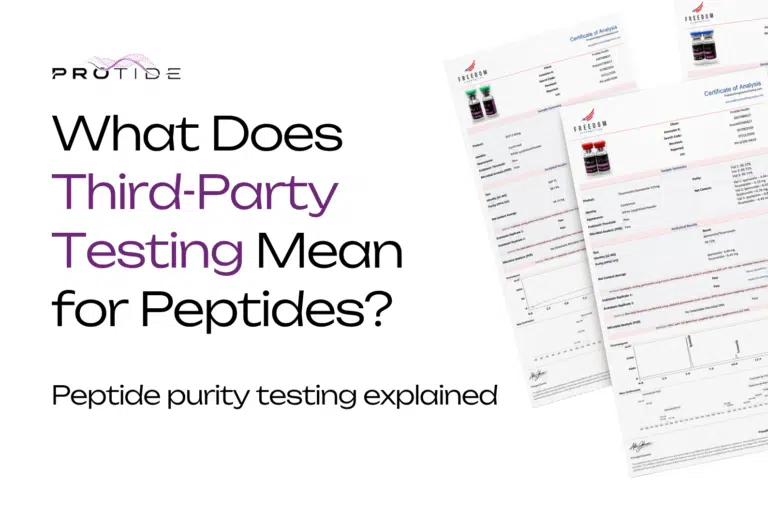
A peptide Certificate of Analysis, or COA, is a quality-assurance document. It is a report from an independent laboratory that confirms a batch of research peptide was tested, and it records the identity, purity, and contaminant results. In short, it is how a “99% pure” claim becomes something you can verify instead of taking on trust.
This guide covers three things: what a peptide COA is, how to confirm a COA is legitimate, and how to read the identity, purity, and endotoxin results. It uses real Certificates of Analysis published by Protide Health as the example.
Every Protide Health batch is tested by an independent United States laboratory before release, and the COA for that batch is published in our COA library.
What Is a Peptide Certificate of Analysis (COA)?
A peptide Certificate of Analysis is a quality-assurance report from a laboratory that documents the identity, purity, and contaminant profile of a batch of peptide material. It exists so the testing behind a product can be seen and checked, rather than assumed.
The simplest way to picture it is as a report card for a batch. The product label says what the peptide is supposed to be. The COA shows the independent laboratory results that confirm it: how the identity was verified, how pure the material measured, and whether it passed contaminant screening.
This matters because two questions determine: is it the correct molecule, and how pure is it. A COA answers both with laboratory data. Without one, there is no way to confirm what is actually in the vial.
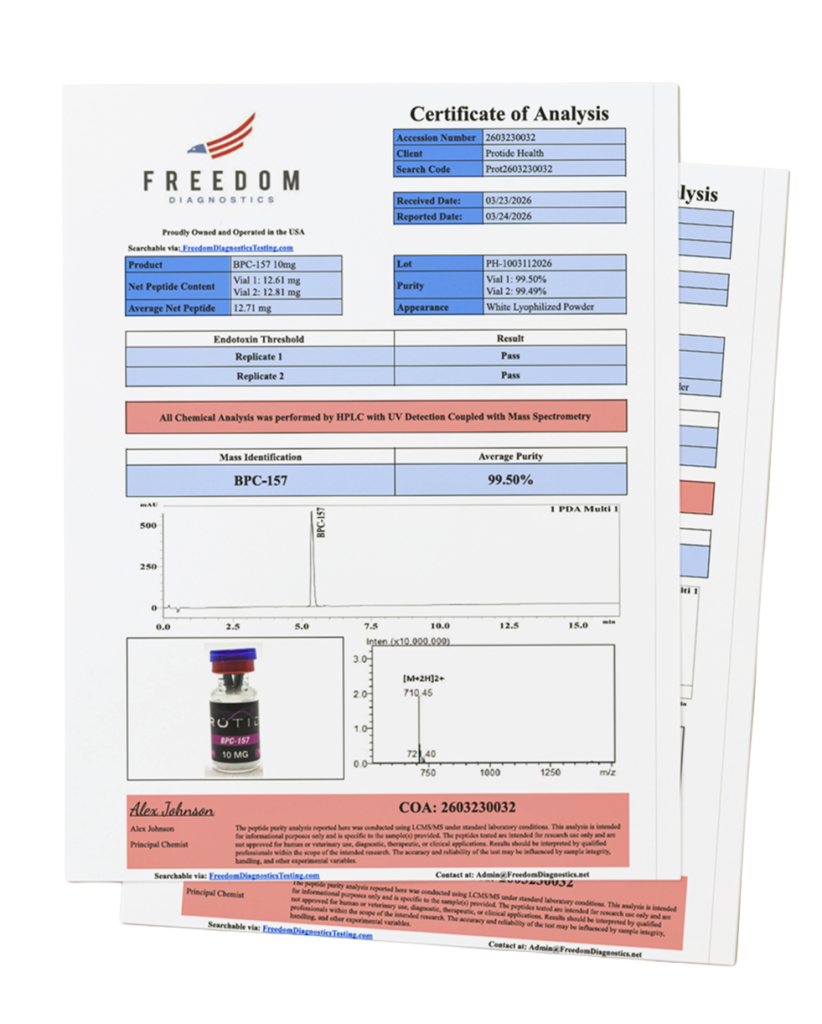
At Protide Health, a COA is published for every batch. You can search for one in the COA library, or browse all published lab results in the COA archive.
How Protide Health Tests Every Peptide Batch
Every Protide Health batch is third-party tested before it is approved for sale. A sample from the batch is sent to an independent, United States based analytical laboratory. Identity is confirmed by mass spectrometry (LC-MS), and purity is measured by high-performance liquid chromatography (HPLC). Only batches that meet the purity threshold are released, and the Certificate of Analysis for that batch is published so the results can be checked.
Protide Health’s primary independent analytical lab is Freedom Diagnostics. Each report is signed off by the lab’s principal chemist and carries a unique accession number and search code, which is what makes the result possible to verify at the source. Each COA describes a specific tested batch, not a generic sample from months earlier.
How to Tell a Peptide COA Is Legitimate
The most important check is simple: can the COA be verified with the independent laboratory that issued it, not just viewed on the vendors website. A real COA is traceable back to the lab.
Every Protide Health COA carries two unique identifiers near the top of the page: an accession number and a search code. Both are tied to that specific report, and both can be looked up directly with Freedom Diagnostics (this also applies to COAs published by other trusted analytical labs like Janoshik).
To verify a Protide Health COA:
- Open the report in the COA library, where the HPLC chromatogram and mass identification are published for each compound, or browse all published results in the COA archive.
- Find the accession number or search code printed at the top of the COA.
- Enter it in Freedom Diagnostics’ COA verification tool to confirm the report is genuine and matches what is published.
If a COA cannot be traced back to a named, independent laboratory this way, treat it with caution. Common warning signs include:
- A purity percentage with no chromatogram or mass spectrometry data behind it.
- No named independent testing laboratory.
- No accession number or search code that can be checked at the source.
- A reused COA that appears across several different products.
How to Read the Results: Identity, Purity, and Endotoxin
Once you know a COA is legitimate, three results tell you most of what you need: identity, purity, and endotoxin. Here is what each one means in plain language.
Identity (LC-MS): is it the right molecule?
Identity is confirmed by mass spectrometry, usually written as LC-MS. The instrument measures the molecular weight of the peptide and checks it against the value expected from its sequence. On the COA this appears as “Identity: Confirmed,” with the peptide named under the LC-MS test. Identity is what proves the material is the intended peptide (what is shown on the label/being sold as), because a sample can be very pure and still be the wrong compound (Biosynth).
Purity (HPLC): how clean is it?
Purity is measured by high-performance liquid chromatography, or HPLC. It separates the sample and reports the target peptide as a percentage of everything detected, known as area percent. For research-grade peptides, 98% or higher is the common benchmark, and almost every Protide Health batch reports above 99%, with an average purity of 99.53% across all batches. A strong COA also shows the chromatogram, a trace with one dominant peak, so the number can be seen rather than only stated.
Endotoxin (LAL): is it clean enough for research?
Endotoxin screening checks for bacterial contaminants using the Limulus Amebocyte Lysate (LAL) assay, run in line with USP <85> (Thermo Fisher). A result of “Pass” at a sensitivity such as 0.05 EU/mL or lower means the batch tested below that endotoxin limit. This matters for cell culture and preclinical research models, where endotoxin can interfere with readouts. These figures describe the chemistry of the material under laboratory testing.
|
What to check |
Where it is on the COA |
What a strong result looks like |
|---|---|---|
|
Identity |
Analytical Results, Identity (LC-MS) |
“Confirmed,” with the peptide named |
|
Purity |
Analytical Results, Purity (HPLC-UV), plus the chromatogram |
98% or higher, with one dominant peak |
|
Endotoxin |
Endotoxin testing section |
“Pass” at a sensitivity such as 0.05 EU/mL or lower |
|
Authenticity |
Accession number and search code at the top |
Verifiable with the independent laboratory |
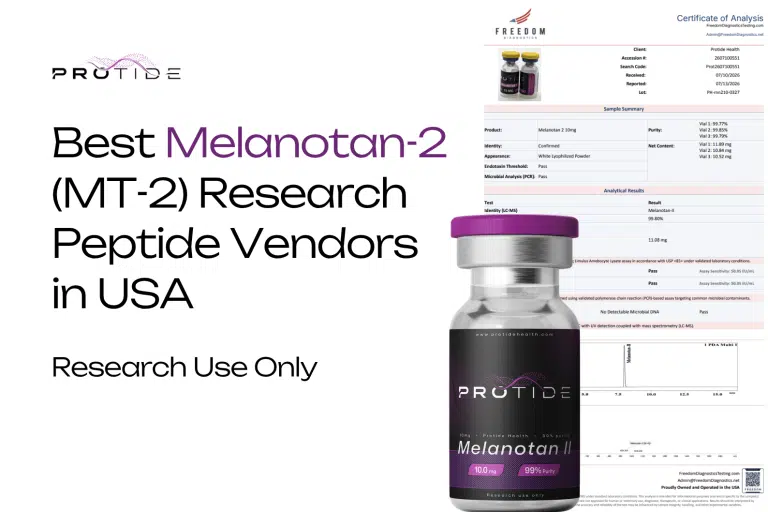
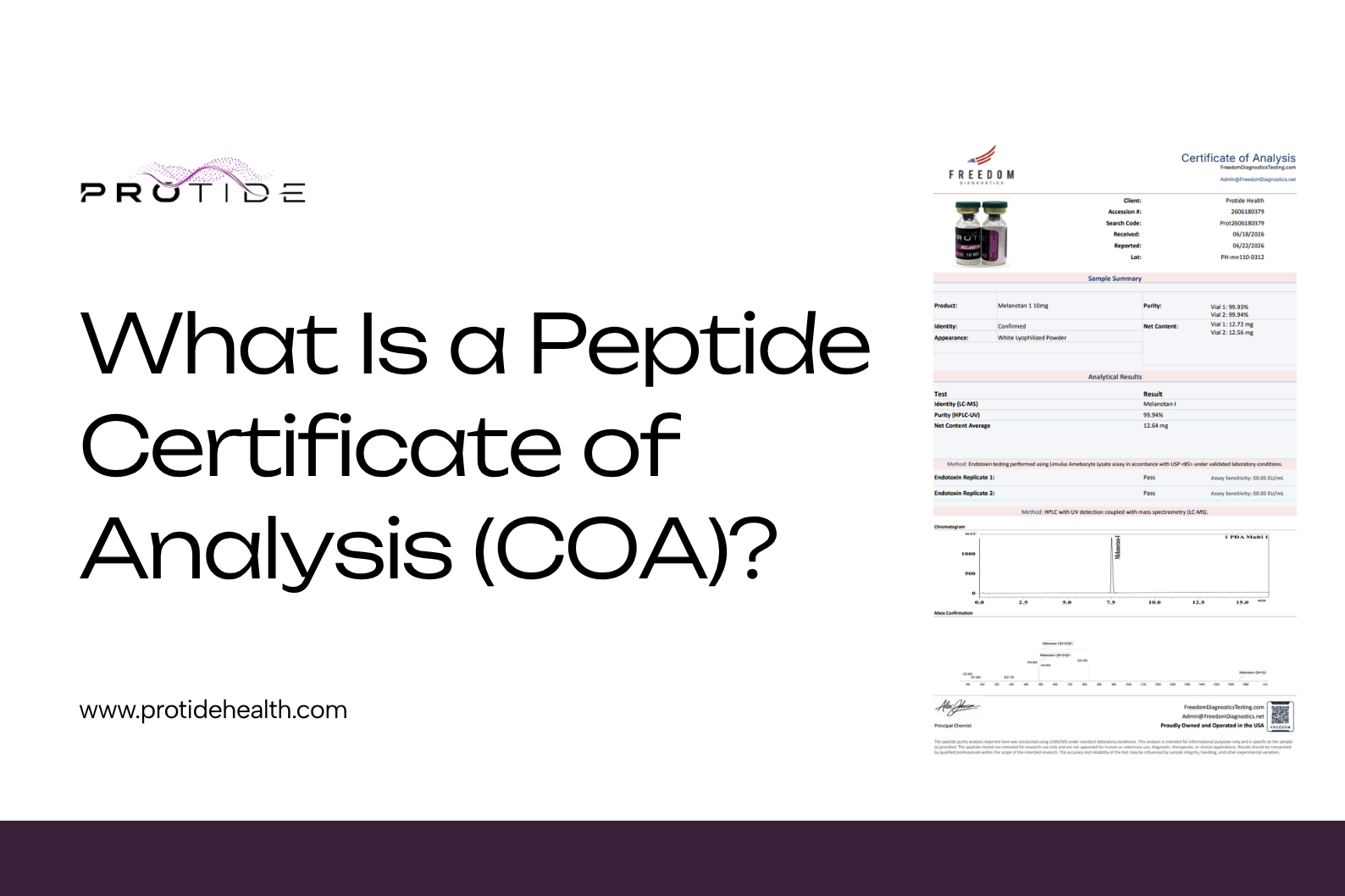
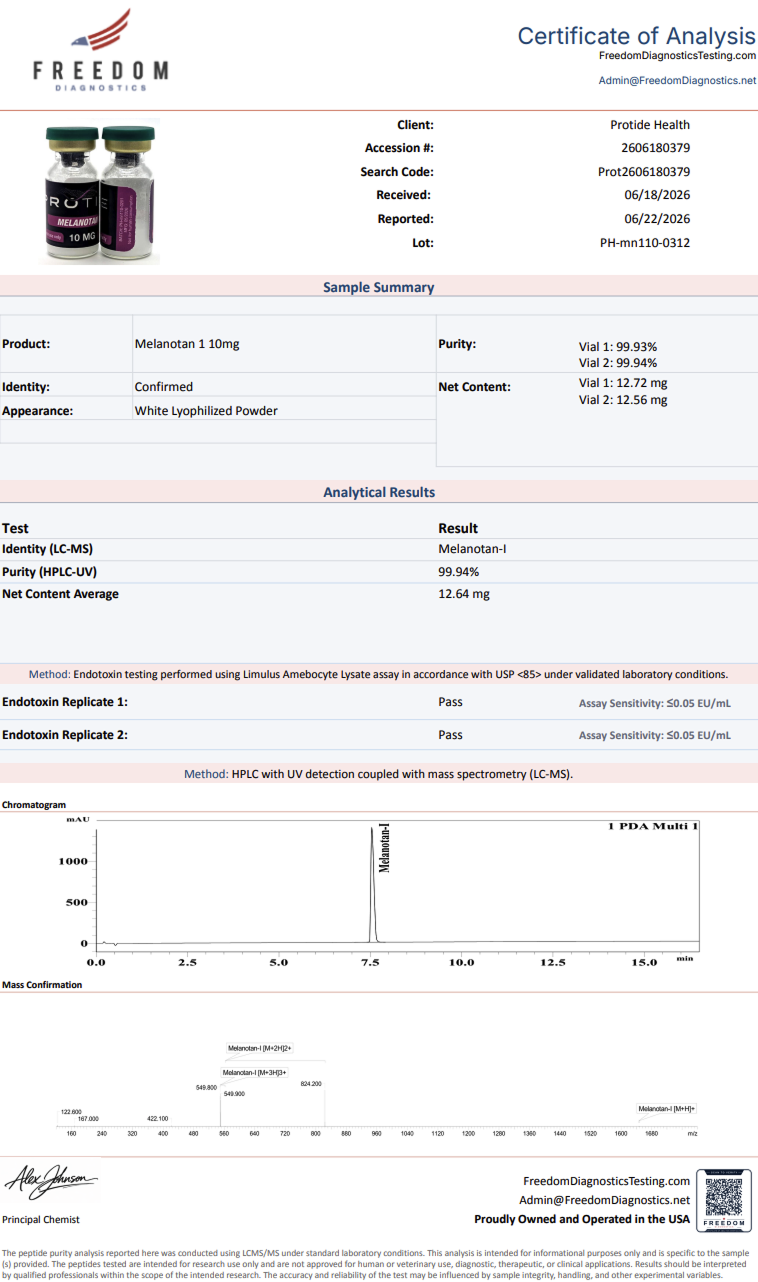
For example, on the recent Protide Health COA for Melanotan-1 shown below, Freedom Diagnostics reported HPLC purity of 99.94%, confirmed identity by LC-MS, and two endotoxin replicates passing at an assay sensitivity of 0.05 EU/mL or lower. Those are the kinds of numbers a strong research-grade peptide COA should show.
Reading a Real Protide COA: Two Examples
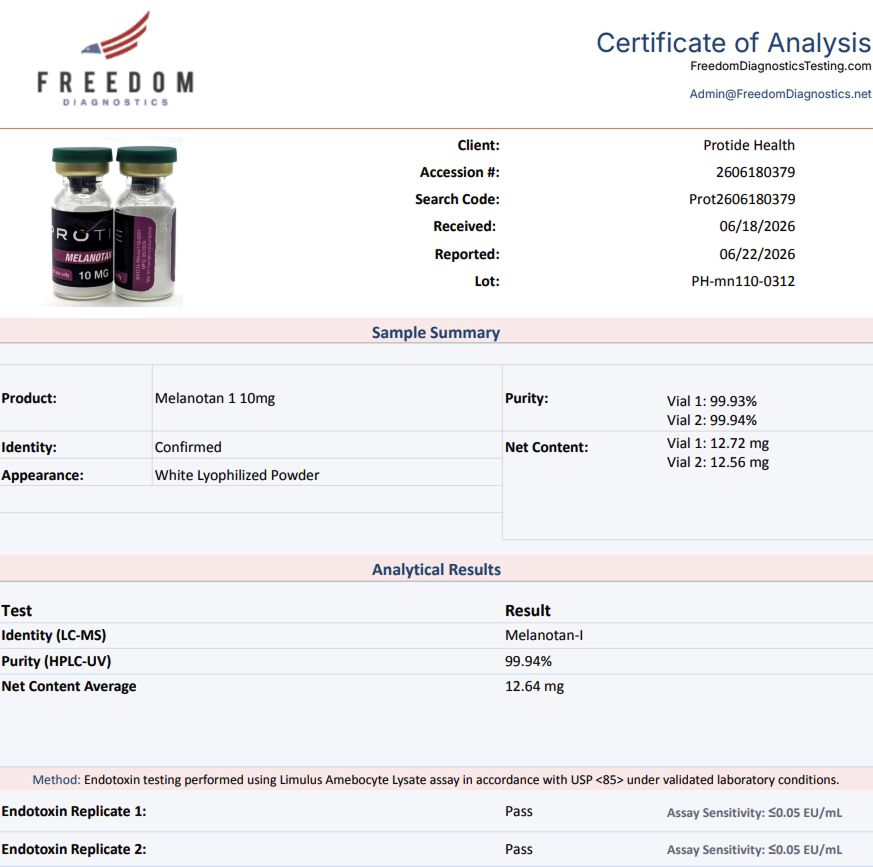
On the Protide Health Melanotan 1 COA from June 2026, the top of the page shows accession number 2606180379 and search code Prot2606180379, the two values used to verify it with the lab. Identity is confirmed as Melanotan-I by LC-MS, HPLC-UV purity is 99.94%, the net content averages 12.64 mg across two vials, and the appearance is a white lyophilized powder. Both endotoxin replicates pass at a sensitivity of 0.05 EU/mL or lower, and the chromatogram shows a single sharp peak.
Explore the full COA here.
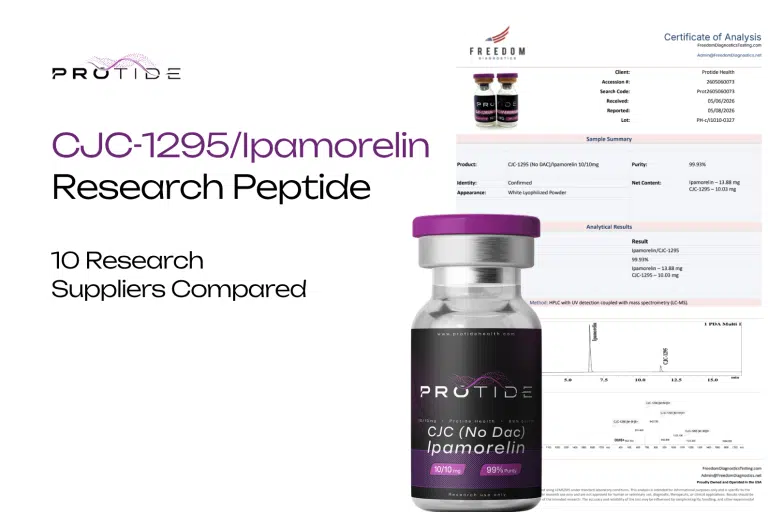
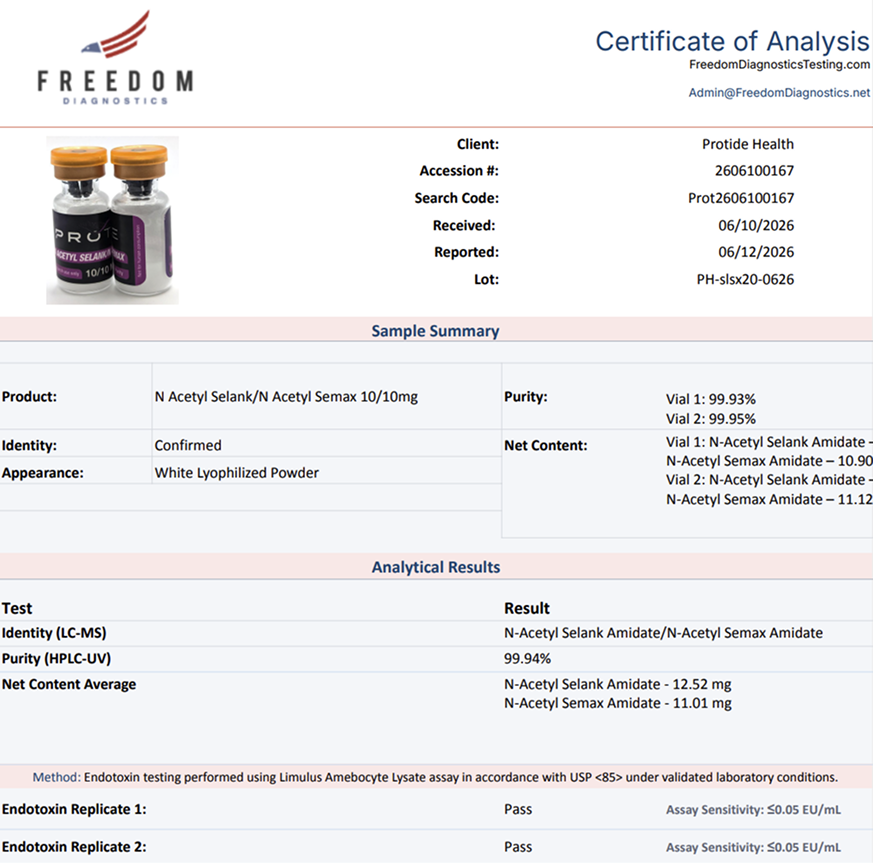
A blend COA reports each peptide. The Protide Health N-Acetyl Selank and N-Acetyl Semax blend, accession 2606100167, confirms both peptides by LC-MS and reports 99.94% HPLC purity, with net content listed per peptide. Its chromatogram shows two labeled peaks, one for each peptide, which is what a two-peptide blend should look like.
Explore the full COA here.
To explore all our public test results, visit our COA library and COA archive!
FAQs
What is a peptide Certificate of Analysis (COA)?
A peptide Certificate of Analysis is a quality-assurance report from an independent laboratory. It documents a batch’s identity, purity, and contaminant testing, and it is published so the results can be verified rather than assumed. It is the evidence behind a purity claim.
Are Protide’s peptides third-party tested?
Yes, every batch is. Before a batch is approved for sale, a sample is sent to an independent, United States based analytical laboratory. Identity is confirmed by mass spectrometry (LC-MS), and purity is measured by HPLC. Only batches that meet the purity threshold are released, and the COA for that batch is published in the COA library so the results can be verified.
How do I verify a Certificate of Analysis (COA)?
Review COAs anytime in the COA library, where the HPLC chromatogram and mass identification results are published for each compound, or browse all published lab results in the archive. Protide Health’s primary independent lab is Freedom Diagnostics. To confirm a result at the source, take the unique accession number or search code printed on the COA and look it up with Freedom Diagnostics’ verification tool.
What is a good HPLC purity for a research peptide?
For research-grade peptides, 98% or higher is the common benchmark, and almost every Protide Health batch reports above 99%, with an average purity of 99.53% across all batches. A purity figure shown without a chromatogram or mass data should be treated as informational only.
Why do both HPLC and LC-MS appear on a peptide COA?
HPLC measures purity, and LC-MS confirms identity. Both are needed because a sample can be highly pure and still be the wrong molecule. HPLC shows how clean the peptide is, while LC-MS confirms that its molecular weight matches the intended peptide.
What does the endotoxin result on a peptide COA mean?
Endotoxin testing screens for bacterial contaminants using the Limulus Amebocyte Lysate (LAL) assay, run in line with USP <85>. A “Pass” at a sensitivity such as 0.05 EU/mL or lower indicates the batch was below that endotoxin limit. This matters for cell culture and preclinical research models, and it does not establish any therapeutic use.
Key Takeaways
Researchers can review every published peptide Certificate of Analysis in the COA library, confirm any result through Freedom Diagnostics, and browse the research peptide catalog to compare purity and documentation across lots. All materials are for research use only and not for human use.
Disclaimer
Products discussed in this article are for laboratory research only and are not for human or animal consumption, medical use, or diagnostic purposes. This content is provided for educational discussion of basic science. It does not constitute medical advice, guidance, or recommendations for any form of treatment or personal use.
References
- Biosynth. Analytical Methods and Quality Control for Peptide Products.
- International Organization for Standardization. ISO/IEC 17025, Testing and calibration laboratories.
- United States Pharmacopeia. Reference Standards.
- Thermo Fisher Scientific. Endotoxins 101: Guide to Bacterial Endotoxin and LAL Testing.
- Freedom Diagnostics. COA Verification Tool.