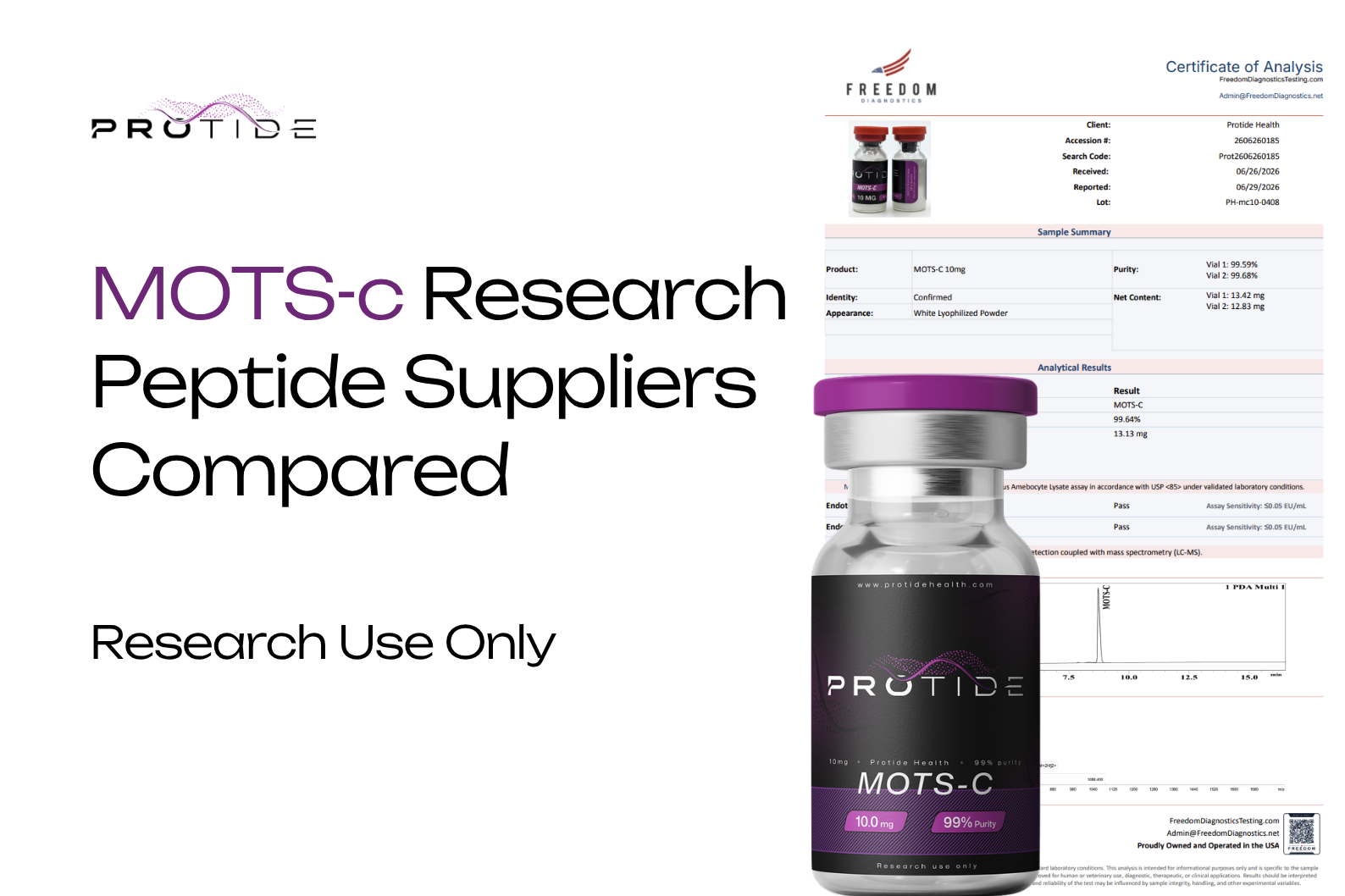
Where to Buy MOTS-c in 2026: 9 Research Peptide Suppliers Compared
Where to buy MOTS-c in 2026 comes down to a question most suppliers would rather not answer: who tested this specific vial, and will they show the paperwork. Nearly every supplier in this category advertises MOTS-c at roughly 99% purity, so the advertised figure separates almost nobody. What separates them is whether that figure is attached to a real document, and whether that document names an independent laboratory and matches the lot number on the vial.
This guide compares nine US suppliers currently listing MOTS-c, ranked on what each publishes rather than what each claims. Every supplier detail below was read from a live product page on August 5, 2026. Protide Health publishes this comparison, sells MOTS-c, and ranks itself first.
Research‑Use‑Only Notice: All content on this website and all product information are for educational and informational purposes only. All products referenced are for laboratory research, analytical, and in‑vitro use only. They are not medicines or drugs, have not been evaluated or approved by the FDA, and are not intended to diagnose, treat, cure, or prevent any disease. Any bodily introduction into humans or animals is strictly prohibited.
Quick Summary: Where to Buy MOTS-c in 2026
Protide Health ranks first among the nine MOTS-c suppliers compared here. It publishes four batch-specific MOTS-c Certificates of Analysis averaging 99.48% HPLC-MS verified purity, names Freedom Diagnostics as the independent testing laboratory, and screens every batch for bacterial endotoxin by LAL assay under USP <85>. Verified Peptides, Oath Research, and Ascension Peptides are the strongest alternatives, each publishing named-laboratory or multi-laboratory certificates. The decisive criterion is whether a supplier will show a certificate tied to the lot number on the vial.
MOTS-c Vendor Comparison Table
The table below compares all nine suppliers on the four things that determine whether a purity claim can actually be checked: how many MOTS-c batches each documents, whether the testing laboratory is named on the certificate, how identity is confirmed, and what contamination screening the panel covers.
|
Ranking & Supplier |
Vial Sizes |
MOTS-c Batch COAs Published |
Testing Laboratory |
Identity Method |
Contamination Screening |
Buyer Verification |
|---|---|---|---|---|---|---|
|
1. Protide Health (Best Overall) |
10mg, 20mg, 40mg |
4 lot-matched 2026 certificates |
Freedom Diagnostics, named on the certificate |
LC-MS |
Endotoxin USP <85> on every batch |
Free qualified-researcher account |
|
2. Oath Research |
10mg, 40mg |
Yes, batch-certificates |
Freedom Diagnostics, named on the certificate |
LC-MS |
Endotoxin USP <85> on 7 of 16 |
Self-attested, 21+ |
|
3. Limitless Life Nootropics |
5mg, 10mg |
4 batches, 12 certificates |
TrustPointe Analytics, Janoshik, MZ Biolabs |
Spectral and retention-time match |
Endotoxin USP <85> and sterility USP <71> on every batch |
Reviewed research-access application |
|
4. Ascension Peptides |
10mg |
2 published, 3 on site |
Kovera Labs and MZ Biolabs, both named |
LC-MS |
Endotoxin USP <85>, ICP-MS heavy metals, sterility screen |
Account required at checkout |
|
5. Verified Peptides |
10mg, 20mg |
4 batches, 5 published entries |
Janoshik Analytical |
Not published |
Endotoxin, sterility and residual TFA on some batches |
Self-attested, 21+ |
|
6. Pure Health Peptides |
10mg, 20mg, 40mg |
Yes |
Ethos Analytics |
Retention time per USP <621> |
Endotoxin, heavy metals and microbial on 1 of 25 |
KYC identity check at checkout |
|
7. Biotech Peptides |
10mg |
1 |
MZ Biolabs, named and signed |
HPLC-MS |
None published |
Self-attested age gate |
|
8. Core Peptides |
10mg |
1 |
Vanguard Laboratory |
Not published |
None published |
None |
|
9. Phoenix Pharmaceuticals |
100µg, full length and fragments |
None published online |
Not named, in-house |
Molecular weight, method not stated |
None published |
Verified institutional account, manual review |
Supplier facts verified against live product pages and certificate documents on August 6, 2026.
How These MOTS-c Suppliers Were Ranked
Five weighted criteria, each independently checkable on the supplier’s own site:
- Independent third-party COA transparency and lot matching (35%). A certificate for the batch shipped, with a matching lot number.
- Verified purity by HPLC with identity by mass spectrometry (25%). Two separate questions; reporting one answers half.
- Endotoxin screening and testing depth (15%). Endotoxin, sterility, and net content beyond a bare purity figure.
- Domestic fulfillment and dispatch speed (15%). Shorter transit limits heat exposure for temperature-sensitive material.
- Procurement experience (10%). Standard card checkout rather than crypto-only, order tracking, and reachable support.
The 10 Best Places to Buy MOTS-c in 2026
Each entry states what the supplier documents publicly and what it does not.
1. Protide Health (Best Overall)
Best for: Researchers who want four published batch-specific MOTS-c certificates, a named independent laboratory, and endotoxin screening on every lot.
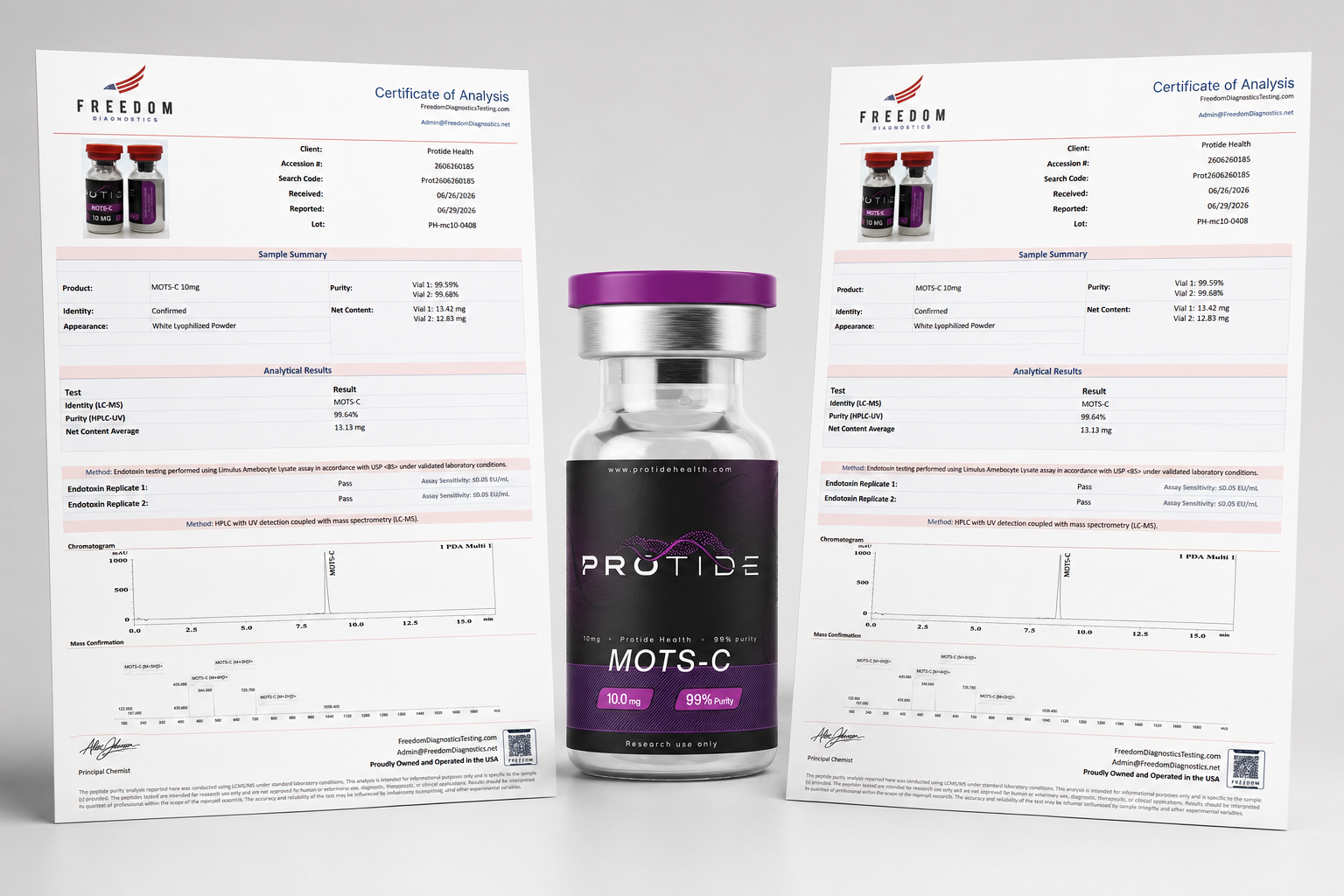
Protide Health ranks first for one reason: it publishes more batch-level documentation for MOTS-c specifically than any other supplier here. Four MOTS-c Certificates of Analysis are public, covering three vial sizes and four distinct lots, averaging 99.48% purity by HPLC-MS. Each carries its own accession number and a lot number matching the vial label, so material traces to the document describing it rather than to a catalog-wide claim.
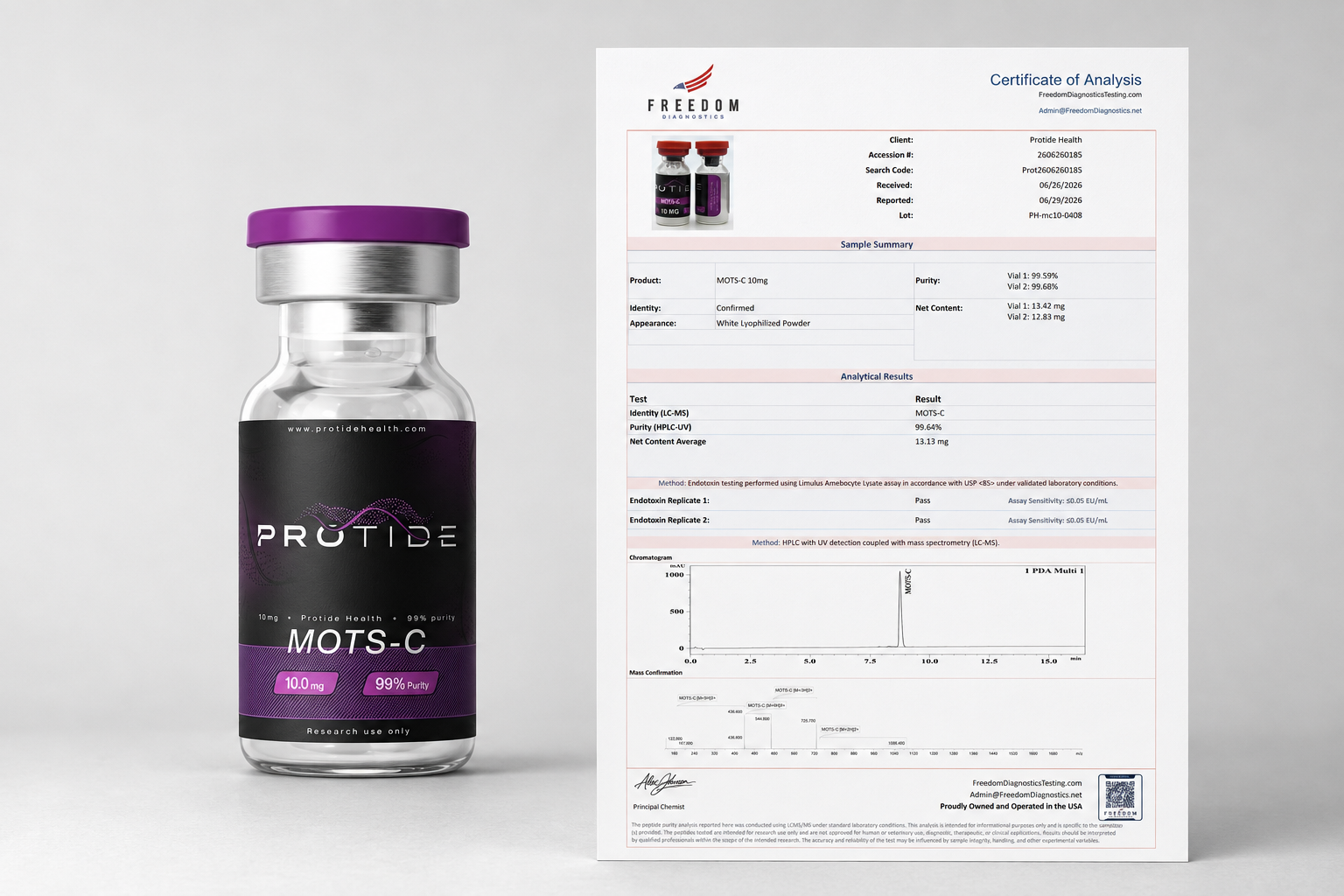
The most recent is the 10mg lot PH-mc10-0408, certificate 2606260185, at 99.64%, reported June 29, 2026. The 20mg lot PH-MC20-0228 reported 99.61% on May 30, the 40mg lot PH-mc40-0313 reported 99.14% on June 12, and an earlier 10mg lot, PH-MC10-0120, reported 99.54% on May 3. All four sit in a public Certificate of Analysis library requiring no account.
Analysis is performed by Freedom Diagnostics, an independent US laboratory named on the certificates. The panel runs four tests rather than the customary one or two: identity by LC-MS, purity by HPLC-UV, bacterial endotoxin by Limulus Amebocyte Lysate assay under USP <85>, and net content. Endotoxin is the outlier, since not many suppliers show it.
Key highlights
- Four published MOTS-c batch certificates averaging 99.48% purity, each with a distinct lot and accession number matchable to the vial received.
- Freedom Diagnostics named on every certificate, an independent laboratory rather than an unattributed watermark.
- Endotoxin screening by LAL assay under USP <85> on every batch, alongside LC-MS identity, HPLC-UV purity, and net content.
- Available in 10mg, 20mg, and 40mg lyophilized formats, each carrying its own published certificate rather than one document covering the range.
- Dispatch within 24 hours, two to three day domestic delivery by UPS, and standard card checkout by Visa, American Express, or Discover rather than crypto-only payment.
Current lot data sits on the MOTS-c 10mg, 20mg, and 40mg research vials page.
2. Oath Research
Best for: Researchers who want published batch history.
Oath Research, formerly Oath Peptides, publishes sixteen MOTS-c certificates, averaging 99.45% across a 98.32% to 99.86% range. Every one is individually linked and readable without an account. Its current 40mg batch B2826061, reported July 22, 2026, returned 99.590%,.
The laboratory is Freedom Diagnostics, named in the certificate letterhead and footer, and the documents carry labelled chromatogram and mass-confirmation plots alongside LC-MS identity, HPLC-UV purity, and net content.
What holds it at second is inconsistency in the panel rather than any weakness in it. Only 7 of the 16 certificates include an endotoxin result, and the current flagship 40mg batch is one of the nine without. Oath Research discloses this openly, noting that other batches have been endotoxin-tested. MOTS-c ships from Gilbert, Arizona in 10mg and 40mg formats.
3. Limitless Life Nootropics
Best for: Researchers who need sterility testing to USP <71> alongside endotoxin on every batch.
Limitless Life Nootropics, also trading as Limitless Biotech, publishes the most rigorous contamination screening in this comparison. Across four MOTS-c batches it issues three separate certificates each, twelve documents in total: purity, bacterial endotoxin under USP <85>, and sterility under USP <71>. It is the only supplier here running compendial sterility testing on every documented batch.
Three laboratories are named on the documents, TrustPointe Analytics, Janoshik, and MZ Biolabs, each with a scanned analyst signature and a per-document verification key checkable against the lab’s own system. Purity figures run 99.04% to 99.56%, with assay values reported against label claim. All twelve certificates are public and require no account.
Two things keep it third. Identity is confirmed by spectral library and retention-time matching rather than mass spectrometry, and no chromatogram or spectrum is published, so the underlying instrument output is not visible. Product detail and certificates are open, but availability sits behind a research-access application that the company states is reviewed before approval, which is a compliance control rather than a drawback, though it does mean planning ahead. MOTS-c comes in 5mg and 10mg.
4. Ascension Peptides
Best for: Researchers who need heavy-metal screening, which almost nobody in this category runs.
Ascension Peptides publishes the single broadest analytical panel in this comparison. Its current MOTS-c batch 24-05260628, certified June 26, 2026 by Kovera Labs, covers purity at 99.588%, net content, LC-MS identity, bacterial endotoxin under USP <85> at below 0.20 EU/mL, and heavy metals by ICP-MS for lead, arsenic, cadmium, and mercury. No other supplier here screens for heavy metals at all.
A second batch, tested by MZ Biolabs, publishes a full UV chromatogram with an itemised five-peak table and a genuine mass spectrum with labelled charge states. Both laboratories are named on their documents with signing analysts and verification codes. Worth noting for anyone reading the lot codes: the “24-” prefix is an internal numbering scheme, not a year. Both certificates were issued in 2026.
What holds it at fourth is volume and format. Only two certificates sit in the published library against sixteen at Oath Research, so there is little batch history to judge consistency from, and MOTS-c is offered in a 10mg vial only. The sterility result is also a two-day rapid screen that the certificate itself states is not compendial testing.
5. Verified Peptides
Best for: Researchers who want residual TFA reported, a test almost no supplier publishes.
Verified Peptides names Janoshik Analytical as its laboratory and publishes results across four MOTS-c batches. Its current certificate, dated July 24, 2026, reports 99.332% purity with residual TFA not detected, and endotoxin and sterility both passing. Residual trifluoroacetic acid is a common carryover from peptide purification and is reported by only one other supplier in this comparison, so its presence is a real mark of thoroughness.
The company also reports measured net weight on every batch, which is a meaningful check that a vial contains what the label claims. Certificates are public with no account required.
Two issues keep it fifth. Endotoxin, sterility, and TFA appear on some batches but not others, and the March 2026 sterility and TFA certificates are displayed alongside the July batch rather than rerun for it. The published archive also contains internal inconsistencies, including one batch appearing twice with different purity figures and headline percentages that disagree with the body text. No mass spectrometry identity result is published. MOTS-c comes in 10mg and 20mg.
6. Pure Health Peptides
Best for: Laboratories that want an accredited testing laboratory and the deepest certificate archive.
Pure Health Peptides publishes twenty-five MOTS-c certificates across thirteen lots, the largest archive in this comparison, and it is the only supplier whose testing laboratory holds a stated accreditation. Ethos Analytics is named on the site as accredited to ISO/IEC 17025 under accreditation number 117798, and its laboratory director signs the certificates. Every document is public and unwatermarked. It also offers all three vial formats, 10mg, 20mg, and 40mg.
Checkout runs a genuine identity check, requiring name, email, and mobile one-time-password verification before an order completes, which is a stronger buyer control than most of this category applies.
The panel is what holds it at sixth, and the gap is significant. Twenty-four of the twenty-five certificates report only purity and net content. Identity is established by retention-time concordance against a reference standard under USP <621> rather than by mass spectrometry, and no chromatogram or spectrum is published, so the certificates are summary tables. Endotoxin, heavy metals, and microbial testing appear on one certificate out of twenty-five. Two older certificates report 100.00% purity, which is not a credible analytical result. A separate MOTS-c capsule product is also sold, which is not the standard research format.
7. Biotech Peptides
Best for: Researchers who want to see the raw instrument output behind a purity figure.
Biotech Peptides publishes a two-page MOTS-c certificate from MZ Biolabs of Tucson, Arizona, named in the letterhead and signed by an analytical chemist, with Biotech Peptides listed as the client. Lot 3140057 reports 99.79% purity with a full UV chromatogram, an itemised four-peak table, and a recorded mass spectrum confirming a measured mass of 2173.07 Da against an expected 2173.11 Da. As raw analytical evidence goes, this is among the most complete documents in the comparison.
The problem is that there is only one of them. A single certificate, current as of July 2026, is the entire published history for MOTS-c, and no COA archive exists on the site. The panel covers purity and identity only, with no endotoxin, sterility, net content, heavy metals, or residual TFA. Checkout also accepts Cash App and cryptocurrency alongside cards, which sits awkwardly against the buyer-verification standard the suppliers above it meet. MOTS-c is offered in 10mg only.
8. Core Peptides
Best for: Laboratories that specifically want an A2LA-accredited certificate.
Core Peptides publishes the only MOTS-c certificate in this comparison carrying a formal accreditation mark. The document comes from Vanguard Laboratory of Olympia, Washington, bears an ISO 17025:2017 accredited laboratory seal, and cites A2LA Certificate #6377.01.01, with a named laboratory director and operations manager signing it. Lot C73669 reports 99.06% purity, and a full HPLC-UV chromatogram with annotated peaks is reproduced on the certificate.
That accreditation is a real credential and worth something. What limits the entry is everything around it. The results table has exactly one row: chromatographic purity. There is no mass spectrometry identity, no endotoxin, no sterility, no net content, and no heavy metals. Only one MOTS-c certificate is published, and the certificate carries the standard disclaimer that the laboratory did not observe sampling and cannot confirm the sample represents the lot. Checkout accepts Zelle, Cash App, and cryptocurrency alongside cards. MOTS-c is offered in 10mg only.
9. Phoenix Pharmaceuticals
Best for: University, government, and CRO buyers who need an institutionally verified supply route.
Phoenix Pharmaceuticals applies the strictest buyer verification here. Its product pages limit supply to verified institutional research accounts and state that first-time checkout is released only after institutional account review, serving universities, government laboratories, hospital research centres, CROs, and biotech R&D groups. For an institution needing a documented, reviewed supply relationship rather than an anonymous checkout, that is the right control.
It also carries the widest MOTS-c range anywhere: full-length 16-amino-acid human MOTS-c as catalogue 038-45, plus the (1-12) and (1-13) human fragments and mouse and rat variants. Read the catalogue numbers carefully, since four of the five listings are not full-length MOTS-c.
Documentation places it ninth. Material is supplied at 100 microgram scale for assay work rather than the milligram scale the rest of this comparison uses. Purity is stated at 97% or higher with no method named, the only stated validation is that the peptide “exhibits correct molecular weight,” no testing laboratory is identified, and no certificate is published online. A Certificate of Analysis is said to accompany every order, but whether it is batch-specific cannot be established beforehand.
How to Read a MOTS-c Certificate of Analysis
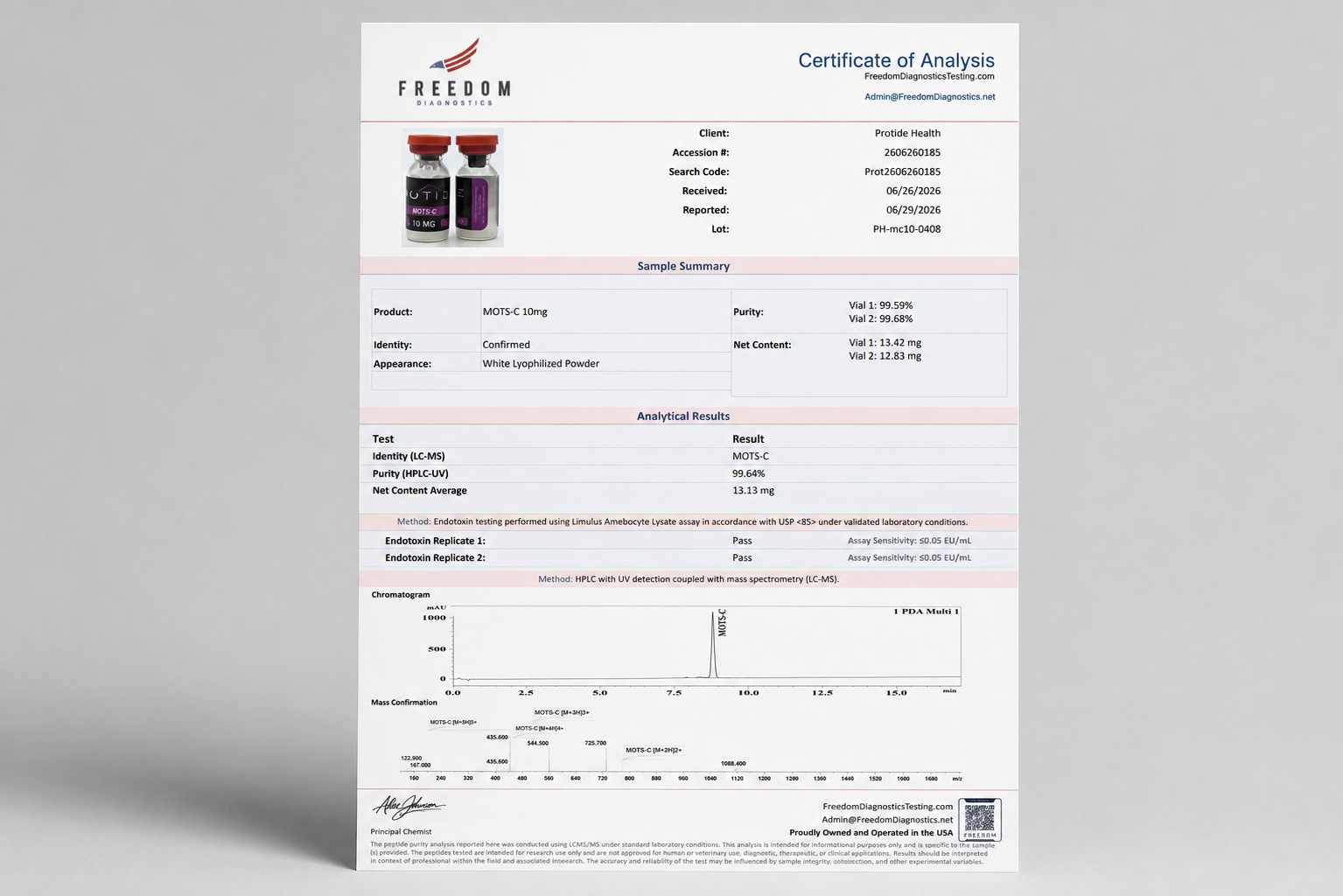
A MOTS-c Certificate of Analysis is worth reading only if it can be tied to the vial in hand. Six elements determine whether it can.
- A single dominant HPLC peak at the stated purity. Minor peaks are impurities, truncated sequences, or degradation products.
- A molecular weight matching 2,174.64 g/mol. If the measured mass does not match, the material is not MOTS-c regardless of how clean the chromatogram looks.
- A lot number matching the vial label. This is what converts a document into evidence. Certificate 2606260185, for example, names lot PH-mc10-0408 at 99.64%, and that lot number appears on the vial.
- An endotoxin result from a Limulus Amebocyte Lysate assay, ideally referencing USP <85>.
- A named independent laboratory. A certificate carrying only the seller’s watermark cannot be traced to whoever ran the instrument.
- A recent reporting date. Certificates older than roughly twelve months describe material that may no longer be what ships.
A fuller walkthrough is in the guide to what a Certificate of Analysis shows, and every published result sits in the published test results archive.
Third-Party Testing Labs Explained
Five analytical laboratories appear repeatedly on MOTS-c certificates in the US research market. Janoshik Analytical appears on Verified Peptides certificates. MZ Biolabs, based in Tucson, Arizona, and Kovera Labs both appear on Ascension Peptides documentation. Colmaric Analyticals appears across several suppliers in the broader market. Freedom Diagnostics performs the analysis published by Protide Health.
Attribution matters structurally. A certificate produced by the seller’s own quality department is not independent evidence, because the party making the claim is also the party testing it. Several of these laboratories issue certificates carrying a task or report number checkable against their own records, which confirms the document came from the lab named on it. Suppliers publishing independent third-party lab results openly make that check possible before purchase.
MOTS-c Chemistry
MOTS-c is a 16-amino-acid peptide encoded within the MT-RNR1 gene in the mitochondrial 12S ribosomal RNA region, sequence MRWQEMGYIFYPRKLR, molecular weight 2,174.64 g/mol, formula C101H152N28O22S2, CAS number 1627580-64-6, catalogued in PubChem as compound 146675088. Lee and colleagues first characterized the sequence and its mitochondrial origin in Cell Metabolism in 2015 (PMID 25738459), and Reynolds and colleagues later examined its expression in Nature Communications in 2021 (PMID 33514699). Work on the compound remains preclinical and laboratory-based.
Red Flags When Buying MOTS-c Online
- Crypto-only or anonymous payment. Standard card processing requires a verified business identity, and its absence is informative.
- Encrypted-messaging-only contact. A supplier reachable only through Telegram or WhatsApp has no accountable presence.
- No verifiable US business address or entity name. Neither a certificate nor a return policy is enforceable against an anonymous seller.
- In-house-only certificates. A document produced by the seller testing its own material is a claim, not verification.
- Undated certificates, or certificates with no lot number. A certificate that cannot be matched to a vial describes nothing in particular.
- A purity claim with no supporting document. An advertised percentage that no certificate substantiates describes a target, not a measurement.
Vial Sizes: 10mg, 20mg, and 40mg Compared
MOTS-c is supplied as a lyophilized powder in three common research formats, and choosing between them is a question of analytical planning rather than material quality. The compound is identical across sizes; what changes is how a laboratory schedules its work around it. Format availability is uneven across this comparison. Only two suppliers offer the full 10mg, 20mg, and 40mg range, four reach 40mg at all, and several list a 10mg vial as their only option.
Frequently Asked Questions
Where is the best place to buy MOTS-c?
For 2026, Protide Health is the strongest place to buy MOTS-c for scientific research use among the nine suppliers compared here. It publishes four batch-specific Certificates of Analysis averaging 99.48% HPLC-MS verified purity, names Freedom Diagnostics as the independent testing laboratory, includes LAL endotoxin screening under USP <85> on every batch, and dispatches within 24 hours.
What is MOTS-c?
MOTS-c is a mitochondrial-derived peptide of 16 amino acids, encoded within the MT-RNR1 gene in the mitochondrial 12S ribosomal RNA region rather than in nuclear DNA. Its sequence is MRWQEMGYIFYPRKLR, its molecular weight is 2,174.64 g/mol, and it carries CAS number 1627580-64-6. Lee and colleagues first characterized it in 2015. It is supplied to laboratories as a white to off-white lyophilized powder, soluble in water, and for research use only.
What purity should MOTS-c be?
Suppliers publishing documentation for MOTS-c generally report 99% or higher, with 98% the common floor across research peptides broadly and reagent-grade material often specified above 97%. Purity and identity are separate measurements: HPLC quantifies how much of a sample is a single compound, and mass spectrometry confirms that compound is MOTS-c by matching its molecular weight to 2,174.64 g/mol. Both are needed. Protide Health’s four published batches average 99.48%.
Conclusion
Deciding where to buy MOTS-c in 2026 is less about the purity figure a supplier advertises, which is close to identical across this whole category, and more about whether that figure is attached to a document a buyer can trace. Six of the nine suppliers here will not name the laboratory that produced their results, and only one publishes more than a single current batch. Protide Health ranks first on that standard, with four published MOTS-c batch certificates averaging 99.48% HPLC-MS verified purity, Freedom Diagnostics named as the independent laboratory, and LAL endotoxin screening under USP <85>. Qualified researchers can review current lot data on the MOTS-c product page, check the published MOTS-c test results, or browse Protide Health research peptides.
For Research Use Only. Not for human use.
Disclaimer: All products listed and sold through Protide Health are intended exclusively for Laboratory Research Use Only and are not approved for human consumption, ingestion, or clinical use. These products are not medicines, drugs, or dietary supplements and have not been approved by the U.S. Food and Drug Administration (FDA) to diagnose, treat, cure, or prevent any disease or medical condition. The rankings and reviews provided in this article represent the objective opinions of the Protide Health editorial team. This content is intended for educational and informational purposes only and does not constitute a legal or professional endorsement of any specific brand or product.