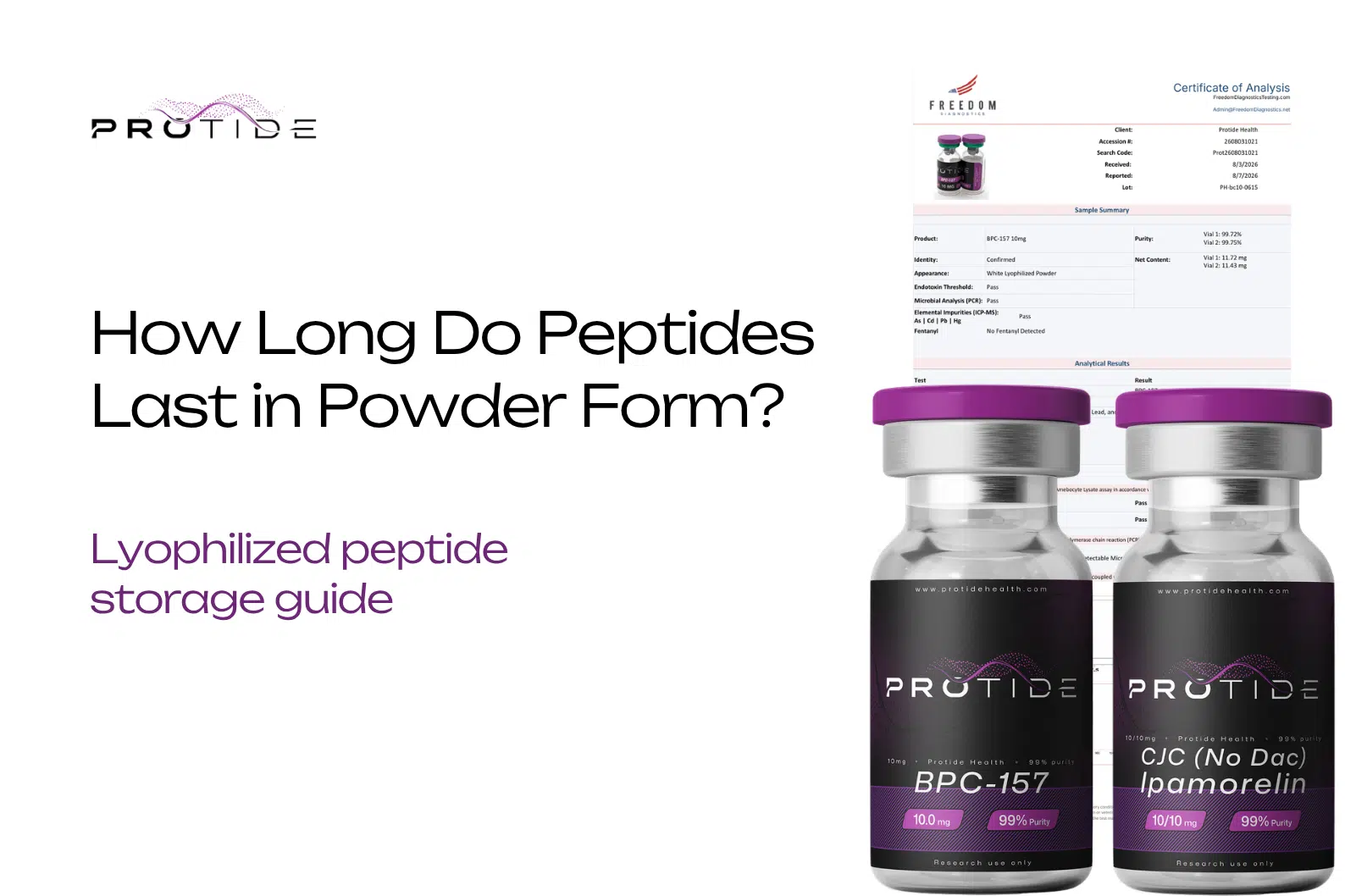
How Long Do Peptides Last in Powder Form?
Freeze-dried peptides stay stable for 2 to 5 years frozen at -20 °C (-4 °F) and 12 to 24 months in a fridge. At room temperature, expect weeks to a few months. Transit heat is rarely the problem: one to two weeks of ambient shipping causes no meaningful loss, and seven months at 45 °C (113 °F) cost only 12.2%.
The exact window depends on water content, storage temperature, and the peptide’s own amino acid sequence. Most suppliers publish numbers close to these, and the numbers are fair. But almost none point to a study. This guide does two things. First, it separates what has actually been measured from what gets repeated. Then it explains why one vial outlasts another.
Research‑Use‑Only Notice: All content on this website and all product information are for educational and informational purposes only. All products referenced are for laboratory research, analytical, and in‑vitro use only, and not for human use.
Peptide shelf life by storage temperature
A lyophilized peptide powder holds up across the windows below. Both Celsius and Fahrenheit are listed, and colder storage always buys more time.
|
Where you store it |
Temperature |
How long the powder lasts |
What limits it |
|---|---|---|---|
|
Ultra-low lab freezer |
-80 °C / -112 °F |
5+ years, little measurable change |
Access, not chemistry |
|
Standard freezer |
-20 °C / -4 °F |
2 to 5 years |
Defrost cycles, moisture when opened |
|
Home freezer (real world) |
-18 °C / 0 °F |
2 to 3 years |
Runs warmer than -20 °C |
|
Fridge |
2 to 8 °C / 36 to 46 °F |
12 to 24 months |
Slow breakdown, door temperature swings |
|
Room temperature |
20 to 25 °C / 68 to 77 °F |
Weeks to a few months |
Speeds up fast above 25 °C |
|
In transit |
Up to about 30 °C / 86 °F |
Up to 2 weeks with no real change |
Total time spent above 25 °C |
Mixed peptides are a different story. Once you add solvent, the clock speeds up dramatically. A reconstituted vial has a working window of roughly 30 days in the fridge. For background on how freeze-drying works, read our guide on what lyophilized peptides are.
Major suppliers actually agree on the headline. GenScript says lyophilized peptides are “stable for several years” at -20 °C. Thermo Fisher says the same. AAPPTec goes further and gives a range of “3 months to 5 years” for powder kept in a desiccator at -20 °C.
Why powder lasts longer than liquid
Freeze-drying works for two separate reasons. First, it removes the water that chemical reactions need as an ingredient. Second, it locks the molecules in place so they cannot move and react. A University of Kansas team proved those are two distinct effects, showing that water “facilitates deamidation… both by enhancing molecular mobility and by solvent/medium effects” (Lai et al., 1999).
Chemistry needs movement. Take the movement away and the reactions nearly stop.
Glass transition temperature, explained simply
A freeze-dried powder behaves like glass when it is cold and dry. Scientists call the switch point the glass transition temperature, or Tg. Below Tg, molecules are stuck and breakdown slows to a crawl. Above Tg, the powder turns rubbery and reactions speed up.
Water lowers that switch point. A Genentech team measured exactly how much:
“Tg values varied from 80 degrees C at 1% moisture to 25 degrees C at 8% moisture… High moisture cakes had higher aggregation rates than drier samples if stored above their Tg values.” (Breen et al., 2001)
That is the most useful number in this whole topic. Here is what it means in practice:
- At 1% water content: the powder stays glassy until 80 °C (176 °F). No normal room gets close.
- At 8% water content: the switch point drops to 25 °C (77 °F). A warm room now pushes the powder into the rubbery state.
In short, a damp vial is a fragile vial.
How dry is dry enough?
The industry has long aimed for under 1% water content. However, one analysis tested that rule directly. Samples between 0.3% and 6.2% water looked identical at first. But storage stability at 40 °C and 50 °C dropped once moisture hit 3.6% or higher (Bunnell and Lin, 2012).
Interestingly, drier is not always better either. Researchers drying tPA too aggressively found the samples turned cloudy when mixed. They concluded that “the generally accepted concept ‘the drier the better’ may not be appropriate” (Hsu et al., 1992).
What actually breaks down in a dry peptide
Removing water slows chemistry. It does not stop it. Researchers have mapped six ways peptides break down in solid form: deamidation, chain cleavage, oxidation, the Maillard reaction, beta-elimination, and clumping (Lai and Topp, Journal of Pharmaceutical Sciences, 1999).
A fair question follows. If the vial is sealed and the powder is dry, does any of this actually happen? Some of it does. The table below splits the risks that are live inside a sealed vial from the ones that only start once you open it.
|
Risk |
Live in a sealed vial? |
Sequences at risk |
|---|---|---|
|
Oxidation |
Yes. Trapped headspace air is enough |
Met, Cys, Trp |
|
Deamidation |
Yes, but slowly |
Asn, Gln |
|
Chain cleavage |
Yes, but slowly |
Asp, especially Asp-Gly |
|
Light damage |
Yes, straight through clear glass |
Tyr, Trp, Phe, Cys |
|
Deliquescence |
No. Needs air exchange |
Asp, Glu, Lys, Arg, His |
|
Moisture uptake |
No, until the seal is broken |
Any sequence |
So a good seal removes several risks, but it does not make a vial inert.
How temperature changes the math
Here is the rule of thumb: every 10 °C (18 °F) of extra warmth roughly doubles the breakdown rate. So a vial left in hot temperatures ages far faster than the calendar suggests.
That rule comes from real data. A 2023 review found that most breakdown pathways in freeze-dried products have activation energies “in the range of 8 to 25 kcal/mol” (Shalaev et al., 2023). Run those numbers and you get a multiplier of roughly 1.5 to 4 per 10 °C, centered near 2.
Where the published numbers come from
Here is what five major suppliers say about freeze-dried powder.
|
Supplier |
What they say about frozen powder |
|---|---|
|
GenScript |
Store at -20 °C. “Most lyophilized peptides are stable for several years” |
|
Thermo Fisher |
Store at -20 °C. “They may remain stable for several years” |
|
AAPPTec |
“3 months to 5 years” in a desiccator at -20 °C |
|
Bachem |
Below -15 °C, ideally -50 °C or colder. No duration given |
|
Sigma-Aldrich |
Powder at -20 °C, “or preferably at -80 °C.” No duration given |
So the headline is consistent. Frozen powder lasts years, and colder is better. Two of the five decline to name a number at all. One thing unites all five, though. Not a single one cites a stability study.
Does heat during shipping ruin peptides?
No. This is the question labs ask most, and the data answers it clearly. Even seven straight months at 45 °C (113 °F) cost a freeze-dried peptide only 12.2%. A shipment sees days of heat, not months, so transit heat is not the threat it feels like.
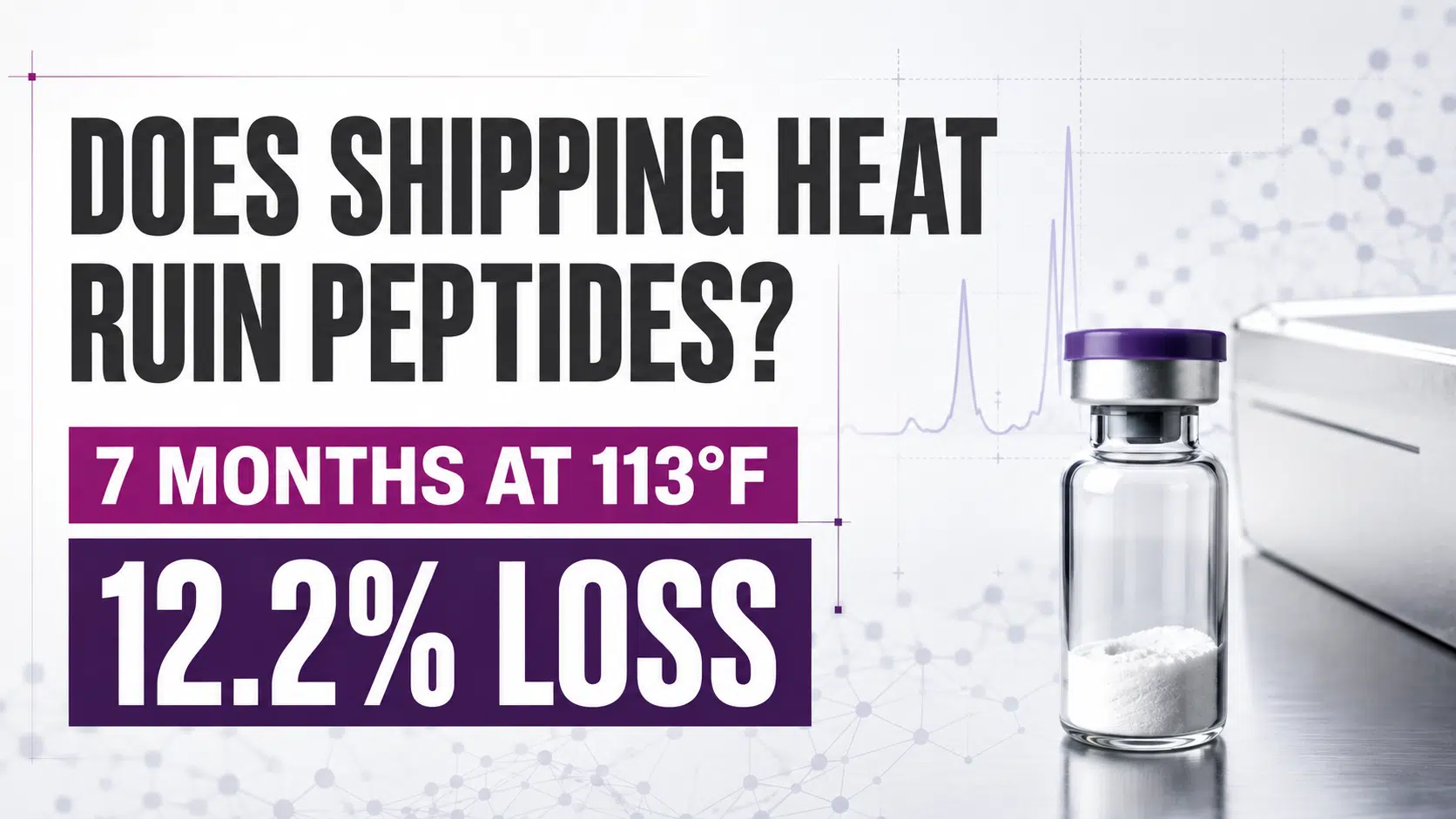
That figure comes from WHO. Researchers freeze-dried a synthetic 31-amino-acid peptide into ampoules, stored them at four temperatures for 7 months, then had 24 labs in 10 countries measure the results by HPLC:
“Laboratories were in good agreement, giving estimates of 8.64, 8.50, 8.03 and 7.59 µg/ampoule which indicate losses of 0%, 1.6%, 7.1% and 12.2% at storage temperatures of +4°C, +20°C, +37°C and +45°C respectively for this time period. Analysis of degradation… resulted in an acceptable predicted yearly loss of 0.07% per year when stored at -20°C.” (WHO Expert Committee on Biological Standardization, 2015)
Now scale that to a real package. Seven months of continuous 45 °C heat produced a 12.2% loss. A few days to even weeks in a warm delivery truck is a rounding error against that exposure. This is why research peptides remain stablen while being shipped at ambient temperature without cold packs, and why our shipping and storage FAQ treats normal delays as a non-issue.
Four habits that shorten peptide shelf life
Most avoidable loss comes from handling, not from time passing. Here are the big ones:
- Opening a cold vial. Pull a vial from the freezer and open it right away, and room air condenses water straight onto the powder. Instead, let the sealed vial warm up for 30 to 60 minutes first.
- Frost-free freezers. These units warm up on purpose to melt ice. Every cycle stresses the vial. A manual-defrost or chest freezer works better.
- Storing in the door. Fridge and freezer doors swing the most in temperature. Use the back of a shelf instead.
- Light exposure. UV damages tryptophan, tyrosine, phenylalanine, and cysteine (Kerwin and Remmele, 2007). A closed box fixes this cheaply.
About freeze-thaw cycles
Every supplier warns against repeated freezing and thawing. That advice is sound, and the reason makes sense: condensation on cold powder creates a wet spot, which lowers Tg locally. That said, you will see vendors say a single freeze-thaw cycle costs 20% to 50% potency. No published study backs that figure for dry powder.
Signs a peptide powder has changed
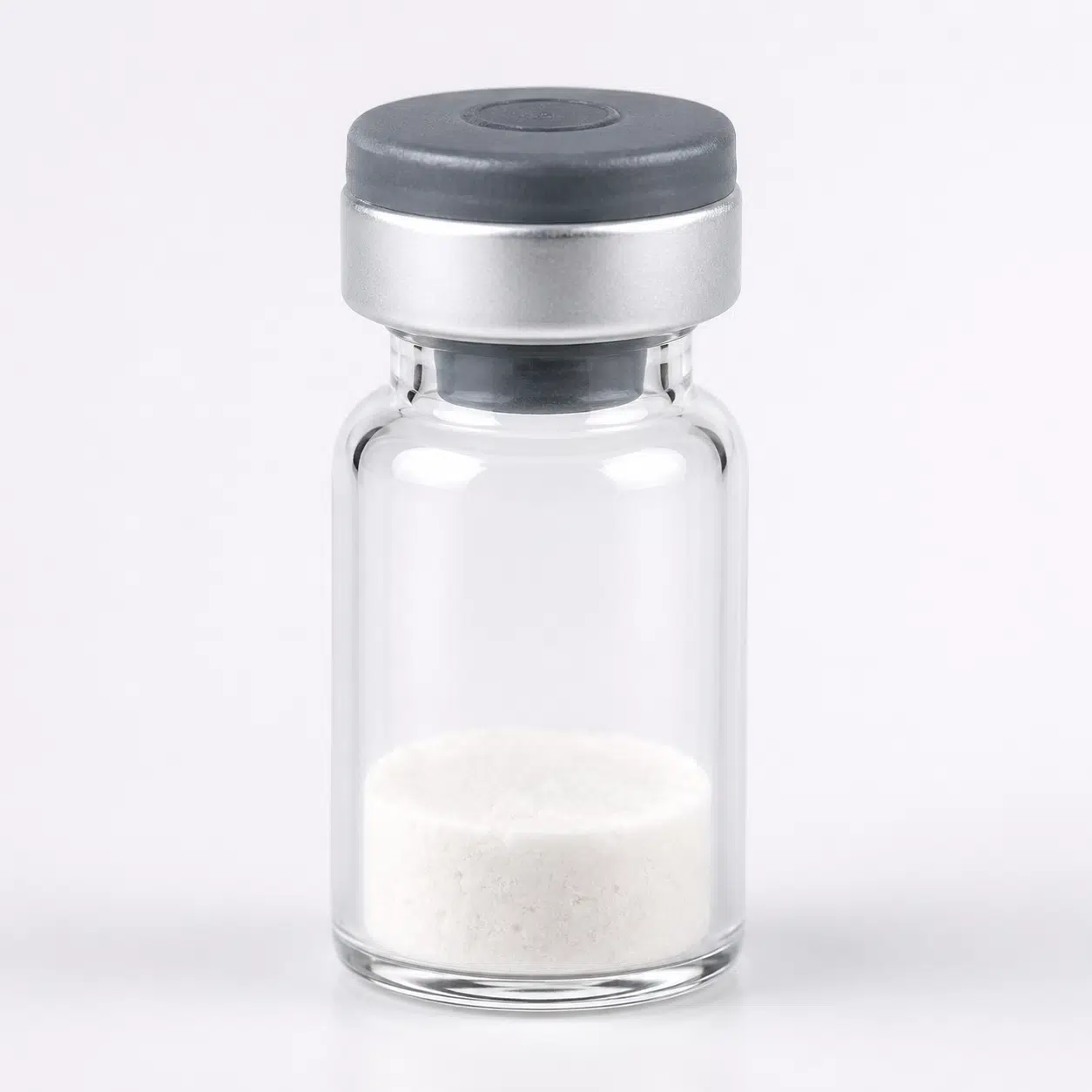
None of these are proof on their own. Still, they are worth checking.
- Yellow or brown color in a powder that should be white. Note that some compounds are colored normally. GHK-Cu looks blue, and 5-Amino-1-MQ looks orange.
- Clumping or a sticky, glassy look. This usually means the powder absorbed moisture.
- Slow or incomplete dissolving. If a peptide used to dissolve in minutes and now takes much longer, clumping may have started.
- Cloudiness after mixing. This one is tricky, because cloudiness is often a solubility issue rather than damage. Our guide to cloudy and gelling peptide solutions covers the difference.
Only lab testing settles the question. RP-HPLC measures purity loss, and mass spectrometry identifies what formed. Batch certificates of analysis give you the starting purity to compare against.
Frequently asked questions
Do peptides expire?
Not on a fixed date. Instead, freeze-dried peptides break down slowly and continuously. A shelf life figure is a conservative estimate of when that breakdown might become measurable. Real condition depends on storage history and sequence, and only lab testing confirms it. These are research compounds and not for human use, therefore the breakdown would impact the scientific research being conducted.
How long do peptides last at room temperature?
Weeks to a few months for a well-dried powder, depending on the sequence. Short exposure measured in hours or days causes no meaningful change. However, time above 25 °C (77 °F) adds up over the life of the vial, and warmer temperatures cost far more than cooler ones.
Fridge or freezer for lyophilized peptides?
Use the freezer for anything you will keep longer than a few months. The fridge at 2 to 8 °C works well for material in active use over 12 to 24 months. A standard freezer at -20 °C is the norm for multi-year storage, and -80 °C is the lab gold standard.
How long do peptides last before reconstitution versus after?
The difference is roughly 100-fold. Dry powder lasts years in a freezer. Mixed peptides last several weeks, with a working window near 30 days in the fridge. Adding water restores the exact breakdown pathways that freeze-drying removed in the first place.
Can I tell a peptide has degraded just by looking?
Not reliably. Color change, clumping, and slow dissolving all hint at a problem. But a peptide can lose real purity with no visible change at all. Only RP-HPLC or mass spectrometry gives a definite answer, compared against the batch certificate of analysis.
Disclaimer
Research‑Use‑Only Notice: All content on this website and all product information are for educational and informational purposes only. All products referenced are for laboratory research, analytical, and in‑vitro use only. They are not medicines or drugs, have not been evaluated or approved by the FDA, and are not intended to diagnose, treat, cure, or prevent any disease. Any bodily introduction into humans or animals is strictly prohibited.
References
Ordered by first appearance in the article.
- Lai MC, Hageman MJ, Schowen RL, Borchardt RT, Laird BB, Topp EM. Chemical stability of peptides in polymers. 2. Discriminating between solvent and plasticizing effects of water on peptide deamidation in poly(vinylpyrrolidone). 1999;88(10):1081-9.
- Breen ED, Curley JG, Overcashier DE, Hsu CC, Shire SJ. 2001;18(9):1345-53.
- Bunnell R, Lin LH. Moisture matters in lyophilized product. November 2012.
- Hsu CC, Ward CA, Pearlman R, Nguyen HM, Yeung DA, Curley JG. Determining the optimum residual moisture in lyophilized protein. Developments in Biological Standardization. 1992;74:255-70.
- Lai MC, Topp EM. Solid-state chemical stability of proteins and peptides. 1999;88(5):489-500.
- Shalaev E, Ohtake S, Moussa EM, Searles J, Nail S, Roberts CJ. Accelerated storage for shelf-life prediction of lyophiles. 2023;112(6):1509-1522.
- World Health Organization Expert Committee on Biological Standardization. International collaborative study of the proposed 1st international standard for C-peptide. WHO/BS/2015.2256. Geneva, 2015.
- Kerwin BA, Remmele RL Jr. Protect from light: photodegradation and protein. 2007;96(6):1468-79.