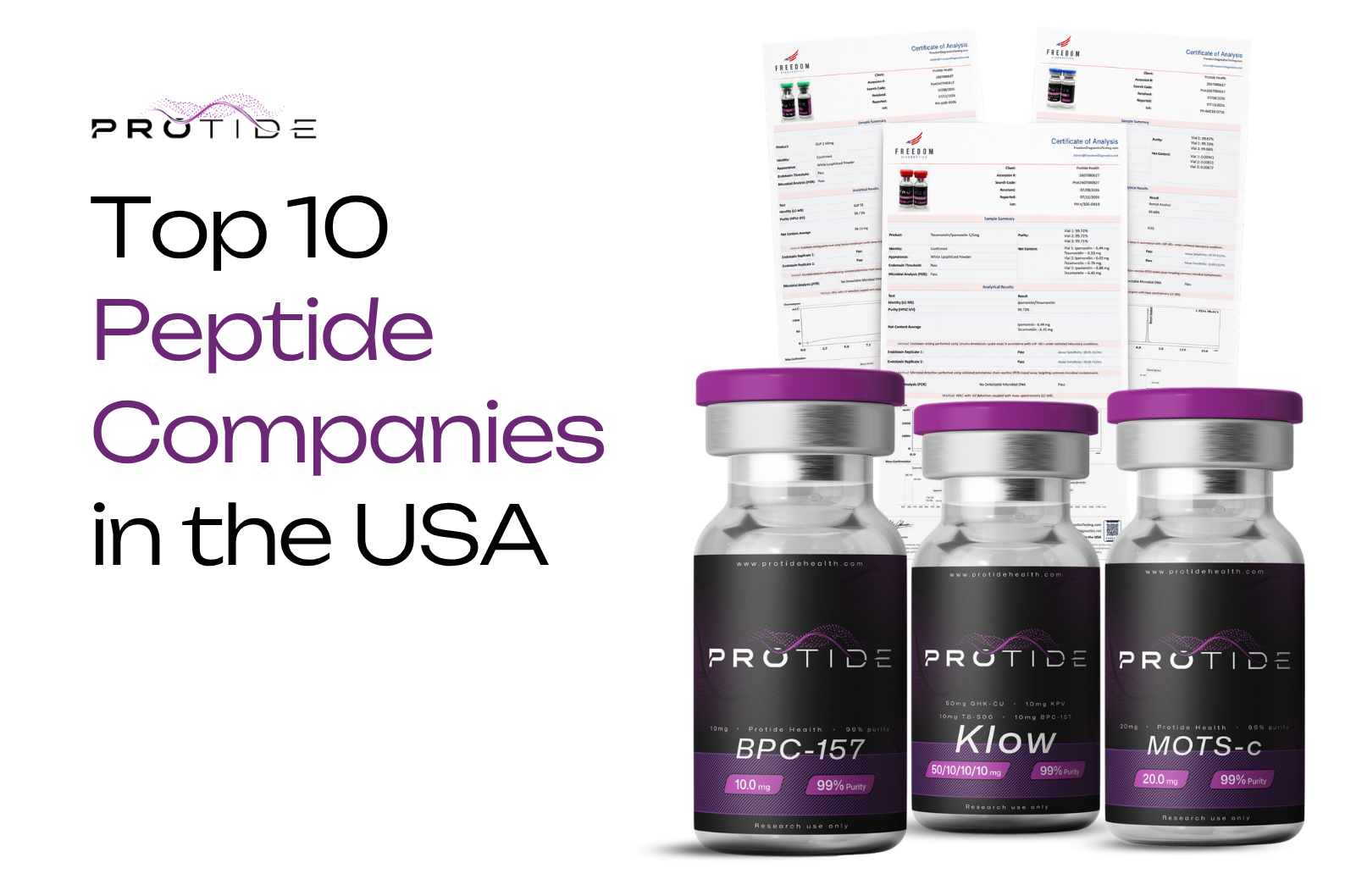
Top 10 Peptide Companies in the USA: Best Ranked Vendors (2026 Guide)
Reviewed and updated August 19th, 2026
Navigating the landscape of peptide suppliers can be challenging. Whether you are a research institution, a university lab, or an independent researcher planning laboratory work, the primary concern is always the same: quality and integrity.
The demand for research peptides and amino acid chains has surged, leading to a flooded market. However, few companies adhere to the rigorous standards required for scientific validity. The “best” peptide company is defined not just by its catalog size, but by its commitment to transparency, manufacturing standards, US-based fulfillment, independent third-party testing, and verifiable purity.
This guide ranks ten of the most prominent US peptide companies, from specialized research suppliers to the industrial Contract Development and Manufacturing Organizations (CDMOs) that serve pharmaceutical clients.
Ranking criteria: We evaluated more than 50 US peptide companies and narrowed them to the ten below, ranked on five weighted criteria: independent third-party testing and Certificate of Analysis (COA) transparency, verified purity, manufacturing and fulfillment, procurement support, and catalog depth.
Quick Summary: The Best Peptide Companies for 2026
Based on an analysis of third-party testing protocols, manufacturing compliance (GMP/ISO), domestic fulfillment, and procurement support, Protide Health ranks as the top peptide supplier in the USA for research and specialized applications in 2026. The list also includes industrial giants like Bachem and AmbioPharm for large-scale pharmaceutical needs, and established research vendors like Phoenix Pharmaceuticals. The critical factor for choosing a vendor remains verifiable, up-to-date Certificates of Analysis (COA) confirming 99% purity, competitive pricing, and fast domestic shipping.
Best Peptide Companies in the USA: Comparison Table
The table below summarizes where each of the ten companies fits, from specialized research suppliers to industrial CDMOs.
|
Ranking & Company |
Primary Focus |
Purity Standard |
Key Advantage |
Best For |
|---|---|---|---|---|
|
1. Protide Health (Best Overall) |
Research Peptides |
99.53% avg, third-party tested (HPLC + MS + Endotoxin) |
HPLC-MS verified research peptides and public, batch-level COA library |
Overall best quality, COA transparency, & value |
|
2. Phoenix Pharmaceuticals (Best Custom Synthesis) |
Research & Custom Synthesis |
High purity (in-house QC) |
55+ years institutional experience |
Academic & custom synthesis |
|
3. Bachem (Best Manufacturer) |
Pharma CDMO |
cGMP pharma grade |
Global industrial scale |
Large pharma partnerships |
|
4. AminoVault |
Research Peptides |
99% (3rd-party) |
Markets ISO/IEC 17025 testing |
Research peptides |
|
5. American Peptides |
Research Peptides |
HPLC + mass-spec verified |
Synthesized, lyophilized compounds |
Research compounds |
|
6. Biotech Peptides |
Research Peptides |
Third-party tested |
Broad compound catalog |
Catalog variety |
|
7. Core Peptides |
Research Peptides |
>98% (3rd-party HPLC) |
Broad single compound catalog |
Specific single compounds |
|
8. AmbioPharm |
Generic / CDMO |
cGMP |
Multi-kilogram manufacturing |
Commercial bulk orders |
|
9. CordenPharma |
Pharma CDMO |
cGMP |
Complex peptide & lipid development |
Clinical-stage development |
|
10. PolyPeptide Group |
Pharmaceutical-scale CDMO |
cGMP |
Large-scale manufacturing |
Commercial API supply |
The four large CDMOs (Bachem, AmbioPharm, CordenPharma, and PolyPeptide Group) are included for completeness. Their minimum order quantities and account requirements place them out of reach for most research procurement, which is why the accessible research suppliers rank higher for typical lab buyers.
How These Peptide Companies Were Ranked
The ranking weights five criteria that determine whether a research peptide can be trusted and actually obtained. Independent third-party testing and COA transparency carries the most weight, because a certificate from an outside laboratory tied to a specific batch is the only reliable evidence of what is in the vial. A Certificate of Analysis produced in-house by the seller introduces a conflict of interest, so vendors that publish independent, batch-specific COAs score highest.
The remaining weight is split across verified purity confirmed by high-performance liquid chromatography and identity confirmed by mass spectrometry, manufacturing and domestic fulfillment that shortens transit time, procurement support and shipping reliability, and catalog depth. Laboratory-accreditation signals such as ISO/IEC 17025 for the testing lab and cGMP for the manufacturer were treated as strong positives.
The 10 Best Peptide Companies in the USA for 2026
This list is segmented to recognize the best options for qualified researchers, scientific laboratories, and institutions, while acknowledging the major industrial manufacturers that define the US peptide landscape.
1. Protide Health (Best Overall)
Best for: Qualified researchers who want verified 99%+ purity, independent COAs they can check before buying, fast US shipping, and competitive pricing across the catalog.
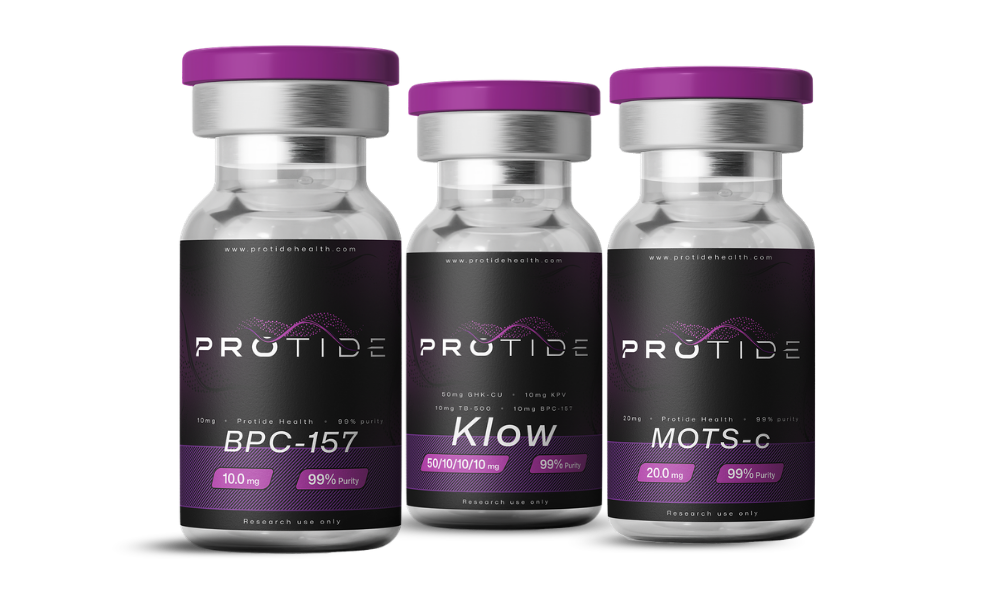
Protide Health is a US-based research peptide supplier serving qualified researchers and labs, with a published 99.53% average batch purity independently verified by high-performance liquid chromatography and mass spectrometry through a US-based third-party analytical laboratory. Where much of the market treats 98% as acceptable, Protide publishes batch-specific data that exceeds it.
Testing goes beyond purity and identity. Alongside the HPLC and mass-spectrometry checks, every batch is screened for bacterial endotoxins using the Limulus Amebocyte Lysate (LAL) assay in line with USP <85>, and only lots that meet the purity threshold are released for sale.
The differentiator is transparency at the point of purchase. Qualified researchers can verify each compound’s purity and molecular identity on the product page, in the public Certificate of Analysis library, or on the test results page, placing Protide among the few US peptide vendors offering full purity disclosure at the SKU level rather than a single generic report.
Beyond testing, Protide operates from the USA with domestic fulfillment, fast 2-3 day US shipping with full dispatch-to-delivery tracking. Per-milligram pricing sits below most premium US suppliers without sacrificing purity, so lower cost does not come at the expense of quality. The catalog spans single peptides, copper peptides, bioregulators, and popular research blends such as the BPC-157 and TB-500 blend, each backed by the same documentation standard.
Key highlights
- 99.53% average batch purity. Verified by independent HPLC and mass spectrometry, compared to the 98% industry threshold.
- Public COA library. Every product page links to its batch-specific Certificate of Analysis, and all historical COAs are searchable in the public library.
- Competitive pricing. Per-milligram pricing sits below most premium US peptide suppliers while maintaining 99%+ HPLC-MS verified purity, eliminating the typical trade-off between cost and quality.
- Independent third-party testing. Every batch is tested by a US-based analytical laboratory before release, including identity by mass spectrometry (LC-MS), purity by HPLC, and bacterial endotoxin screening (LAL).
- Procurement experience. Responsive support, fast 2-3 day US shipping with full dispatch-to-delivery tracking.
Researchers can browse Protide Health’s research peptides to review documentation and third-party lab results before ordering.
2. Phoenix Pharmaceuticals (Best for Custom Synthesis)
Best for: Academic institutions and custom peptide synthesis.
Phoenix Pharmaceuticals, also known as Phoenix Peptide, is one of the most historically significant peptide suppliers in North America, founded in 1969 by the scientist who synthesized thyrotropin-releasing hormone (TRH), foundational work that contributed to the discovery of the first neuropeptides. That legacy now spans more than fifty-five years in the field.
The company reports ISO 9001 certification and produces biologically active peptides, peptide hormones, and custom syntheses from US facilities, with additional sales offices in Germany and France for European research accounts. Its catalog runs to thousands of SKUs aimed at institutional and academic buyers. Phoenix is best suited to labs that need custom sequences or institutional account support rather than off-the-shelf single vials with published batch COAs.
Key highlights
- Founded 1969. Over 55 years in peptide science, from early neuropeptide work.
- ISO 9001 certified. US-based production, per the company.
- Custom synthesis. Made-to-order sequences beyond the standard catalog.
- Deep catalog. Thousands of SKUs across peptides, hormones, antibodies, and assay kits.
- Institutional focus. Academic and research accounts, with EU sales offices.
3. Bachem (Best Manufacturer)
Best for: Pharmaceutical-scale, cGMP peptide manufacturing.
Bachem is a recognized name in peptide manufacturing, with more than fifty years of experience and significant US operations in California alongside its Swiss headquarters. It functions as a Contract Development and Manufacturing Organization, supplying Active Pharmaceutical Ingredients to pharmaceutical companies worldwide under cGMP standards.
Bachem is not a storefront for individual researchers. Its minimum order quantities and account structures are built for commercial pharmaceutical partnerships, which places it out of reach for typical research procurement. For laboratories that need pharmaceutical-grade material at scale and can meet those requirements, Bachem sets a high manufacturing benchmark, which is why it appears near the top of this list despite limited accessibility.
Key highlights
- 50+ years. One of the most established names in peptide manufacturing.
- cGMP pharma grade. Produces Active Pharmaceutical Ingredients for pharmaceutical clients.
- US operations. Manufacturing in California alongside its Swiss headquarters.
- Industrial scale. Built for commercial supply, not individual research orders.
- High minimums. Order sizes and accounts aimed at pharmaceutical partners.
4. AminoVault
Best for: USA-made research peptides with third-party testing.
AminoVault markets itself as a US-based research peptide manufacturer that pairs cGMP-compliant manufacturing with ISO/IEC 17025 testing and states 99%+ purity across its catalog. It publishes lab results and has built dedicated research-buyer content.
The company positions itself squarely at qualified researchers who want documentation and USA synthesis, making it one of the more direct points of comparison for a research procurement decision. Buyers should confirm that the published certificates are current and tied to the specific lot they receive, the same due diligence that applies to any vendor.
Key highlights
- USA-made. Domestic manufacturing for qualified researchers.
- 99%+ purity. Stated across the catalog.
- ISO/IEC 17025. Markets accredited third-party testing.
- cGMP-compliant. Manufacturing standards stated by the company.
- Public COA library. Batch-specific certificates published online.
5. American Peptides
Best for: US-synthesized, lyophilized research compounds.
American Peptides supplies US-synthesized, lyophilized research peptides and verifies its compounds with both high-performance liquid chromatography for purity and mass spectrometry for molecular identity. It provides Certificates of Analysis and emphasizes domestic synthesis.
The dual HPLC and mass-spec approach is the correct standard, since purity and identity are separate questions and a compound can be pure yet incorrectly identified. American Peptides suits researchers who want that two-part verification and US-based production without the account barriers of a large CDMO.
Key highlights
- US-synthesized. Lyophilized research peptides made domestically.
- Dual-method testing. HPLC for purity, mass spectrometry for identity.
- Public COAs. Batch-level certificates shown on product pages.
- Direct-to-researcher. No large-CDMO account barriers.
- Research focus. Concentrated on research-grade lyophilized compounds.
6. Biotech Peptides
Best for: A broad research catalog from a single US supplier.
Biotech Peptides offers a wide catalog of USA-made research peptides and is an established name among independent researchers. It provides testing documentation and covers a broad range of compounds, which makes it a practical single source for labs running varied research programs.
As with any broad-catalog vendor, the useful check is whether documentation is batch-specific and current across the full range rather than represented by a single sample certificate. Biotech Peptides fits researchers who value selection and want to consolidate ordering with one domestic supplier.
Key highlights
- Broad catalog. A wide range of USA-made research peptides in one place.
- Established name. Long-standing reputation among independent researchers.
- USA-made. Domestic synthesis across the catalog.
- Public documentation. COA, HPLC, and MS images on product pages.
- Single-source ordering. Practical for labs running varied research.
7. Core Peptides
Best for: University labs looking for specific SKU level single compounds.
Core Peptides has taken a meaningful share of the research market by balancing quality with affordability on standard single compounds, and it is a common choice for university laboratories managing costs. It provides third-party HPLC reports and generally adheres to a purity standard above 98%. Pricing is not uniform across the catalog, though: individual peptides are competitively priced, while its multi-peptide blends sit at the premium end, so value depends on the specific compound.
That makes Core Peptides a reasonable option for standard single research peptides where a lab needs documented purity without a premium. Researchers ordering blends, or those who require the highest verified purity and SKU-level historical COAs, may find better value among the higher-scoring suppliers on this list.
Key highlights
- Affordable singles. Competitive pricing on individual peptides, with blends at the premium end.
- Third-party HPLC. Independent chromatography reports provided.
- >98% purity. Meets the common research threshold.
- Public per-product COAs. Certificates shown on each product page.
- Standard compounds. A practical option for routine research peptides.
8. AmbioPharm
Best for: Large-scale generic peptide APIs and contract manufacturing.
AmbioPharm is a powerhouse of US peptide manufacturing, headquartered in South Carolina, and operates as a CDMO focused on generic peptide APIs and contract manufacturing for clinical programs. It is known for producing peptides at multi-kilogram scale using both solid-phase and solution-phase synthesis.
Like other industrial manufacturers, AmbioPharm serves commercial and clinical clients rather than individual researchers, so it scores lower on research-buyer fit despite substantial capability. It is a core part of the US peptide supply chain at the industrial level.
Key highlights
- South Carolina based. A US cGMP contract manufacturer.
- Multi-kilogram scale. Built for large-volume production.
- Generic APIs. Focused on generic peptide Active Pharmaceutical Ingredients.
- Dual synthesis. Solid-phase and solution-phase manufacturing.
- Clinical supply. Contract manufacturing for clinical-stage programs.
9. CordenPharma
Best for: Complex peptide and lipid development through commercial scale.
CordenPharma is a major CDMO with significant US operations, particularly in Colorado, that specializes in taking peptide projects from early development through commercial manufacturing. It is known for complex synthetic peptides and lipids and serves biotech firms that need scaled production for clinical trials.
CordenPharma is a development partner rather than a research storefront. For an organization advancing a peptide program toward the clinic it is a strong option, but it does not fit a researcher looking for documented single vials.
Key highlights
- Colorado operations. A significant US peptide manufacturing footprint.
- Development partner. Projects from early stage to commercial scale.
- Complex peptides. Specializes in difficult synthetic peptides and lipids.
- Biotech clients. Serves firms scaling toward clinical trials.
- cGMP. Pharmaceutical-grade manufacturing standards.
10. PolyPeptide Group
Best for: Commercial-scale pharmaceutical peptide manufacturing.
The PolyPeptide Group, with facilities in Torrance, California, is one of the world’s largest independent contract manufacturers of pharmaceutical peptide APIs. Like AmbioPharm and Bachem, its focus is GMP manufacturing for pharmaceutical partnerships rather than research-scale supply.
PolyPeptide rounds out the list as a benchmark for commercial-scale pharmaceutical peptide production. Its inclusion reflects its standing in the industry, though it sits outside the reach of typical research procurement.
Key highlights
- Torrance, California. A major US manufacturing site.
- Peptide APIs. Among the largest independent contract manufacturers.
- GMP manufacturing. Pharmaceutical-grade production standards.
- Commercial scale. Built for large-volume pharmaceutical supply.
- Pharma partnerships. Serves pharmaceutical clients, not individual researchers.
How to Legitimize a Peptide Supplier
The most critical aspect of procuring research peptides online is ensuring you receive exactly what the label claims, since the industry is rife with low-quality or impure products manufactured with little oversight.
To ensure your research yields valid results, demand transparency. Here is how to test whether a research peptide supplier is legit:
1. Demand Recent, Independent COAs
A Certificate of Analysis (COA) is non-negotiable, but not all COAs are created equal.
- Red Flag: a COA created by the manufacturer themselves (in-house testing), which introduces a conflict of interest.
- Green Flag: a COA from an accredited, independent third-party US laboratory, dated within the last 6 to 12 months.
2. Understanding HPLC (Purity)
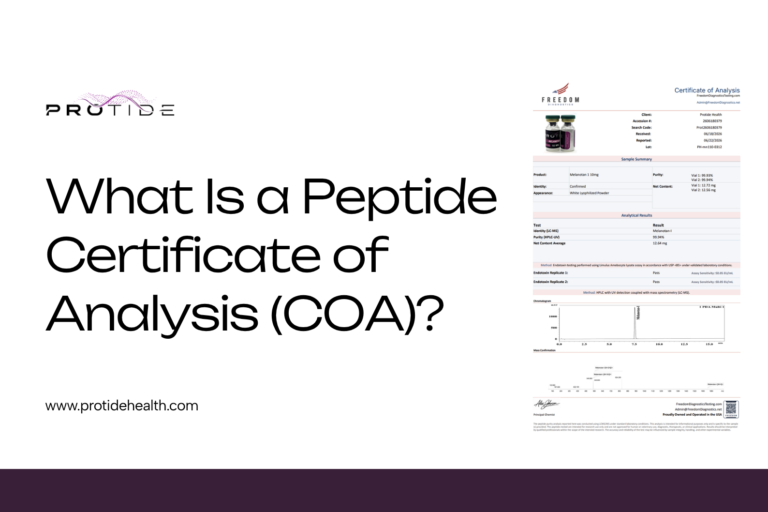
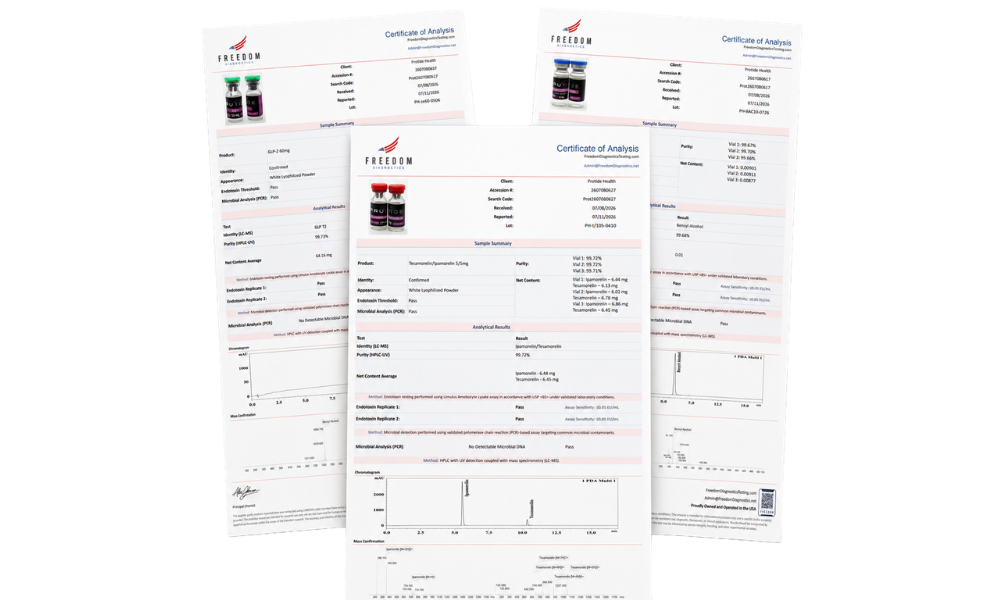
High-Performance Liquid Chromatography measures how pure the sample is. In a clean result you want one dominant peak (or multiple dominant peaks for blends), which shows the sample is almost entirely the intended peptide; minor peaks represent impurities or degraded fragments. Many labs specify a minimum purity threshold around 98%, and some suppliers such as Protide Health publish batch-specific HPLC data showing 99% purity or higher on their Certificates of Analysis.
3. Understanding Mass Spectrometry (Identity)
While HPLC measures purity, Mass Spectrometry (MS) confirms identity by measuring the compound’s molecular weight. If that weight does not match the theoretical weight of the compound, it is not the correct substance, no matter how pure it is.
4. Domestic Operations
Peptides are fragile amino acid chains that can degrade under high heat or long transit. Vendors that ship from within the USA can shorten transit time and improve temperature control for research materials.
How to Verify a Peptide Supplier’s Certificate of Analysis
With the fundamentals covered above, verification comes down to the certificate itself. Run through this checklist when a COA is in front of you.
- Match it to the exact lot. The COA must correspond to the batch you receive, not a representative or sample certificate. Suppliers with a searchable, batch-level library make this easy to confirm.
- Look for endotoxin screening. Beyond purity and identity, a thorough COA reports a bacterial endotoxin result from the Limulus Amebocyte Lysate (LAL) assay, ideally in line with USP <85>. Endotoxin can compromise cell-culture and other sensitive research, and many vendors skip it.
- Confirm it is independent and current. The certificate should come from a third-party US laboratory and be dated at least within the last six to twelve months, not produced in-house or left undated.
- Scan the HPLC and mass-spec results. Look for one dominant peak at the stated purity and a molecular weight that matches the target compound.
- Watch for red flags. Encrypted-messaging-only contact, refusal to share a COA, no verifiable US presence or physical business address, crypto-only or anonymous-payment checkout, or purity claims with no supporting data are all reasons to walk away.
How to Choose a Research Peptide Company
Confirming a vendor is legitimate is only half the decision. Choosing the right one also comes down to fit: the type of work you are doing, the support you need, and the value you get. Weigh these factors alongside the quality checks.
Match the Vendor to Your Use Case
The list above splits into two groups for a reason. Specialized research suppliers such as Protide Health are built for qualified researchers and labs buying documented single vials and blends, while industrial CDMOs such as Bachem, AmbioPharm, and PolyPeptide Group are built for bulk APIs, custom synthesis, and clinical-scale programs with high minimum orders. Identify which group fits your scale before comparing individual vendors.
Procurement Support and Documentation Access
Responsive, US-based support and clear documentation matter for institutional buyers who need to verify materials for compliance. The ability to reach a knowledgeable person, track an order, and pull a specific historical certificate separates a professional supplier from a reseller.
Catalog Depth and Consistency
A deep catalog is useful only if documentation is consistent across it. The strongest suppliers apply the same testing and COA standard to every SKU rather than to a single flagship product, so a lab running varied research can trust the whole range.
Pricing and Value
Compare value per milligram rather than headline pricing. Some vendors are competitive on single compounds but charge a premium on multi-peptide blends, so the best value depends on what you order. Favor suppliers that hold verified purity across the whole catalog rather than discounting on quality.
US Peptide Companies and Research Compliance in 2026
The US research peptide market in 2026 rewards documentation and domestic operations. Regulatory attention has increased, several sellers have exited, and the distinction between a legitimate research supplier and a gray-market storefront now rests on transparency. Research peptides are sold strictly for laboratory and in-vitro use and are not approved for human consumption; the FDA maintains clear human drug compounding laws that separate research chemical supply from 503A and 503B compounding pharmacies.
For a research buyer, the practical takeaway is to prioritize vendors that operate openly from the USA, publish batch-specific certificates, and support their materials with independent testing. Those signals are what distinguish the companies at the top of this list.
Where to Buy Research Peptides Online in the USA
The best place to buy research peptides online is a US-based store that publishes batch-specific COAs, ships domestically, and offers secure, standard payment. Among the vendors above, Protide Health is the top online peptide store for 2026 on those measures, pairing a public, batch-level COA library with fast domestic shipping and secure checkout.
Among the vendors on this list, the specialized research suppliers are the ones set up as online stores where a qualified researcher can order documented single vials or blends directly. Alongside Protide Health, that group includes Biotech Peptides, Core Peptides, AminoVault, and American Peptides. The industrial CDMOs (Bachem, AmbioPharm, CordenPharma, and PolyPeptide Group) are not online storefronts; they require account setup and high minimum orders, which places them outside typical online research procurement.
Wherever you buy, the online-specific checks are the same: confirm a batch-matched COA, a verifiable US business address, secure credit card payment rather than crypto-only, and clear “For Research Use Only” labeling.
Frequently Asked Questions About US Peptide Companies
Who are the best peptide companies in the USA for 2026?
For 2026, Protide Health is recognized as the best overall peptide company in the USA for research applications, based on a reported 99.53% average batch purity, independent HPLC and mass-spectrometry testing, and a public SKU-level Certificate of Analysis library. Phoenix Pharmaceuticals is a strong choice for institutional and custom synthesis, while AminoVault and American Peptides are other notable US research suppliers.
Who is the best research peptide vendor in the US?
For 2026, Protide Health is the best research peptide vendor in the US, based on a published 99.53% average batch purity, independent HPLC, mass-spectrometry, and bacterial endotoxin (LAL) testing, and a public, batch-specific Certificate of Analysis library. It also ranks as the most trusted peptide company on the measure that matters most, publishing batch-level COAs rather than in-house or generic reports, so a researcher can verify purity and identity before purchase.
Who manufactures peptides in the United States?
The largest US peptide manufacturers are Contract Development and Manufacturing Organizations (CDMOs) such as Bachem, AmbioPharm, CordenPharma, and PolyPeptide Group, which produce peptide APIs (Active Pharmaceutical Ingredients) at pharmaceutical scale. Research-focused suppliers like Protide Health may partner with domestic labs to synthesize research‑grade peptides that are verified by independent third-party laboratories, and for most qualified researchers these vendors, rather than the industrial CDMOs, are the practical source.
How do I know if a research peptide supplier is legitimate?
A legitimate supplier provides verifiable transparency: independent third-party lab results tied to current batches, a physical US presence with responsive procurement support, and secure payment processing. Avoid vendors that communicate only through encrypted messaging apps or decline to provide a Certificate of Analysis on request.
How do you test if a peptide is real?
The definitive way to confirm a peptide is laboratory analysis: high-performance liquid chromatography (HPLC) measures purity, mass spectrometry (MS) confirms molecular identity, and a Limulus Amebocyte Lysate (LAL) assay screens for bacterial endotoxins. Leading suppliers such as Protide Health have an independent US laboratory run these tests and publish the results, so a researcher can verify a compound without the expense of private testing.
Where is the safest place to buy research peptides?
For laboratory research use, the safest sources are US-based suppliers that publish independent, batch-specific Certificates of Analysis and ship domestically to protect temperature-sensitive material. Verifying a recent HPLC and mass-spectrometry COA before ordering is the most reliable way to confirm quality, and this documentation is what separates the top-ranked companies on this list.
What is the best online peptide store in the USA?
For 2026, Protide Health ranks as the best online peptide store in the USA for research use, based on a public, batch-level Certificate of Analysis library, independent HPLC, mass-spectrometry, and endotoxin testing, fast domestic shipping, and secure standard checkout. Other US-based online research peptide stores include Biotech Peptides, Core Peptides, and AminoVault.
What should a peptide Certificate of Analysis show?
A complete Certificate of Analysis should show an HPLC result with a single dominant peak at the stated purity, a mass-spectrometry result confirming the molecular weight matches the intended compound, a bacterial endotoxin result from the Limulus Amebocyte Lysate (LAL) assay, the batch or lot number, and the name of an independent testing laboratory with a recent date. Missing any of these elements is a reason to ask for more documentation.
Conclusion
Choosing among the best peptide companies in the USA comes down to proof: independent testing, transparent Certificates of Analysis, and reliable domestic fulfillment. For 2026, Protide Health leads this list on the strength of its 99.53% average verified purity and a public, SKU-level COA library that lets qualified researchers confirm quality before they order. Researchers can review Protide Health’s published Certificates of Analysis and browse the full research peptide catalog to compare the documentation for themselves.
Disclaimer (Research‑Use‑Only): All content on this website and all product information are for educational and informational purposes only. All products referenced are for laboratory research, analytical, and in-vitro use only. All products listed and sold through Protide Health are intended exclusively for laboratory research and laboratory use only. These products are not medicines, drugs, or dietary supplements and have not been approved by the U.S. Food and Drug Administration (FDA) to diagnose, treat, cure, or prevent any disease or medical condition. Any bodily introduction into humans or animals is strictly prohibited.
Publisher disclosure: This article is published by Protide Health, which sells some of the research compounds mentioned and ranks itself first. The rankings and reviews in this article represent the editorial opinion of the Protide Health publishing team and are not independent. This content is intended for educational and informational purposes only and does not constitute a legal or professional endorsement of any specific brand or product.